
(🇪🇸 Leer la versión en español aquí)
When the biggest compute buyer in the industry tells memory and silicon suppliers to stop believing the sum of their own spreadsheets, engineering and finance teams should stop skimming headlines. Speaking on stage at Semafor’s Silicon Valley and the World event on November 16, 2026 — following an October 31 closed-door session in Yongin, South Korea, with roughly 50 senior Samsung affiliate executives — OpenAI CEO Sam Altman spelled out an uncomfortable supply-chain reality: near-term AI hardware demand is inflated by widespread double-counting, as reported by SammyFans, 24/7 Wall St., and CryptoBriefing.
The apparent paradox is what makes the warning credible. Altman simultaneously urged Samsung and SK Hynix to keep investing aggressively in memory fabs and data-center supply chains to cover genuine multi-year scarcity, as noted by DigiTimes. Yet he openly flagged a structural distortion in current chip and HBM forecasting: multiple hardware intermediaries are projecting future sales as though the same concentrated pool of frontier AI labs will buy out every single supplier’s full production run.
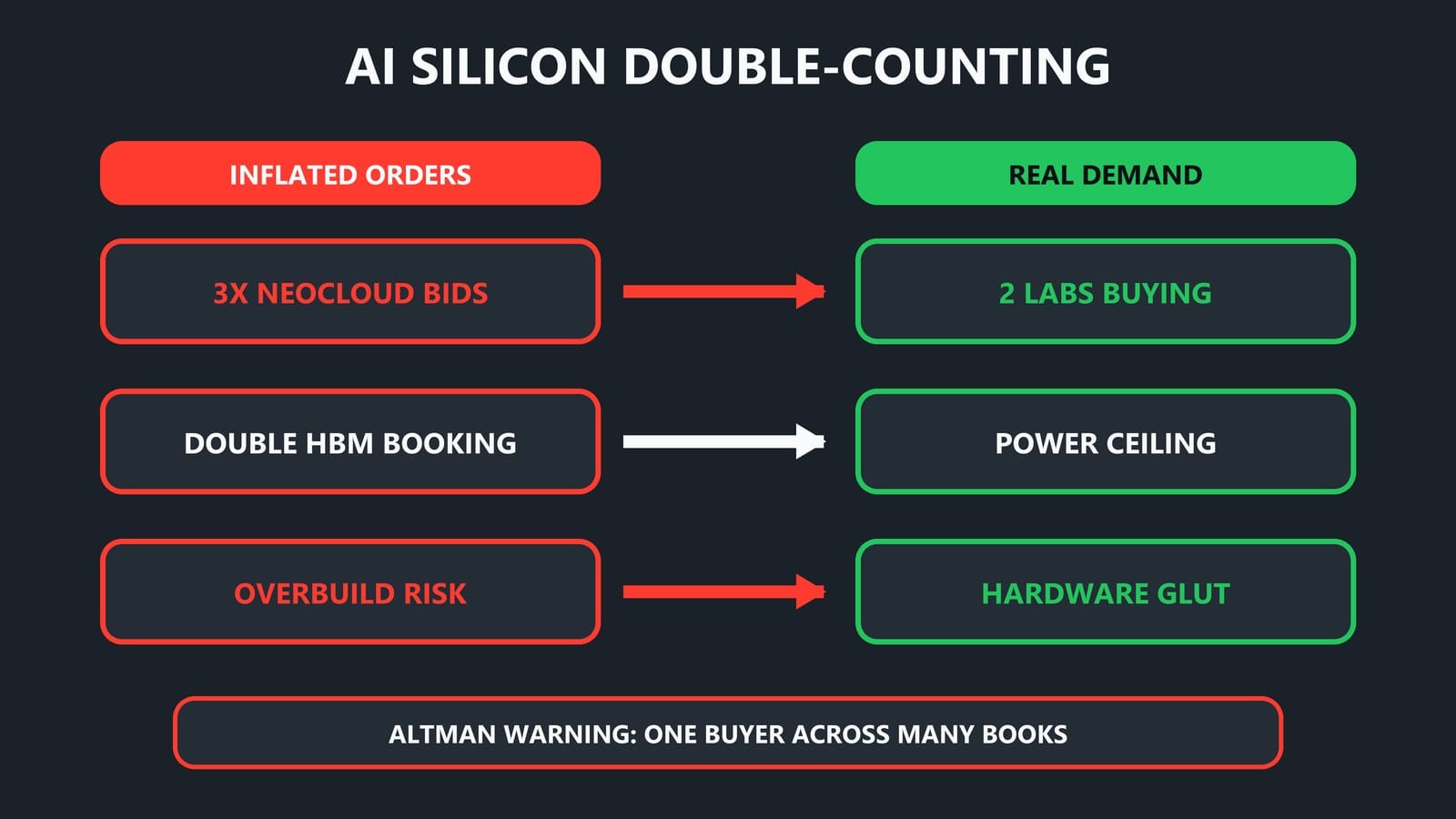
How Order Books Get Inflated Twice Across the AI Stack
When a single GPU vendor controlled virtually every large training cluster on earth, tallying aggregate hardware demand was simple arithmetic. Today’s intermediate stack creates systemic overcounting:
- Narrow demand concentration at the top: Altman pointed out that massive hyperscale demand still hinges primarily on just a couple of frontier lab buyers — explicitly naming OpenAI and Anthropic.
- Parallel bidding by neoclouds and integrators: dozens of GPU cloud renters, OEM server builders, and neocloud operators reserve silicon, packaging, and HBM allocations assuming they will capture those exact same frontier training or inference contracts.
- False aggregate sums at the fab level: when memory suppliers and foundries add every downstream forecast together, top-line demand looks two to three times larger than the actual megawatts, financing, and final compute budget the end buyers can absorb at once.
We broke down how hyperscale capex, grid constraints, and advanced packaging collide in our analyses of Microsoft and Intel Foundry’s EMIB Azure silicon deal and Nvidia’s Q3 results and Vera Rubin purchase commitments.
| Supply-Chain Layer | What Sits in the Sales Forecast | Production & Capex Reality (2026–2027) |
|---|---|---|
| Frontier AI Labs (OpenAI / Anthropic) | Multi-sourcing silicon so no single vendor bottlenecks scale | Finite near-term spend gated by energized MW and cash burn |
| Neoclouds & GPU Lessors | Full rack utilization backed by frontier lab demand | Multiple neoclouds underwriting the exact same finite tenants |
| HBM & Fab Suppliers (Samsung / SK Hynix) | Sum of all OEM and neocloud forecasts treated as net demand | Sharp inventory or pricing volatility risk if duplicate bookings unwind |
Megawatts — Not Marketing Decks — Cap Real Deployment
Warning about near-term order volatility does not mean foundation-model scaling is suddenly ending. It means substation lead times and power delivery govern actual burn rates far more strictly than non-binding hardware LOIs.
If three competing neoclouds place parallel HBM and accelerator reservations against the same 100,000-GPU workload, at least two of those demand forecasts will stretch out or cancel once energized power and project debt come due. For engineering leads weighing API token bills against dedicated clusters, cold math beats hype — whether benchmarking economics in our AI API vs dedicated GPU cost calculator or tightening everyday domain and email infrastructure with tools like our offline DNS SPF, DMARC & CAA record validator.
Three Concrete Checks for Infrastructure Leads & Hardware Buyers
- Audit energized power before trusting cloud capacity promises: non-binding chip allocations mean nothing without grid interconnects and contracted utility megawatts.
- Keep an eye on HBM and server DRAM pricing cycles: if duplicated neocloud bookings unwind in the near term, memory pricing volatility will ripple first through leveraged GPU renters sitting on peak-priced hardware.
- Avoid multi-year lock-in on transitional accelerator tiers: with 12-month silicon refresh cadences and tight performance-per-watt economics, locking long-term fixed rates at peak scarcity prices transfers every depreciation risk straight onto your P&L.
When even the industry's largest compute consumer tells chipmakers they are counting the same demand twice, ignoring the math is strictly optional.
Credits: Syncroma Studio. Cover photo: Sam Altman speaking at TED by Duncan Hull (CC BY 2.0) via Wikimedia Commons; original editorial infographic by Syncroma Studio.
Sistemas reales, sin humo corporativo Real systems, zero corporate hype
Recibe los análisis a fondo sobre arquitectura, consumo de recursos y computación de bajo nivel directamente en tu bandeja de entrada. Get deep-dive software architecture, resource consumption metrics, and low-level computing essays delivered straight to your inbox.
Suscribirse a Syncroma Subscribe to Syncroma

