
(🇪🇸 Leer la versión en español aquí)
When a hyperscaler spends years stuck in the exact same foundry wafer and CoWoS packaging queue as every rival, it eventually builds a second physical exit ramp. Microsoft and Intel just unveiled a major multi-year expansion of their infrastructure partnership: Microsoft is officially the first announced customer adopting Intel Foundry's EMIB (and vertical-power EMIB-T) advanced packaging for future first-party Azure custom silicon across upcoming compute and accelerator lines.
Confirmed in Microsoft's official announcement and covered by TechPowerUp and QuantisNow, the agreement pairs multi-year server CPU allocations—explicitly including Intel's upcoming Diamond Rapids Xeon generation—with concrete VM memory and offload upgrades already showing up in Azure production fleets.
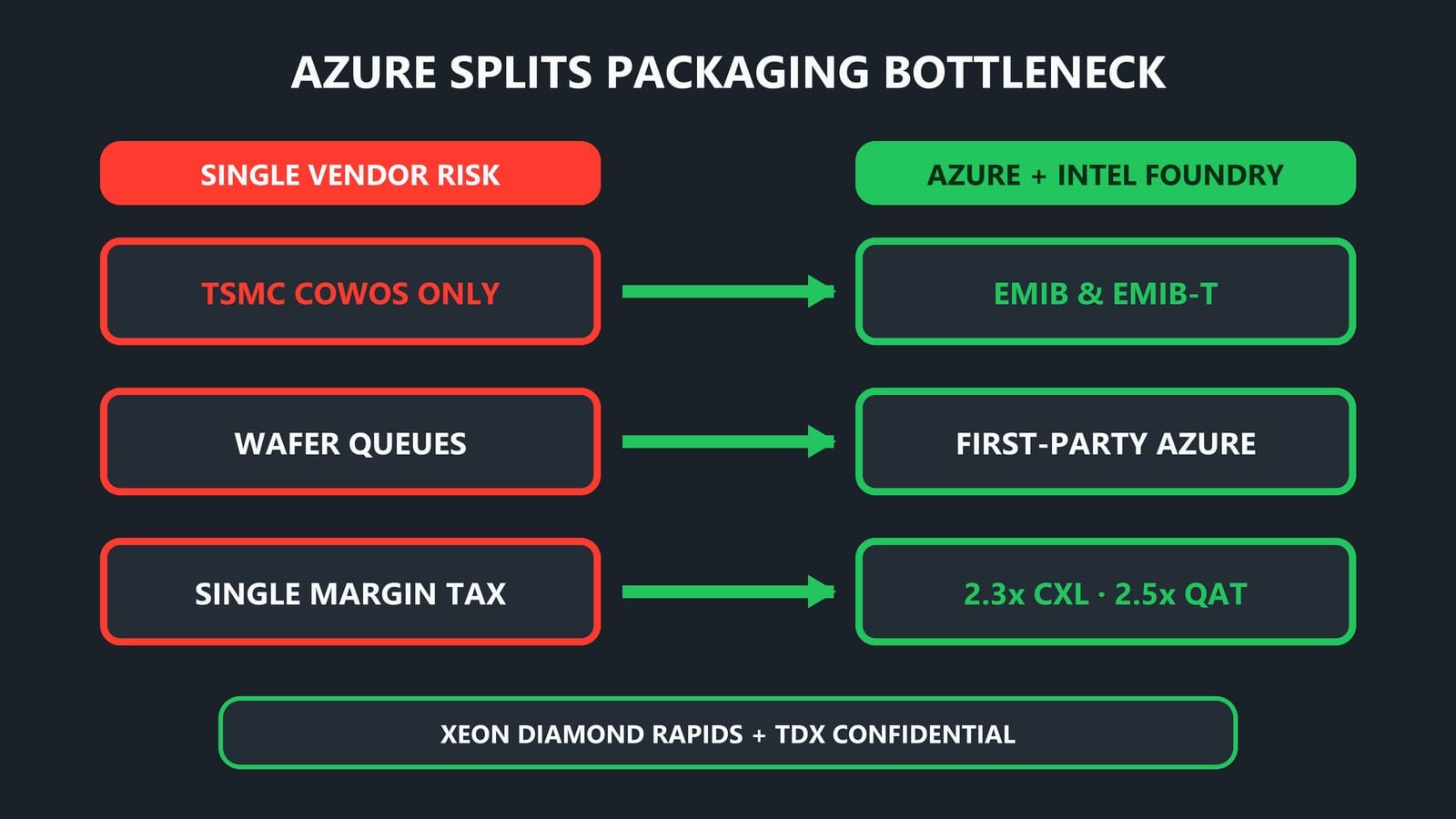
Breaking Down the Hardware Stack Inside the Deal
Look past the press-release warmth and each pillar addresses a specific datacenter bottleneck:
| Hardware Pillar | What It Solves in Azure Datacenters | Measured Cloud Impact |
|---|---|---|
| Intel Foundry EMIB & EMIB-T | Silicon-bridge multi-die interconnects with vertical power delivery (EMIB-T) | Cuts single-vendor advanced packaging lock-in for future Maia / Cobalt custom silicon |
| Multi-Year Xeon "Diamond Rapids" | Secured forward x86 server CPU supply capacity | Stabilizes general-purpose Azure VM fleet scaling beyond GPU racks |
| Compute Express Link (CXL) | Memory pooling & Flat Memory Mode on Xeon 6 Azure M-series v4 VMs | Up to 2.3x greater performance & flexibility for memory-bound database workloads |
| Intel QuickAssist (QAT) | Hardware crypto/compression offload inside cloud VMs | Up to 2.5x faster SQL backups without burning billable general-purpose vCPUs |
| Intel TDX Confidential Migration | Hardware-encrypted CPU register & RAM state across live host moves | Seamless host patching for regulated banking/healthcare VMs without downtime |
For FinOps teams paying Azure VM invoices, the immediate engineering win isn't even custom silicon years from now—it's CXL memory pooling (up to 2.3x gains) and QAT hardware offload (up to 2.5x faster SQL backups) reducing how aggressively you must over-provision expensive high-RAM instances just to survive nightly backup windows.
Why Packaging Competition Matters to Cloud Buyers
- Advanced packaging is the true silicon choke point: Getting logic wafers etched is half the battle; stitching compute chiplets to high-bandwidth HBM stacks without cratering yields decides who actually ships racks. Validating EMIB-T inside Azure breaks total dependence on one Asian packaging bottleneck.
- Keep end-to-end cryptography clean outside Confidential VMs too: While Intel TDX secures VM RAM and live migrations at the hypervisor boundary, developers still leak
.envcredentials daily in chat threads. Wrap sensitive snippets locally before sharing via our Private Offline AES-256-GCM Text Encryptor, and verify database memory footprints in our PostgreSQL RAM & Connections Sizer. - Separate real GPU needs from CPU-memory workloads: Benchmark full infrastructure power and hardware tradeoffs in our GPU Cluster Power, PUE & Server TCO Calculator.
Bottom Line
Microsoft didn't sign a multi-year packaging deal with Intel Foundry out of charity—it did so because single-vendor advanced packaging exposure is an existential supply-chain vulnerability heading into 2027. For cloud architects, physical competition across EMIB-T chiplets, Diamond Rapids Xeon CPUs, and CXL memory tiers is the healthiest possible counterweight to monopoly hardware pricing.
Technical analysis infographics by Syncroma Studio. Editorial cover photograph via Wikimedia Commons (Coolcaesar, CC BY-SA 4.0).

Sistemas reales, sin humo corporativo Real systems, zero corporate hype
Recibe los análisis a fondo sobre arquitectura, consumo de recursos y computación de bajo nivel directamente en tu bandeja de entrada. Get deep-dive software architecture, resource consumption metrics, and low-level computing essays delivered straight to your inbox.
Suscribirse a Syncroma Subscribe to Syncroma

