(🇪🇸 Leer la versión en español aquí)
For over a decade, enterprise sales reps from hyperscalers have repeated the same sanitized pitch to corporate executive boards: "Migrate your entire operational stack to our public cloud, decommission your on-premise iron, and relax with our battle-tested 99.999% SLA". But reality in the engineering trenches is far less forgiving. When you funnel 100% of your company's communication, email, identity verification, and document workflows into a single vendor's managed subscription, you haven't engineered true resilience; you have purchased a global single point of failure (SPOF).
Microsoft just delivered an expensive reminder to organizations worldwide: a severe, prolonged outage that knocked out Outlook, Microsoft Teams, SharePoint, and Microsoft Copilot across more than 70 countries, grinding multinationals, financial institutions, and government agencies to a dead halt for nearly an entire business day.
And contrary to early sensationalist rumors on social media, this was not a nation-state cyberattack. It was something far more mundane, predictable, and structurally terrifying to systems architects: a self-inflicted cascading failure fueled by client retry storms.
The Spark: Edge WAN Partitions and Route Degradation
According to preliminary network telemetry and incident forensics, the disruption originated within internal core routing infrastructure connecting regional datacenter backbones. A routing topology change triggered an internal network partition, dropping cross-region border gateway peering links.
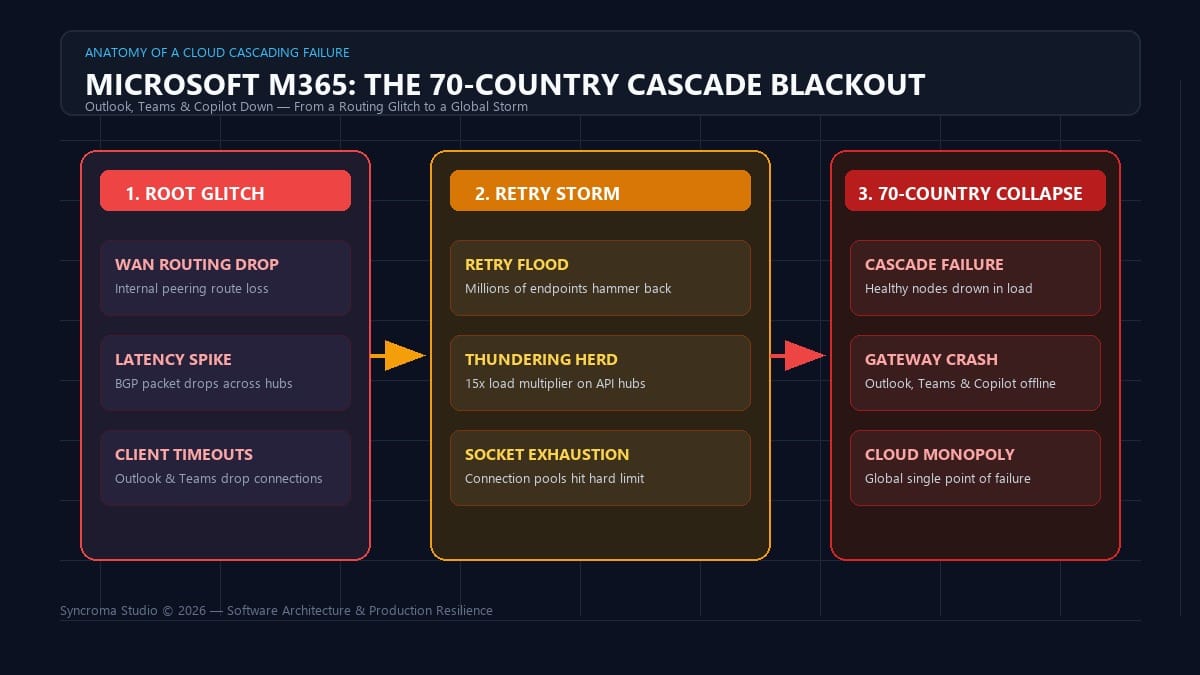
In a loosely coupled architecture, temporary packet degradation results in localized queueing and graceful backpressure. But in a hyper-centralized monolithic ecosystem like Microsoft 365—where hundreds of millions of desktop clients, web browser tabs, and mobile background workers maintain persistent WebSockets and aggressive polling loops—the momentary network blip detonated a catastrophic chain reaction.
The Retry Storm: How Clients Accidentally DDoS'd Their Own Cloud
The mechanism that amplified an isolated router hiccup into a 70-nation blackout is a classic failure mode in distributed systems engineering: a Thundering Herd triggering a massive Retry Storm.
- Mass Client Drop: Tens of millions of active Teams video calls and Outlook sync sessions simultaneously hit connection timeouts as cross-region packets dropped.
- Missing Jitter & Exponential Backoff: Rather than introducing randomized delay intervals (decorrelated jitter) across client reconnection attempts, native endpoints immediately hammered API endpoints simultaneously.
- 15x Load Multiplier: Ingress gateways, reverse proxies, and Microsoft Entra ID (formerly Azure AD) authentication backends were suddenly inundated with an artificial tidal wave of requests spiking over 15 times baseline capacity.
- Cascading Server Starvation: Healthy application servers in adjacent regions attempting to absorb redistributed traffic quickly experienced thread pool starvation and TCP socket exhaustion. When these overloaded instances failed to respond to internal health checks, Microsoft's automated control plane erroneously designated them as dead nodes, removing them from load balancer pools and dumping the entire destructive traffic surge onto the few surviving instances.
The Monoculture Trap: Why Cloud SLAs Are Illusions
The hard architectural truth exposed across 70 countries is unmistakable: the cloud does not eliminate systemic risk; it merely centralizes and multiplies it.
- The Software Monoculture Footgun: Global enterprises boasting redundant data centers and disaster recovery binders discovered their laptop fleet, VoIP calling, identity tokens, and corporate files all depended on the exact same proprietary pipeline. When Microsoft 365 went dark, their entire operational existence evaporated for hours.
- The Meaningless SLA Refund: A contract promising a 99.9% uptime SLA does nothing to compensate for $40 million in lost trading revenue and stranded operational logistics. All a breach of an enterprise cloud SLA entitles you to is a meager 10% credit applied toward next month's invoice after weeks of contentious ticketing.
- Decoupled Architecture as a Necessity: Organizations that preserved hybrid fallback mail relays, out-of-band messaging channels (Matrix, IRC, Slack, or self-hosted servers), and multi-cloud identity providers continued operating unimpeded. Those who surrendered their entire stack to Redmond learned the true definition of enterprise fragility in 2026.
True high availability cannot be purchased with a corporate credit card in the Azure management portal. High availability is built by assuming that even the largest hyperscalers on earth will inevitably fail under their own weight.
Infographic credits: Syncroma Studio.
Sistemas reales, sin humo corporativo Real systems, zero corporate hype
Recibe los análisis a fondo sobre arquitectura, consumo de recursos y computación de bajo nivel directamente en tu bandeja de entrada. Get deep-dive software architecture, resource consumption metrics, and low-level computing essays delivered straight to your inbox.
Suscribirse a Syncroma Subscribe to Syncroma