(🇪🇸 Leer la versión en español aquí)
The worst nightmare for any infrastructure engineering team on a Friday afternoon isn't just an attacker uncovering a remote zero-day exploit; it’s the mandated maintenance window. When a critical remote code execution (RCE) flaw emerges within the Linux kernel or low-level system libraries, standard enterprise runbooks demand applying vendor patches and rebooting thousands of bare-metal and virtual host nodes. In multi-tenant Kubernetes clusters running real-time databases and stateful caches, that means hours of pod draining, TCP reconnections, cold cache penalties, and substantial SLA risk.
To solve this persistent operational deadlock, OpenAI and Cisco have publicly released Shirudo (Japanese for shield), an open-source security runtime engineered to intercept, quarantine, and drop active exploits in real time directly within kernel space using eBPF (Extended Berkeley Packet Filter)—all without modifying compiled kernel source code or triggering a single machine reboot.
The Engineering Behind Shirudo: In-Kernel Defense at Ring 0
Historically, hot-patching running Linux hosts relied on binary-replacement engines like Kpatch or KGraft, which swap function prologues and modify kernel jump tables dynamically. However, compiling binary ftrace patches matching exact kernel build signatures (build-id) is an operational minefield prone to catastrophic kernel panics if CPU register state diverges during runtime instruction swapping.
Shirudo flips this architecture on its head. Instead of replacing binary kernel functions, it attaches programmable eBPF countermeasure probes to existing kernel hooks (kprobes, tracepoints, and low-overhead XDP network drivers).
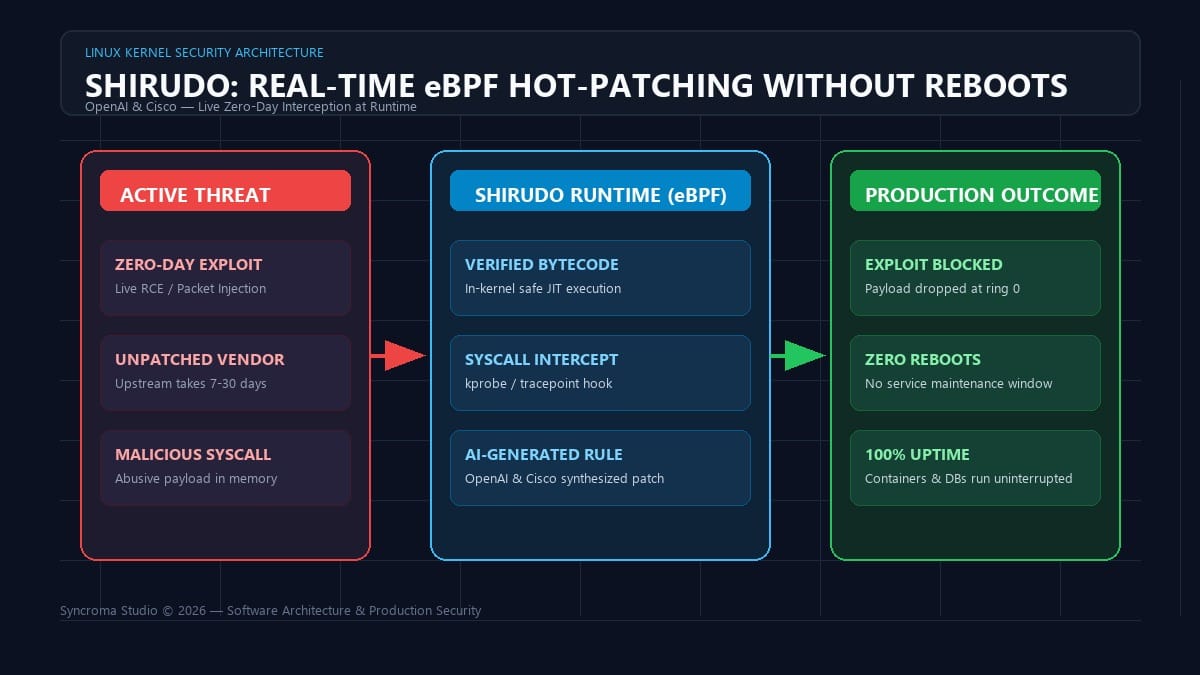
- AI Threat Synthesis: When OpenAI's cyber research models or Cisco's Talos threat intelligence identify an active exploit pattern, Shirudo generates a structural signature describing the abnormal system call argument or malformed network header.
- Bytecode Verification: The signature translates into restricted C bytecode. Before execution, the Linux kernel’s native eBPF verifier mathematically proves the bytecode contains no unbounded loops, no out-of-bounds pointer arithmetic, and zero capability of crashing Ring 0 data structures.
- Microsecond Interception: During an exploit attempt, the eBPF filter captures the offending syscall (such as malformed payloads hitting
sys_bpf()or network socket buffers) and forces an immediate return code (-EPERMor-EACCES) before the vulnerable kernel code branch executes. The attacking process fails cleanly, while production workloads continue running at 100% uptime.
Production Benchmarks: Thwarting Java4Shell and Exploits
During pre-release validation against real-world vulnerabilities (including complex exploit sequences targeting database backends like Elasticsearch), Cisco and OpenAI recorded clear operational metrics:
- Hook Overhead Latency: Less than 1.2 microseconds per monitored system call when attached to
kprobeentry points. - Remediation Turnaround: Reduced from an industry average of 14 days (waiting for upstream patches, coordination meetings, and rolling cluster reboots) to under 3 minutes to distribute and load eBPF rules globally via container daemonsets.
- Memory Footprint: Less than 8 MB of dedicated physical kernel memory per active protection rule suite.
The Production Reality: Can AI Safely Patch Kernels?
While "zero reboots forever" makes for compelling executive slide decks, battle-tested systems architects must evaluate the tradeoffs carefully:
- eBPF Verifier Complexity Limits: The in-kernel verifier enforces strict cyclomatic and instruction bounds. Vulnerabilities originating from intricate multi-threaded race conditions or deep memory corruption cannot be resolved via simple syscall trapping without introducing synchronization locks that degrade network P99 tail latency.
- Overfitting Hazards: If an automated security model drafts an overly broad filtration filter, it risks dropping legitimate enterprise transactions or API proxy calls, triggering self-inflicted denial-of-service outages.
- Shirudo is a Tourniquet, Not a Final Cure: Hot-patching via eBPF serves as an emergency stopgap to buy weeks of operational breathing room while distribution maintainers (Debian, Red Hat, Ubuntu) thoroughly vet upstream C patches. Treating eBPF scripts as permanent architectural replacements merely accumulates technical debt inside the operating system control plane.
The collaboration between OpenAI and Cisco on Shirudo underscores how deeply eBPF has transformed infrastructure defense. It's not marketing hype: it is strict, JIT-compiled kernel verification ensuring that vulnerability disclosures no longer paralyze global cloud operations.
Infographic credits: Syncroma Studio.
Sistemas reales, sin humo corporativo Real systems, zero corporate hype
Recibe los análisis a fondo sobre arquitectura, consumo de recursos y computación de bajo nivel directamente en tu bandeja de entrada. Get deep-dive software architecture, resource consumption metrics, and low-level computing essays delivered straight to your inbox.
Suscribirse a Syncroma Subscribe to Syncroma