(🇪🇸 Leer la versión en español aquí)
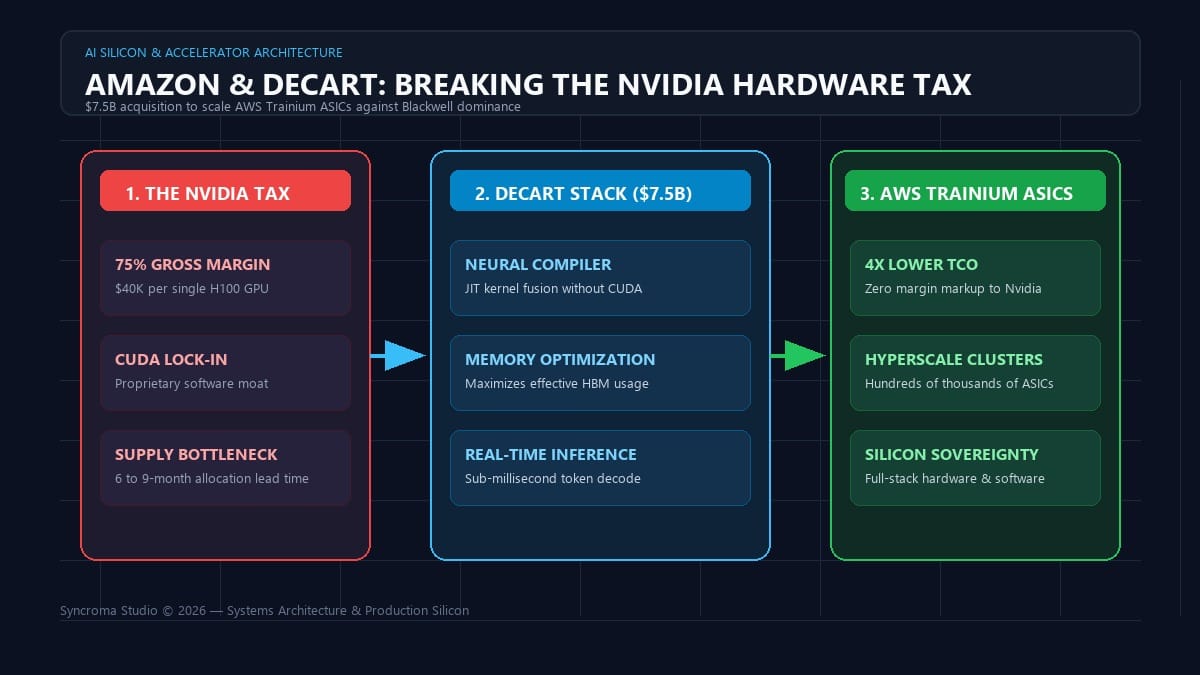
Inside the executive boardrooms of the hyperscalers, there is an uncomfortable economic truth that no earnings call sugarcoats: paying the "Nvidia Tax" is an unsustainable drain on cloud margins. With gross margins soaring above 75% and enterprise GPUs like the H100 and Blackwell commanding up to $40,000 per socket, every multi-cluster expansion Amazon, Microsoft, or Google buys from Jensen Huang pads Santa Clara’s bottom line while eroding the unit economics of cloud computing.
To break this strategic chokehold, Amazon has pulled the trigger on one of the largest infrastructure acquisitions in its history: purchasing AI optimization startup Decart and onboarding its core engineering team in a landmark $7.5 billion transaction.
This acquisition is not about launching another trendy consumer chatbot. It focuses squarely on the most unglamorous, critical frontier of computing: neural compilers, low-level JIT kernel fusion, and hardware-software co-design for AWS Trainium and Inferentia ASICs, targeting the real fortress guarding Nvidia's monopoly: the closed CUDA software moat.
The CUDA Trap: Why Competing Silicon Stalled
Over the past four years, designing custom silicon capable of matching Nvidia’s raw floating-point compute has become feasible for hyperscalers with bottomless balance sheets. Amazon’s Trainium2 chips and Google’s TPUs boast formidable dense TFLOPS figures on whitepapers. Yet, in production datacenters, machine learning engineers consistently retreated back to Nvidia.
The obstacle was never just raw hardware specs; it was the software stack.
- Low-Level Micro-Optimization: Over two decades, libraries like cuBLAS, cuDNN, and TensorRT have been meticulously hand-tuned to extract every available clock cycle and milliwatt from Nvidia’s streaming multiprocessors.
- The Compiler Chasm: Running frontier models like Llama 3 or Claude on non-Nvidia architectures required months of bespoke engineering to prevent accelerator cores from sitting idle 60% of the time, stalled on HBM memory bus bottlenecks.
- Framework Friction: Compiling PyTorch computation graphs into efficient native machine code on alternative ASICs without triggering numerical drift, silent accuracy degradation, or VRAM memory leaks remained an ongoing operational headache.
What Decart Delivers: JIT Compilers and Real-Time Inference
Founded by distributed systems architects and recognized for real-time generative models (capable of running interactive 3D simulations at over 30 frames per second), Decart did not build monolithic foundation models; they engineered the most mathematically optimized inference engine and compiler layer in existence.
Decart’s proprietary stack introduces three architectural breakthroughs that integrate directly into AWS silicon:
- Aggressive Kernel Fusion: Merges chained tensor operations (GEMM matrix multiplies, LayerNorm, and Softmax activations) into single-pass execution across on-chip SRAM cache, radically slashing round trips across the slower HBM memory bus.
- Deterministic Memory Scheduling: Eliminates dynamic memory allocation overhead at runtime, driving Trainium memory bandwidth utilization from the typical 50%–60% seen in open-source compilers up to 85% effective throughput.
- Sub-Millisecond Token Decode: By stripping away CUDA-layer abstractions, Decart’s runtime allows AWS inference clusters to deliver streaming tokens at a fraction of standard power consumption and with significantly lower tail latency (P99).
The Production Reality: Can AWS Crack the Monolith?
Spending $7.5 billion on Decart proves Andy Jassy and the AWS engineering leadership have absorbed the lesson: the AI infrastructure race is not won by queuing up for more Nvidia allocations, but by controlling the compiler and software layer orchestrating your own silicon.
If Amazon succeeds in making model training and inference on Trainium3 with Decart’s compiler stack as seamless and frictionless as spinning up an EC2 GPU instance—at one-third the cost per million tokens—Nvidia’s datacenter dominance will face its first true architectural reckoning.
This isn't marketing fluff: it is ruthless, low-level compiler engineering designed to reclaim silicon sovereignty in modern production datacenters.
Infographic credits: Syncroma Studio.
Sistemas reales, sin humo corporativo Real systems, zero corporate hype
Recibe los análisis a fondo sobre arquitectura, consumo de recursos y computación de bajo nivel directamente en tu bandeja de entrada. Get deep-dive software architecture, resource consumption metrics, and low-level computing essays delivered straight to your inbox.
Suscribirse a Syncroma Subscribe to Syncroma