
(🇪🇸 Leer la versión en español aquí)
Locking the front door of an API means nothing if your cloud distributor keeps the loading dock wide open for $500 million a year. On November 18, 2026, The Next Web and KR-Asia reported via The Information that ByteDance —TikTok's parent company— is in advanced negotiations to spend roughly $500 million more on Microsoft Azure, mostly to run OpenAI models.
Hours later, House Select Committee on China Chairman John Moolenaar issued an official statement on House.gov demanding a bipartisan briefing: "Microsoft should not sell AI tools to ByteDance. It is unacceptable for Microsoft, which has crucial contracts with the Pentagon, to arm ByteDance."
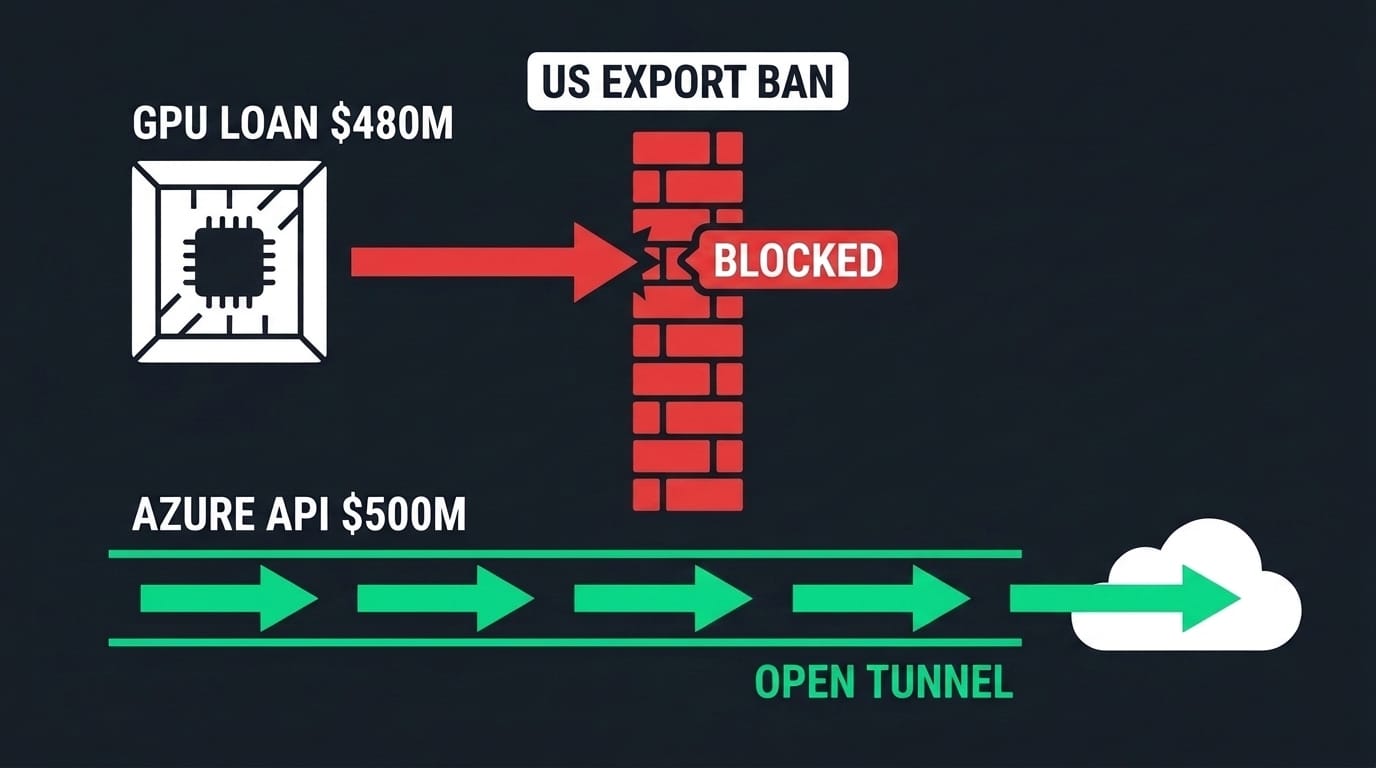
Hardware embargoes vs. multi-tenant cloud endpoints
For infrastructure engineers, this story exposes the central flaw in chip-only export policy: you cannot quarantine silicon on bare metal while leaving managed HTTPS inference endpoints unblocked across hyperscaler tenants:
| Compute Path | Remote Nvidia GPUs in Malaysia (Aolani Cloud) | Managed Azure OpenAI Service (Microsoft) |
|---|---|---|
| Deal Size Under Scrutiny | $480M bank loan paused by lenders (arranged via DBS) | ~$500M incremental Azure cloud commit under negotiation |
| Enforcement Mechanism | New US export licenses required for Singapore/Malaysia GPU clusters | OpenAI blocks most Chinese firms directly; Azure enforces looser terms |
| Operational Outcome | Five lenders weigh exit; bankers call the GPU financing deal effectively dead | Standard enterprise REST API access to frontier OpenAI weights |
| Core Technical Risk | Remote bare-metal compute training and inference | Model distillation: harvesting structured frontier outputs to train rival models |
Just days after Washington imposed licensing rules blocking remote GPU rentals out of Singapore and Malaysia —freezing a $480 million loan for Singapore's Aolani Cloud to buy Nvidia GPUs for ByteDance— the managed cloud plane acted as a frictionless bypass around the hardware choke point.
The distillation headache splitting OpenAI and Microsoft
Per The Next Web, the proposed Azure expansion sits right on an existing fracture between the two partners. OpenAI has repeatedly complained to Microsoft that Chinese AI labs are distilling its frontier releases —querying models such as GPT-6 Astra at scale and using the reasoning traces and outputs to train competing domestic models— while ByteDance actively scales its own Seedream image models and autonomous agents.
From a pure systems perspective, sending JSON payloads over TLS 1.3 beats smuggling HBM silicon every day of the week: zero customs risk, predictable latency, and instant scaling. If you are modeling whether paying cloud token margins beats buying or renting dedicated GPUs for your own stack, run the unit economics through our AI API vs. GPU Cost Calculator and audit long-context overhead in our LLM Token & Prompt Caching Cost Calculator.
We broke down Microsoft's broader margin play in Microsoft MAI-Code-2 vs. OpenAI & GitHub Copilot pricing and supply bottlenecks in Sam Altman's warning on AI chip double-counting. Redmond is treating OpenAI weights as enterprise cloud fuel first —monetizing Pentagon workloads on one hand and massive Asian cloud contracts on the other— while hedging its own first-party model lineup.
Architectural takeaways for production teams
- Upstream vendor bans do not guarantee downstream cloud parity: Model creators and hyperscaler resellers run separate compliance rulebooks; never assume Azure/AWS/GCP Terms of Service mirror direct-API exclusions.
- Enterprise token quotas double as IP exfiltration vectors: Standard rate limits will not stop systematic distillation if a multi-hundred-million-dollar enterprise tier masks synthetic data harvesting.
- Geopolitical blast radius hits multi-region dependencies: Expect abrupt export-control patches on Azure OpenAI tenant routing, region availability, and KYC checks if Washington turns congressional anger into Commerce Department rules.
Image credits: Editorial cover image generated by Syncroma Studio. Localized 2D dark-mode infographic by Syncroma Studio.
Sistemas reales, sin humo corporativo Real systems, zero corporate hype
Recibe los análisis a fondo sobre arquitectura, consumo de recursos y computación de bajo nivel directamente en tu bandeja de entrada. Get deep-dive software architecture, resource consumption metrics, and low-level computing essays delivered straight to your inbox.
Suscribirse a Syncroma Subscribe to Syncroma

