(🇪🇸 Leer la versión en español aquí)
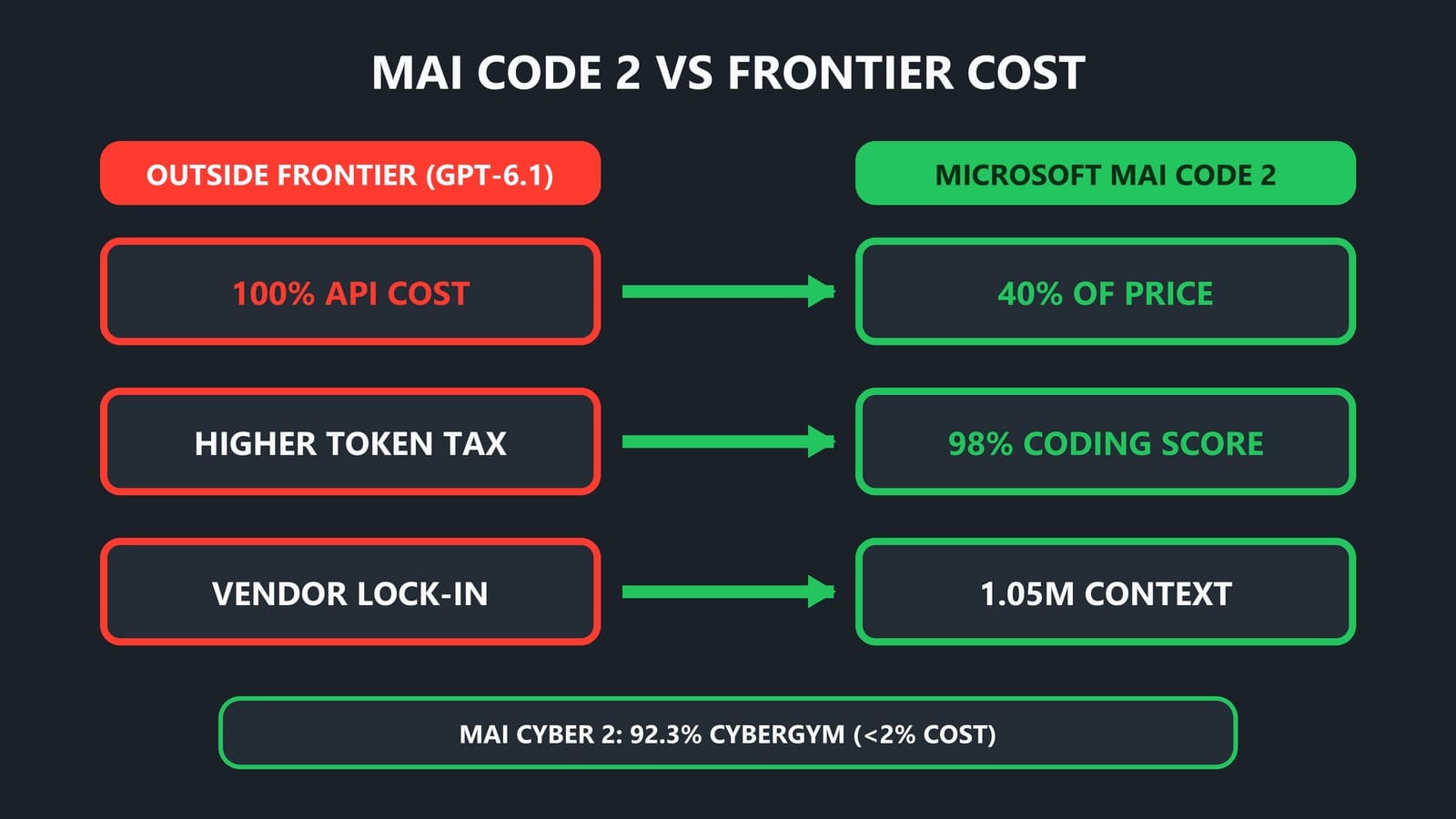
For three years, Microsoft played the role of cloud landlord for external frontier labs while wiring huge partner compute checks. At Microsoft Ignite 2026, Redmond showed its real end-game: releasing proprietary in-house models MAI Code 2, MAI Code 2 Flash, and MAI Cyber 2 Flash directly into GitHub Copilot and Microsoft Foundry. Rather than another research demo, this is a blunt price-under-cutting play designed to match frontier coding and defensive cybersecurity scores at less than half the API bill.
Confirmed in Microsoft's official Ignite 2026 release and the GitHub Copilot changelog, the models target the exact bottleneck crushing enterprise AI budgets right now: autonomous multi-file coding agents burning hundreds of thousands of context tokens on every CI pass.
MAI Code 2 & MAI Cyber 2 Flash: Real Pricing and Benchmarks
Cross-checking the technical figures published alongside Ignite 2026 via TechTarget, eesel AI, and The Decoder, here is how Microsoft's in-house family stacks up against OpenAI and Anthropic:
| Microsoft AI Model | Production Workload Target | Context Window | Reported Benchmark vs. Rivals | Official API List / Promo Price |
|---|---|---|---|---|
| MAI Code 2 | Repo-wide debugging, multi-file edits & UI | 1,050,000 tokens (922k in / 128k out) | 98% of GPT-6.1 Sol score at ~40% price; 67% blind UI preference vs GPT-6 Sol | $1.00 / $5.00 per 1M tokens ($0.50 / $2.50 promo through May 2027) |
| MAI Code 2 Flash | High-volume PR checks & targeted refactors | 1,050,000 tokens | Outpaces GPT-6 Luna & Claude Haiku 5.5 at lower per-task spend | Metered via GitHub Copilot / Microsoft Foundry |
| MAI Cyber 2 Flash | 24/7 SOC alert triage & automated patching | Controlled enterprise Microsoft Security rollout | 92.3% on CyberGym-E2E vs 91.5% GPT-6 Astra at < 2% cost per task | 86% output token price drop vs MAI Cyber 1.1 Flash |
Notice two crucial engineering details buried past the headline: first, five tunable reasoning-effort tiers (low to max) let platform teams trade latency and token burn per repo task; second, Foundry billing runs straight against existing Azure enterprise commits, removing the procurement friction of juggling multiple separate API vendors.
What This Price War Means for 2027 Engineering Budgets
As The Decoder highlighted, replacing third-party APIs inside Microsoft's own developer and security products is all about stopping margin leakage on high-frequency agent loops. For engineering leads and FinOps architects, three practical actions stand out immediately:
- Token unit economics matter more than 2% leaderboard bragging rights: Running continuous background agents across 500k-token monorepos at flagship frontier rates melts budgets instantly. Dropping input tokens to $0.50/1M promo completely alters the buy-vs-self-host math—plug your own token throughput into our AI API vs Self-Hosted GPU Cost Calculator and test context savings with our LLM Token Cost & Prompt Caching Calculator.
- Route by difficulty, not brand loyalty: With MAI Code 2 and Code 2 Flash sitting side-by-side inside VS Code, Visual Studio, JetBrains, Xcode, and GitHub CLI, teams can send routine refactors and test scaffolding to cheaper models while reserving expensive reasoning calls for ambiguous architecture changes.
- Verify against your own test suite before switching: Internal vendor benchmarks always flatter house models. Run deterministic regression evals against your real codebase, and sanitize proprietary secrets before sending debug traces externally using our Private Offline PII & Secret Anonymizer.
Bottom Line
MAI Code 2 and MAI Cyber 2 Flash confirm that fat frontier API margins on software engineering and defensive security automation are compressing fast. When your own cloud provider delivers ~98% parity at 40% of the cost (and < 2% for security triage), paying premium per-token rates for every routine workflow stops making financial sense.
Technical analysis infographics by Syncroma Studio. Editorial cover photograph via Wikimedia Commons (Jiaqian AirplaneFan, CC BY 3.0).

Sistemas reales, sin humo corporativo Real systems, zero corporate hype
Recibe los análisis a fondo sobre arquitectura, consumo de recursos y computación de bajo nivel directamente en tu bandeja de entrada. Get deep-dive software architecture, resource consumption metrics, and low-level computing essays delivered straight to your inbox.
Suscribirse a Syncroma Subscribe to Syncroma

