
(🇪🇸 Leer la versión en español aquí)
Imagine opening an Instagram account you've owned for a decade only to find your settings locked down because a machine-learning classifier guessed you might be under 18. Meta has expanded its AI-driven age-estimation technology globally on Instagram, automatically sweeping suspected underage accounts into restricted Teen Accounts — even when the user registered with an adult birth date — as announced on Meta Newsroom and covered by TechCrunch and the Associated Press.
The friction erupts when probabilistic guessing gets an adult wrong. To prove you are legally an adult and lift Teen Account restrictions, flagged users face a familiar two-door identity toll detailed by AP News and Fortune: record a video selfie analyzed by third-party verifier Yoti via facial geometry, or upload a government ID such as a passport or driver's license.
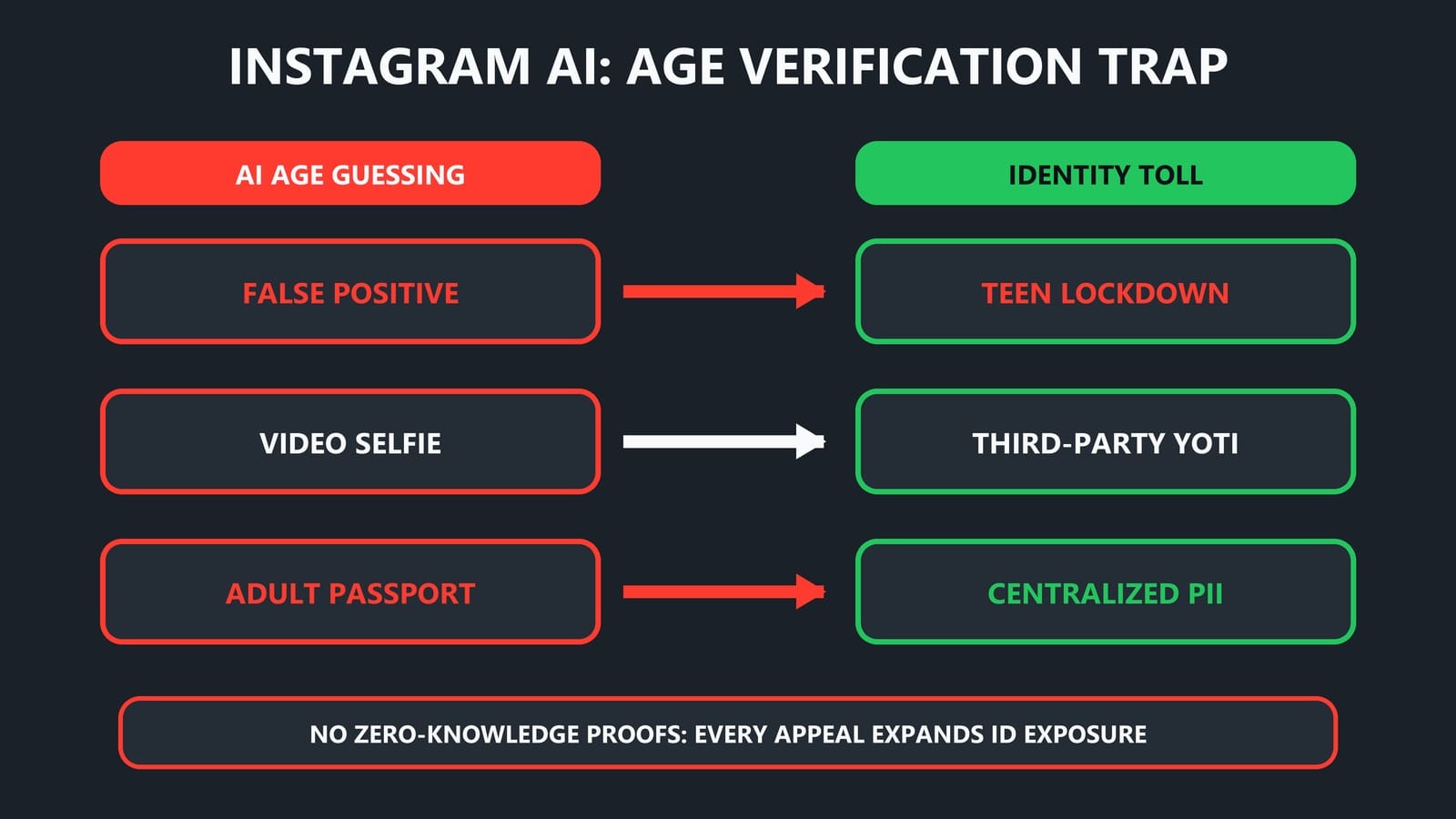
Probabilistic Guesses Up Front, Centralized Identity Vaults on Appeal
Unlike cryptographic age attestation using device-held credentials or Zero-Knowledge Proofs (is_over_18 = true without exposing names or faces), Meta’s architecture pairs opaque behavioral classifiers with high-friction KYC fallbacks:
| Pipeline Stage | Signals & Vendor Stack | Concrete Privacy & Security Consequence |
|---|---|---|
| Automated AI Age Guessing | Behavioral hints (birthday posts, school references, interactions) & visual cues | Guaranteed false positives on young-looking adults, niche creators & faceless accounts |
| Biometric Video Appeal | Live face-scan video routed to third-party processor Yoti | Transfers facial geometry telemetry to an external verification pipeline |
| Government ID Upload | Photo upload of adult passport or driver’s license | Concentrates high-value breach targets (just like recent incidents we covered in driver's license & ID data leaks via AI vendors) |
Nobody disputes the regulatory heat driving this rollout: multibillion-dollar youth safety scrutiny forces platforms to prove minors aren't slipping past simple birth-date dropdowns. Yet solving compliance by pressuring misclassified adults into uploading passports or scanning their faces expands centralized PII exposure across the open web.
Training Users to Upload Passports Is a Gift to Phishing Kits
Security engineers notice a second-order consequence immediately: once mainstream platforms normalize pop-ups demanding "upload your passport or record your face within 48 hours to restore account access", credential-harvesting phishing campaigns practically write themselves.
Fake "Instagram Teen Account Restriction" emails and DMs don't just steal passwords anymore — they harvest crisp government ID scans ready for downstream financial fraud. Before touching any verification prompt or sharing photos publicly, always scrub hidden camera GPS/EXIF headers with our offline photo EXIF & metadata cleaner, inspect suspicious appeal links in our URL UTM & Punycode phishing inspector, and check how browsers fight back against social tracking metadata in our look at Brave stripping Facebook FBMD photo tags.
Three Practical Steps If Your Account Gets Flagged
- Only verify inside the native official app settings screen: never submit facial video or government IDs through external email links or web forms sent via DM.
- Audit retention terms before picking video selfie vs. ID: verify whether the third-party vendor states immediate post-estimation deletion versus prolonged audit storage in your jurisdiction.
- Wait for true Zero-Knowledge age wallets where possible: support OS-level and EU eIDAS selective-disclosure standards that confirm age brackets cryptographically without uploading scans to social-media vendors.
Protecting minors online is essential engineering work — turning AI guessing errors into a biometric and passport collection funnel is the wrong architecture for getting there.
Credits: Syncroma Studio. Cover photo: Instagram app on smartphone (Wikimedia Commons, CC BY-SA 4.0); original editorial infographic by Syncroma Studio.
Sistemas reales, sin humo corporativo Real systems, zero corporate hype
Recibe los análisis a fondo sobre arquitectura, consumo de recursos y computación de bajo nivel directamente en tu bandeja de entrada. Get deep-dive software architecture, resource consumption metrics, and low-level computing essays delivered straight to your inbox.
Suscribirse a Syncroma Subscribe to Syncroma

