
(🇪🇸 Leer la versión en español aquí)
Most users assume that spinning up a pseudonymous Instagram handle behind a separate email alias and a VPN keeps it air-gapped from their real-name Facebook graph. The problem sits inside the JPEG header of the last photo they saved.
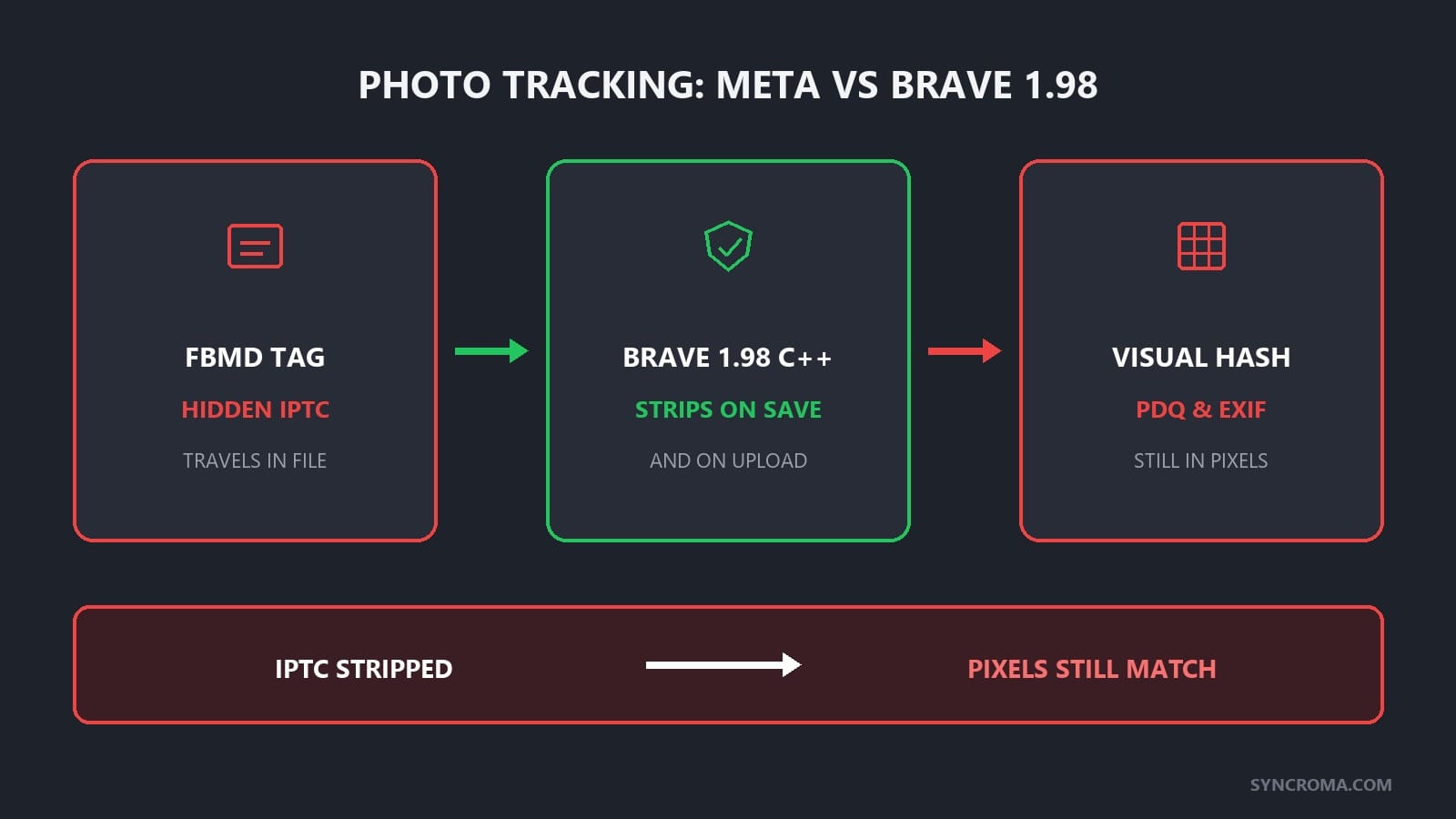
Starting in desktop version 1.98 (tracked under changelog 1.98.60), Brave automatically strips hidden identifiers prefixed with FBMD that Meta injects into images saved from Facebook and Instagram (Brave Privacy Updates, CyberInsider). It closes a quiet seven-year metadata breadcrumb—but treating header stripping as total photo anonymity is a textbook trap.
Inside the FBMD Marker: How One File Bridges Two Separate Accounts
When you upload an image to Facebook or Instagram, Meta discards most original XMP and camera EXIF fields. In return, it populates an undocumented string beginning with FBMD inside the IPTC (International Press Telecommunications Council) "Special Instructions" metadata field—a standard originally created for wire-service captions and copyright notices (IPTC, Brave Privacy Updates).
IPTC first documented in 2019—and Brave re-verified in July 2026 testing—that this marker stays attached across users: if Person A uploads a photo to Facebook, Person B downloads it via "Save Image As…", and Person B reposts it to a pseudonymous Instagram account, the exact FBMD lineage string rides along inside the container (Brave Privacy Updates). Meta has never publicly explained what FBMD is used for, yet technically it acts as a durable cross-account correlation token that survives IP changes and separate emails.
How Brave’s Native C++ Stripper Works Across Browser Chokepoints
Led by Brave VP of Privacy and Security Shivan Kaul Sahib with engineering by Rohit Agarwal, the metadata scrubber runs directly in native C++ with zero third-party image libraries, avoiding binary bloat and keeping file-I/O overhead negligible (Brave Privacy Updates, GitHub #5238).
QA verification on GitHub confirms Brave scrubs FBMD at every major desktop ingestion and egress path without mutating your original local files on upload:
| Browser Flow | What Happens Under the Hood | Original Local File Touched? | Shipping Status |
|---|---|---|---|
| "Save Image As…" download | Purges the IPTC FBMD string before flushing the file to disk (GitHub #5238). |
Saved disk copy is already clean. | Live on desktop 1.98.60 |
| File picker upload | Streams an in-memory sanitized copy with FBMD removed (Brave Privacy Updates). |
No; source file stays untouched. | Live on desktop 1.98.60 |
| Drag-and-drop upload | Applies identical header sanitization across multipart upload streams (GitHub #5238). | No; source file stays untouched. | Live on desktop 1.98.60 |
| iOS & Android browsers / apps | Mobile Brave builds and native Meta apps do not scrub FBMD yet (The Daily Star). |
Marker remains intact on device. | Planned in roadmap |
The Reality Check: Why Scrubbing IPTC Headers Still Leaks Correlation
Stripping FBMD stops naive metadata linkage, yet three massive blind spots remain in production:
- Desktop-only coverage misses most real traffic: The overwhelming share of consumer photo saves and reposts happen inside native iOS and Android apps—not desktop browsers. Until Brave ships mobile support, mobile downloads continue carrying
FBMDverbatim (CyberInsider). FBMDisn’t your EXIF GPS or camera serial: In v1.98, Brave strictly targets Meta’s IPTCSpecial Instructionsstring. When you upload raw photos straight from a phone camera, GPS coordinates, timestamps, and lens metadata still leak unless stripped explicitly—controls Brave notes are still future work (Brave Privacy Updates).- Visual pixels carry their own fingerprint (PDQ): Even if you zero out every single EXIF, XMP, and IPTC byte, Meta open-sourced its own spectral perceptual hashing algorithm, PDQ, inside ThreatExchange—built on Discrete Cosine Transform (DCT) frequency descriptors specifically to match visually similar or re-encoded photos, proven with
faissmatching at up to 4,000 images/sec (Meta ThreatExchange PDQ). Reposting identical pixels back into the same ecosystem still matches visually without needing anyFBMDstring at all.
Practical Hygiene Before Sharing Photos or Screenshots
Before pushing images to social feeds, bug trackers, or public forums—especially screenshots containing faces, IDs, license plates, or internal endpoints—never upload sensitive files to random cloud converters just to crop or clean metadata:
- Audit headers offline first: Inspect embedded GPS, camera EXIF, and IPTC strings strictly inside browser RAM with our Private Offline Photo EXIF & GPS Viewer.
- Re-encode clean binary containers: Strip all EXIF, IPTC, and XMP segments in batch using our Private WebP Image Compressor & EXIF Cleaner.
- Destroy sensitive pixels before upload: Apply irreversible mosaic pixelation or zero-entropy solid blackout over IDs, faces, or secrets directly in memory with our new Private Offline Image Redactor.
Brave deserves credit for shipping a dependency-free C++ scrubber against a quiet cross-account tag that lingered since 2019. Just don't confuse a cleaner JPEG header with operational invisibility when mobile apps and perceptual hashing still see the pixels underneath.
Visual credits: Syncroma Studio (technical infographic). Cover photograph: Tony Webster — Facebook App on Mobile Phone via Wikimedia Commons (CC BY 2.0).

Sistemas reales, sin humo corporativo Real systems, zero corporate hype
Recibe los análisis a fondo sobre arquitectura, consumo de recursos y computación de bajo nivel directamente en tu bandeja de entrada. Get deep-dive software architecture, resource consumption metrics, and low-level computing essays delivered straight to your inbox.
Suscribirse a Syncroma Subscribe to Syncroma

