
(🇪🇸 Leer la versión en español aquí)
Uber just handed engineering teams an uncomfortable lesson on what happens when sensitive customer records touch third-party AI infrastructure. According to U.S. attorney general breach notifications filed between November 10 and November 13, 2026 and reported today by TechCrunch and PCMag, thousands of U.S. drivers had personal details and driver's license data stolen without attackers ever cracking Uber's main consumer app.
Instead, intruders walked through 2026's favorite side door: Fireworks AI, a widely adopted inference and model-hosting provider used by enterprises including Uber and Notion (Fireworks AI security bulletin, SC Media).
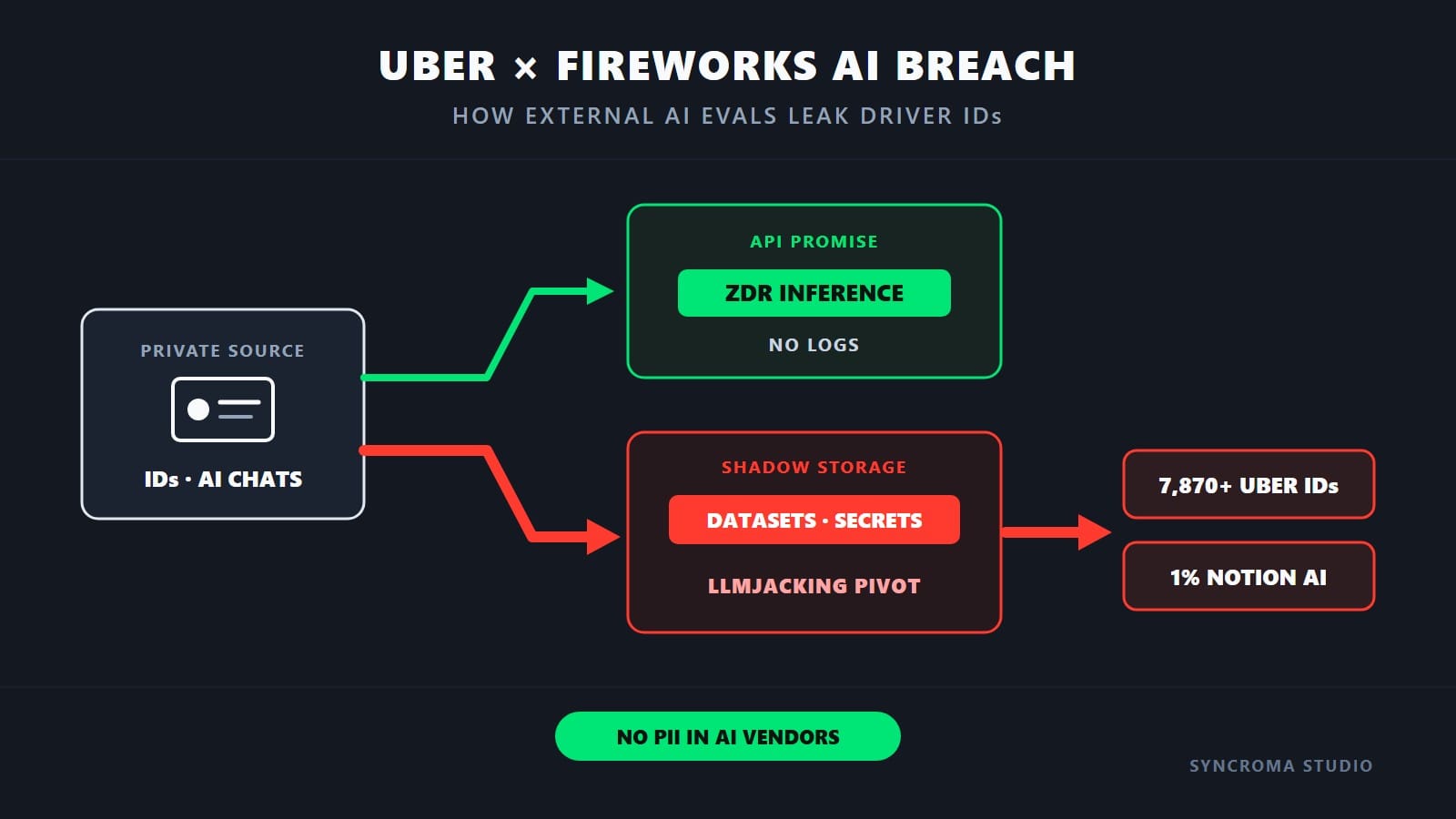
Partial state filings already confirm at least 7,870 affected drivers across three reporting states alone (3,430 in South Carolina, 2,567 in Massachusetts, and 1,873 in Rhode Island), with California and Illinois totals still pending (TechCrunch). Separately, Notion confirmed attackers accessed AI chat transcripts affecting roughly 1% of Notion AI customers (TechCrunch on Notion). The real engineering failure here is seeing how an attacker hunting for cheap LLM tokens ended up walking away with government driver's licenses.
From "LLMJacking" API Tokens to Real Driver's Licenses
Fireworks AI's own November 9 incident update, compiled alongside Palo Alto Networks Unit 42, maps out a two-stage supply-chain failure every AI architect should study:
| Date (2026) | Production Incident Timeline | Data Impacted |
|---|---|---|
| Oct 9 | Fireworks detects intrusion linked to LLMJacking (stealing & reselling unauthorized LLM routing tokens) | Stored customer secrets (e.g., evaluation jobs); Uber notified |
| Oct 13 | Uber's internal probe confirms unauthorized access to its vendor-hosted records | Personal information & driver's license records |
| Oct 23–24 | Attacker breaches a third-party cloud host running Fireworks R&D machines and pivots to dev systems | Resource metadata, billing records, incomplete model weights & stored datasets |
| Nov 3–13 | Notion severs Fireworks integration (Nov 3); Uber files multistate breach notices | ~1% of Notion AI "Insights" transcripts & thousands of Uber IDs |
(Timeline verified from the Fireworks AI Security Bulletin, TechCrunch, and the California DOJ breach notice).
Why "Zero Data Retention" Fails Outside the Inference Endpoint
In its security advisory, Fireworks stresses that its core Inference, Training SDK, and Nexus products default to Zero Data Retention (ZDR) and showed no detected compromise (Fireworks Security Bulletin).
That statement captures the exact gap between compliance marketing and real production pipelines:
- Zero-retention inference does not cover evaluation datasets: Teams routinely upload JSONL prompt benchmarks, support transcripts, or KYC edge-case samples into vendor evaluation suites and fine-tuning buckets. Those files stay persisted on disk even when the live
/chat/completionsendpoint retains zero logs. - Evaluation secrets live next to test inputs: Fireworks confirmed the initial breach exposed secrets stored for evaluation jobs. If vendor-side scripts store API keys or cloud storage references alongside sample payloads, ZDR on the inference wire offers zero blast-radius containment.
- Transitive fourth-party cloud risk: The October 23–24 escalation didn't even originate on Fireworks' main network — attackers pivoted from a third-party R&D cloud host straight into development machines holding customer datasets and billing history.
Production Takeaways for AI & Security Teams
- Never push raw PII into external evaluation buckets: Government IDs, driver's licenses, and real customer transcripts must be scrubbed, masked, or tokenized inside your own VPC before touching any external model or evaluation suite.
- Run the math on isolated open-weight inference: When vendor breach liability and compliance exposure enter the equation, hosting open models on dedicated GPUs inside your own security perimeter often beats shared inference APIs. Compare real break-even numbers in our AI API vs. Self-Hosted GPU Cost Calculator.
- Audit stored vendor secrets offline: Rotate any shared integration tokens immediately and generate high-entropy credentials strictly locally via our zero-server Private Password & Key Entropy Auditor.
Graphics by Syncroma Studio. Cover photograph: HaeB / Wikimedia Commons (CC BY-SA 4.0).

Sistemas reales, sin humo corporativo Real systems, zero corporate hype
Recibe los análisis a fondo sobre arquitectura, consumo de recursos y computación de bajo nivel directamente en tu bandeja de entrada. Get deep-dive software architecture, resource consumption metrics, and low-level computing essays delivered straight to your inbox.
Suscribirse a Syncroma Subscribe to Syncroma

