
(🇪🇸 Leer la versión en español aquí)
Every model launch promises "frontier intelligence at half the cost," yet almost none highlight where production bills quietly explode. Today, November 18, 2026, Google DeepMind made Gemini 4 Neon (gemini-4-neon) generally available across the Gemini API, Google AI Studio, and Google Antigravity, detailed alongside developer specs in the Google AI Studio release notes.
On paper, the unit economics look aggressive: a 1M-token context window, long-decode support up to 1M tokens, $3.00 per million input tokens, $0.15 per million cached input tokens (a 95% discount), and $15.00 per million output tokens. For teams running autonomous coding or research pipelines in production, however, the real story sits behind the pricing ratios and agent harness numbers.
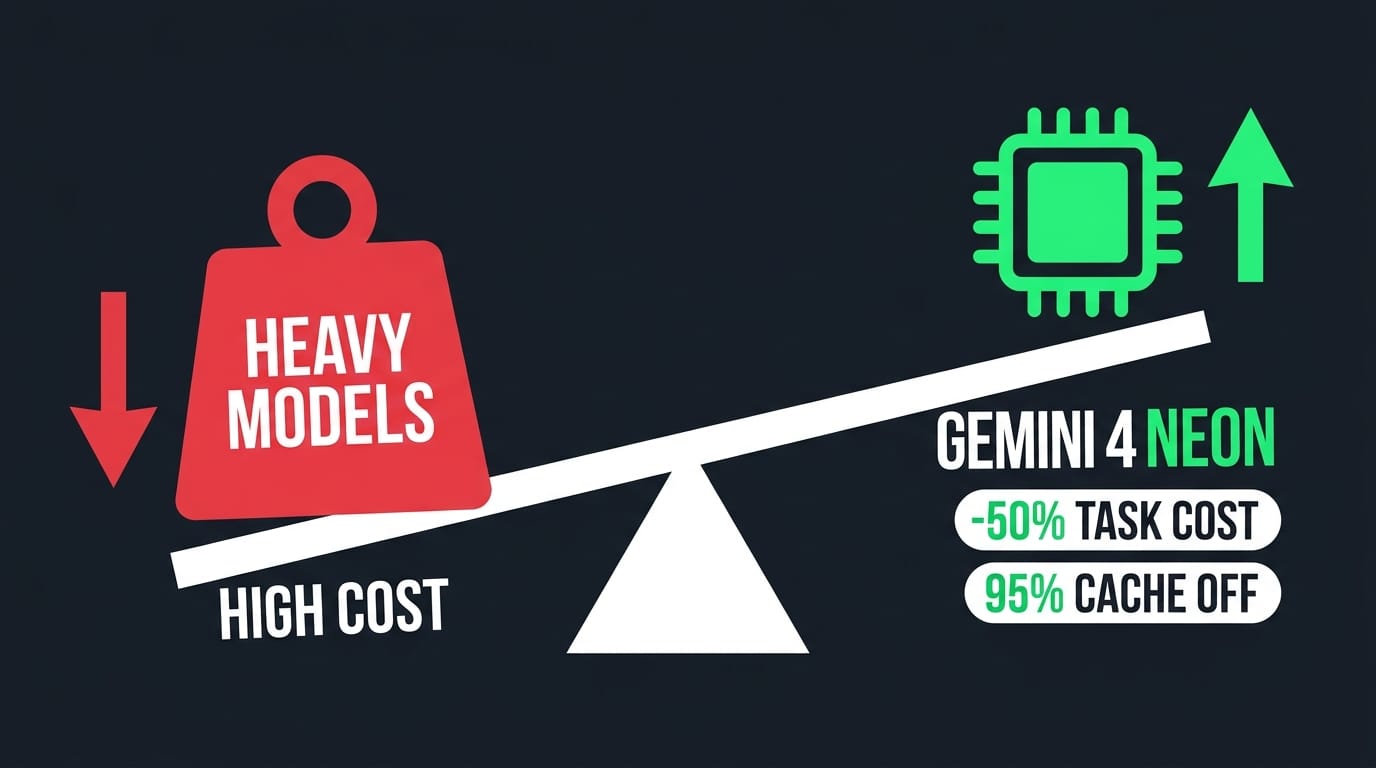
The real engineering numbers behind gemini-4-neon
Strip away the press release framing and the operational trade-offs come into sharp focus:
| Metric / Spec | Gemini 4 Neon (gemini-4-neon) Official Value |
Production Latency & Billing Impact |
|---|---|---|
| Input / Cache Pricing | $3.00 / 1M input · $0.15 / 1M cached (−95%) | Prefix stability is mandatory; cache misses increase prompt costs 20x |
| Output Pricing | $15.00 / 1M tokens (up to 1M decode) | 5:1 output-to-input ratio: verbose xhigh reasoning tokens burn margin fast |
| Thinking Levels | low, medium, default high, and xhigh |
Uncapped xhigh loops spike P95 latency on routine tool calls |
| Coding Benchmarks | 58.6 (#1 Artificial Analysis Coding Agent) · 65.2% Terminal-Bench 4.1 | At default high, delivers 32% lower cost per task than Gemini 4 Carbon |
| Cyber Defense (Fairwind) | 90.5% on SEC-bench Pro · 70.7% on CWE-bench v2 | Vulnerability triage & patching at roughly half the cost of heavier models |
As we broke down in our teardowns of Gemini 4 Hydrogen pricing and thinking controls and Gemini 4 Carbon in AI Mode, headline input pricing is a vanity metric in 2026: your real invoice is dictated by hidden reasoning tokens billed at the $15/1M output rate and how cleanly your system hits the prompt cache.
The 12.8% vs. 39.0% proof that harnesses beat raw weights
Look closely at one benchmark tucked inside Google DeepMind's announcement: on SWE-sweep, the exact same gemini-4-neon weights score 12.8% on the basic mini-SWE harness—and jump more than 3x to 39.0% inside the Google Antigravity harness.
Same weights, zero fine-tuning, 3x the pass rate. That single delta kills the lazy assumption that swapping a model string fixes brittle agents. Context compaction, non-redundant file reads, explicit edit tools, and delegating parallel work (e.g., Neon orchestrating lighter Hydrogen subagents) matter far more in production than chasing +1.5% on static leaderboards.
Alongside Neon, today's Google AI Studio update also ships native multimodal file slicing for Word, Excel, PowerPoint, video, and audio inside prompts and function responses. Instead of stuffing whole 100-page PDFs or multi-tab spreadsheets into context at $3/M, pipelines can slice specific page ranges, Excel cell blocks, or video timestamps before running inference.
Production checklist before switching your stack
- Do not default background crons to
xhigh: Reservexhighfor tough multi-file debugging or hard security audits; keep deterministic routing and extraction onlowormedium. - Treat cache hit rate as a core SRE metric: Moving from $3.00/M to $0.15/M changes unit economics by 20x—model your exact numbers in our LLM Token & Prompt Caching Cost Calculator.
- Verify API vs. dedicated GPU break-even: If sustained volume climbs into hundreds of millions of daily tokens, sanity-check cloud API bills against bare-metal inference in our AI API vs. GPU Cost Calculator.
Image credits: Editorial cover image generated by Syncroma Studio. Localized 2D dark-mode infographic by Syncroma Studio.
Sistemas reales, sin humo corporativo Real systems, zero corporate hype
Recibe los análisis a fondo sobre arquitectura, consumo de recursos y computación de bajo nivel directamente en tu bandeja de entrada. Get deep-dive software architecture, resource consumption metrics, and low-level computing essays delivered straight to your inbox.
Suscribirse a Syncroma Subscribe to Syncroma

