
(🇪🇸 Leer la versión en español aquí)
If you run coding agents or large-repo RAG pipelines in production, you know the classic LLM pricing trap: API sheets headline an attractive per-million rate, then quietly double or triple once your prompt crosses 128K or 200K input tokens.
On November 12, 2026, Google rolled out Gemini 4 Hydrogen (gemini-4-hydrogen) on the Google Blog—its high-efficiency workhorse built for daily coding and multi-step agentic loops, also live on OpenRouter and tracked independently on Artificial Analysis. From an infrastructure-bill perspective, there is one genuine win and one silent token-burn footgun built into its reasoning modes.
Flat Pricing Across 1 Million Tokens—and Outscoring Argon by Default
Looking strictly at the hard production numbers behind Gemini 4 Hydrogen:
- Zero long-context pricing cliff: Hydrogen charges a flat
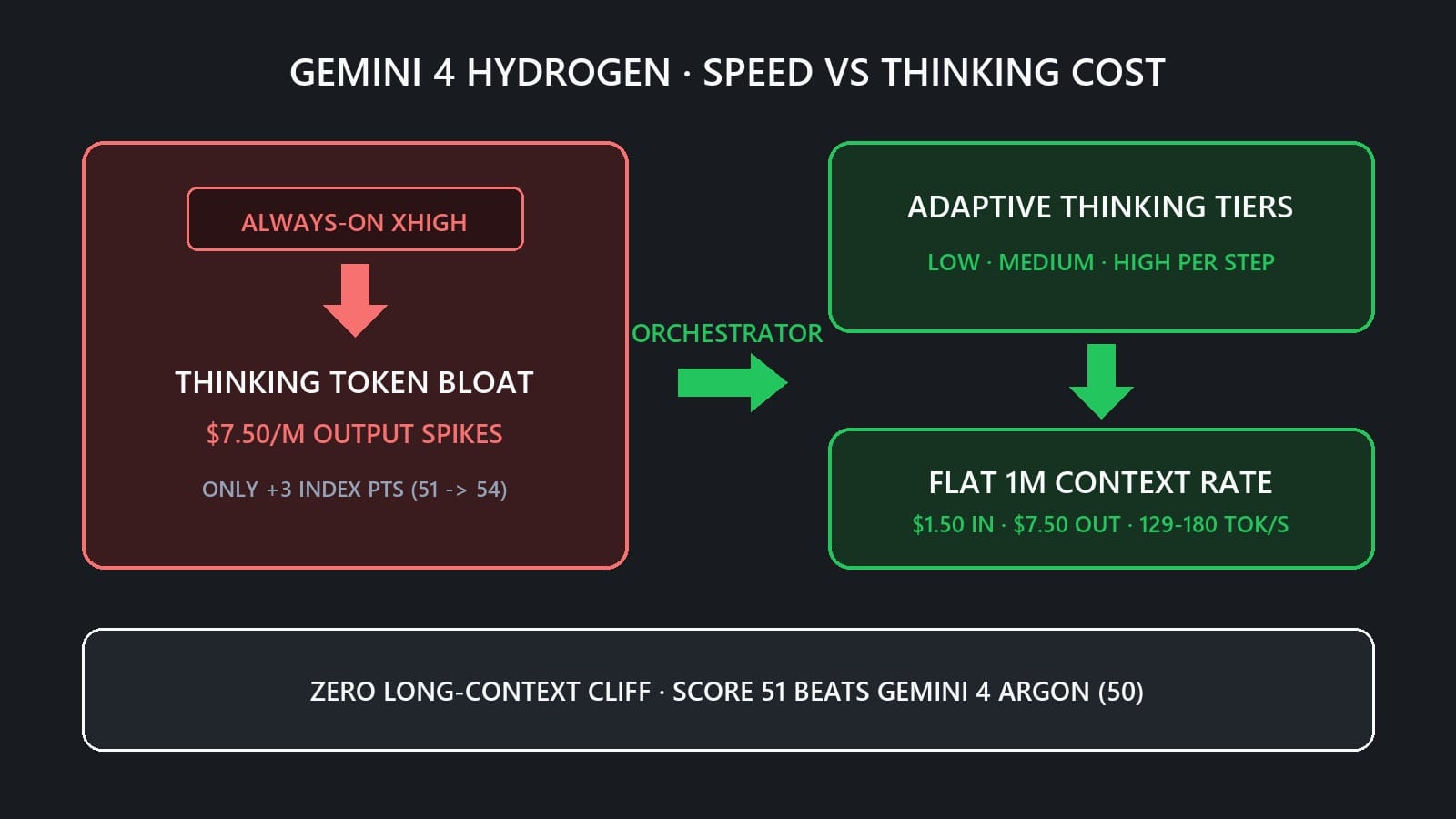
$1.50per million input tokens and$7.50per million output tokens across its entire 1-million-token multimodal context window (text, images, audio, video, and files). - Beats its bigger sibling out of the box: On its default
highthinking tier, Hydrogen scores 51 on the Artificial Analysis Intelligence Index—edging past the larger Gemini 4 Argon (50) at faster throughput and lower API spend. - Measured throughput and TTFT: Independent endpoint benchmarks report roughly 129 to 180 tokens/s output speed with Time-to-First-Answer-Token starting around 1.3s to 5.6s on lighter thinking settings, rising substantially once deeper chain-of-thought budgets trigger.
The high (51) vs xhigh (54) Token-Burn Footgun
Hydrogen exposes four thinking tiers—low, medium, high (default), and xhigh—designed to pair with an Orchestrator that dynamically escalates reasoning instead of maxing out every step:
| Thinking Mode | Intelligence Index Score | API Rate (Flat 1M Window) | Output Verbosity & Production Fit |
|---|---|---|---|
low / medium |
Speed-first routing | $1.50/M in · $7.50/M out |
Fast turnaround for diff summaries, routing, and simple tool calls |
high (Default) |
51 (beats Argon: 50) | $1.50/M in · $7.50/M out |
Sweet spot for daily debugging, refactoring, and multi-step agent loops |
xhigh (Max) |
54 (+3 pts marginal gain) | Same unit price, heavy thinking bloat | Burns massive internal output tokens & pushes heavy tasks to ~13–14 min |
Here is the math engineering leads need to watch: jumping from high (51) to xhigh (54) buys only 3 extra index points, yet benchmark runs show xhigh drives vastly higher reasoning verbosity (exceeding 300M aggregate output tokens across full Artificial Analysis evaluation suites)—all billed at $7.50 per million output tokens.
Three Deployment Rules Before Wiring Into CI/CD
- Never hardcode
xhighas your global default: Let your agent harness default tolowfor log grep / status checks andhighfor code edits, escalating toxhighonly after an explicit test failure loop. - Use the flat 1M window to simplify brittle chunking: When passing whole modules doesn't trigger a 2x long-context surcharge, feeding clean file context often outperforms complex vector-chunk glue.
- Check break-even vs. dedicated hardware before scaling 24/7 swarms: At
$1.50/$7.50, bursty engineering traffic is tough to beat on API; continuous 24/7 batch fleets still justify running your numbers in Syncroma's AI API vs Self-Hosted GPU Cost Calculator, sizing weights in our LLM VRAM Calculator, and accounting for upstream API brownouts via our SLA Uptime & Error Budget Calculator.
Engineering Verdict
Gemini 4 Hydrogen gets the two fundamentals production developers actually care about right: flat $1.50 / $7.50 pricing across all 1M tokens and a default high tier (51) strong enough to outperform bigger sibling Argon (50). Just don't leave xhigh permanently toggled on in autonomous loops unless you enjoy paying $7.50/M for endless internal monologues worth 3 marginal benchmark points.
Infographics created by Syncroma Studio. Cover photo: Wikimedia Commons (Unsplash) (editorial crop).

Sistemas reales, sin humo corporativo Real systems, zero corporate hype
Recibe los análisis a fondo sobre arquitectura, consumo de recursos y computación de bajo nivel directamente en tu bandeja de entrada. Get deep-dive software architecture, resource consumption metrics, and low-level computing essays delivered straight to your inbox.
Suscribirse a Syncroma Subscribe to Syncroma

