
(🇪🇸 Leer la versión en español aquí)
Google just shipped two telling moves around Gemini 4 Carbon that every developer, FinOps engineer, and Search power user ought to read together instead of swallowing marketing blurbs. First, as confirmed today by Google VP of Engineering for Search Rajan Patel via Search Engine Roundtable, Gemini 4 Carbon is now rolling out inside Google AI Mode for AI Pro subscribers (previously locked to Ultra)—right as Google stripped out the header badge showing which model actually answered your query.
Second, scroll down to Footnote #1 in Google DeepMind's official Gemini 4 Carbon announcement alongside the Google AI Studio pricing page: that $2 input / $10 output per million tokens launch rate expires on November 30, 2026, quietly doubling overnight to $4 / $20 starting December 1.
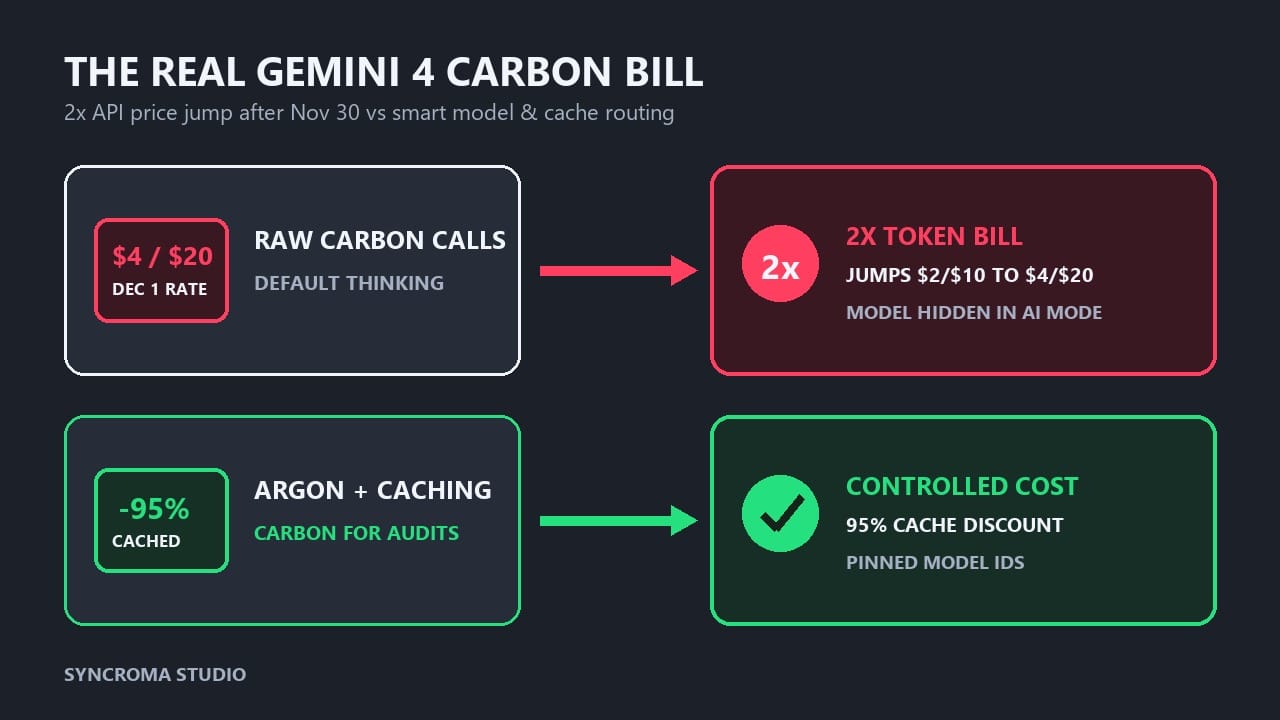
Separating Real Engineering From the Pricing Trap
To be fair, the model itself packs legitimate engineering muscle. Built atop Gemini 4 Argon rather than replacing lighter models like Gemini 4 Hydrogen across basic queries, Carbon burns extra verification loops with tunable thinking depths (low, medium, high):
| Spec / Billing Tier | Promo Rate (Until Nov 30) | Standard Rate (Dec 1, 2026+) | Production Mitigation |
|---|---|---|---|
| Standard Input (per 1M tokens) | $2.00 | $4.00 (2× jump) | Route CRUD / routine extraction to Argon |
| Standard Output (per 1M tokens) | $10.00 | $20.00 (2× jump) | Pin explicit thinking budget instead of uncapped high |
| Cached Context Tokens | 95% discount | Heavy discount on pinned context | Cache static docs, schemas & codebases |
| Unified Context Window | 1M tokens (multimodal) | 1M tokens | Trim stale agent trace logs before escalation |
On real-world coding and security benchmarks disclosed by Google, Carbon holds genuine bragging rights: #1 on CursorBench 4.0, Perplexity WANDR, and Zapier AutomationBench (at over 2× lower cost per task than rival flagship models), while leading vulnerability detection and patching suites (SEC-bench Pro, ExploitGym, and CWE-bench v1—hitting 100% recall on scanning and 95% precision on triage inside Project Fortify).
Why Hiding the AI Mode Badge Matters—And Where API Bills Explode
Stripping the model name out of Google Search's AI Mode header ("Intended", per Patel) turns inference routing into an opaque black box. Users can no longer tell whether a query gets lightweight speed or deep Carbon verification—and backend engineers face three blunt traps if they hook Carbon into pipelines blindly:
- An automated 2× bill cliff on December 1: Budgets modeled on $2/$10 intro pricing during mid-November pilots will instantly double in December without a single git commit changing.
- Reasoning tokens inflate output bills fast: Output tokens jump to $20 per million under standard pricing—meaning unconstrained multi-agent loops burn budget on silent chain-of-thought long before returning a single user-visible patch.
- Model context bloat stresses local infra too: Syncing massive 1M-token workspaces, vector caches, and container builds locally also pounds disk I/O—sanity-check token economics beforehand using our LLM token cost and prompt caching calculator and audit server flash wear with the NVMe SSD endurance TBW and DWPD lifespan calculator.
Verdict
Gemini 4 Carbon is genuinely elite at deep vulnerability auditing, multi-file migrations, and high-stakes debugging—not boilerplate chatbot chatter. Just don't fall asleep on two street realities: Google hid the model indicator inside Search AI Mode right as Carbon arrived for Pro users, and the API's promotional $2/$10 sticker doubles to $4/$20 after November 30. Pin Carbon strictly to architectural reviews and verification loops, keep routine traffic on lighter tiers, and abuse context caching for every repeatable byte.
Visual credits: Cover photograph based on "Pixel 9 & Pixel 9 Pro Hands-On Impressions (ShoAndTech)" via Wikimedia Commons (CC BY 3.0). Infographic by Syncroma Studio.

Sistemas reales, sin humo corporativo Real systems, zero corporate hype
Recibe los análisis a fondo sobre arquitectura, consumo de recursos y computación de bajo nivel directamente en tu bandeja de entrada. Get deep-dive software architecture, resource consumption metrics, and low-level computing essays delivered straight to your inbox.
Suscribirse a Syncroma Subscribe to Syncroma

