
(🇪🇸 Leer la versión en español aquí)
Every few weeks Chrome prompts users to relaunch, and most teams treat it as background UI noise. This time, you should actually force the restart. Google just pushed Chrome 158 to the stable channel (158.0.8127.36 on Linux and 158.0.8127.36/.37 on Windows/macOS, plus 158.0.8127.42 on Android), documented across the official Chrome Desktop Release Notes, the Chrome for Android advisory, and Cyber Security News.
The patch batch clears 204 security vulnerabilities right behind Chrome 157's 213 fixes: 6 Critical, 62 High, 82 Medium, and 54 Low issues. What jumps off the changelog is not just the raw count—it is who uncovered most of the criticals and why browser engines keep bleeding from the exact same memory bugs.
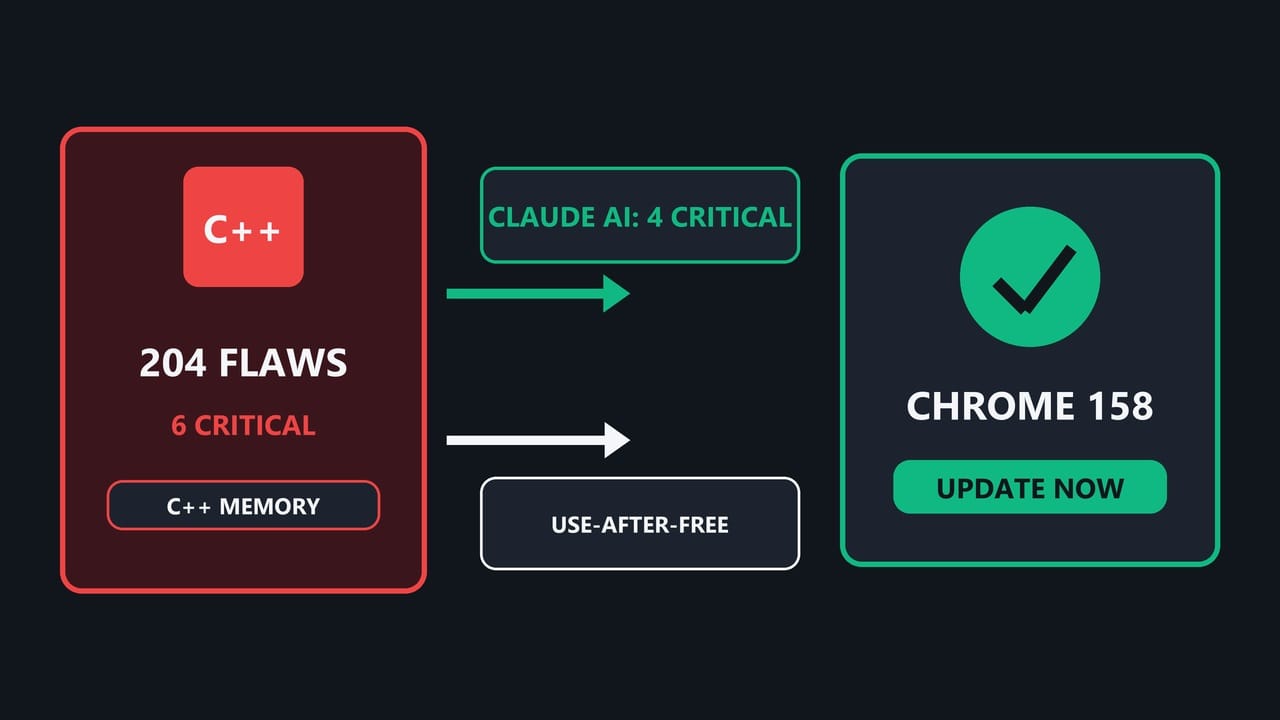
Inside the 6 critical CVEs: C++ memory corruption meets AI bug hunting
Read Google's official release changelog line by line and a clear pattern emerges: all six Critical CVEs are classic C++ memory safety failures (use-after-free, out-of-bounds write, buffer overflow), and four of the six came from Xinyang Ge at Anthropic—credited 15 times in this release, including 8 explicitly marked "assisted by Claude":
| Critical CVE | Chromium Component | Bug Class | Credited Researcher |
|---|---|---|---|
CVE-2026-130963 |
WebView | Use-after-free | |
CVE-2026-131031 |
GPU | Out-of-bounds write | Xinyang Ge (Anthropic), assisted by Claude |
CVE-2026-131060 |
Media | Buffer overflow | Xinyang Ge (Anthropic), assisted by Claude |
CVE-2026-131008 |
GarbageCollection | Use-after-free | Xinyang Ge (Anthropic) |
CVE-2026-131054 |
ANGLE | Out-of-bounds write | |
CVE-2026-130975 |
WebAudio | Use-after-free | Xinyang Ge (Anthropic) |
Beyond the six critical bugs, Chrome 158 closes dozens of High-severity holes across V8, ANGLE, Autofill, Extensions, Loader, Forms, and Bindings, including a $4,000 bounty paid to Arni Hardarson (Neonix Security). Google notes no active in-the-wild exploitation is known for these six criticals yet and is restricting bug tracker details until users update.
Engineering reality check for security & platform teams
As we highlighted in our analysis of Chrome's prior zero-day and legacy parser replacements and Google GTIG's warning on AI-accelerated exploit pipelines:
- LLM-assisted auditing scales faster than legacy C++ remediation: Watching one Anthropic researcher assisted by Claude pull 4 Critical and 11 additional bugs out of Chromium in one cycle proves defensive and offensive teams alike now parse massive C++ trees at software speed.
- GPU, ANGLE, and Media remain high-risk attack surfaces: Even with site isolation and Chromium's sandbox, out-of-bounds writes in graphics translation layers and media decoders expose corporate fleets whenever auto-updates sit un-restarted for weeks.
- Actionable steps right now: Open Chrome $\rightarrow$ Help $\rightarrow$ About Google Chrome and confirm you land on
158.0.8127.36(Linux/Win/Mac) or.37, and update Android clients to158.0.8127.42. On the web defense side, tighten your own browser execution boundary with our Private CSP Header Builder & Validator and HTTP CORS Preflight Debugger.
Image credits: Cover photograph via Wikimedia Commons (CC BY 2.0). Localized 2D dark-mode infographic by Syncroma Studio.
Sistemas reales, sin humo corporativo Real systems, zero corporate hype
Recibe los análisis a fondo sobre arquitectura, consumo de recursos y computación de bajo nivel directamente en tu bandeja de entrada. Get deep-dive software architecture, resource consumption metrics, and low-level computing essays delivered straight to your inbox.
Suscribirse a Syncroma Subscribe to Syncroma

