
(🇪🇸 Leer la versión en español aquí)
For years, ops teams leaned on one unwritten buffer: when a vendor shipped a security patch on Tuesday afternoon, you had a few days — or at least until the weekend maintenance window — before threat actors reversed the fix and sprayed working mass exploits across the internet. Today, Google Threat Intelligence Group (GTIG) and Mandiant just published forensic proof that this buffer is gone.
In the November 2026 GTIG AI Threat Tracker — paired with a technical deep dive on ARTEX and agentic offensive frameworks and covered by The Hacker News and Infosecurity Magazine — Google documents live offensive pipelines that diff public patches, write PoCs, and compromise internet-facing servers with zero human in the loop.
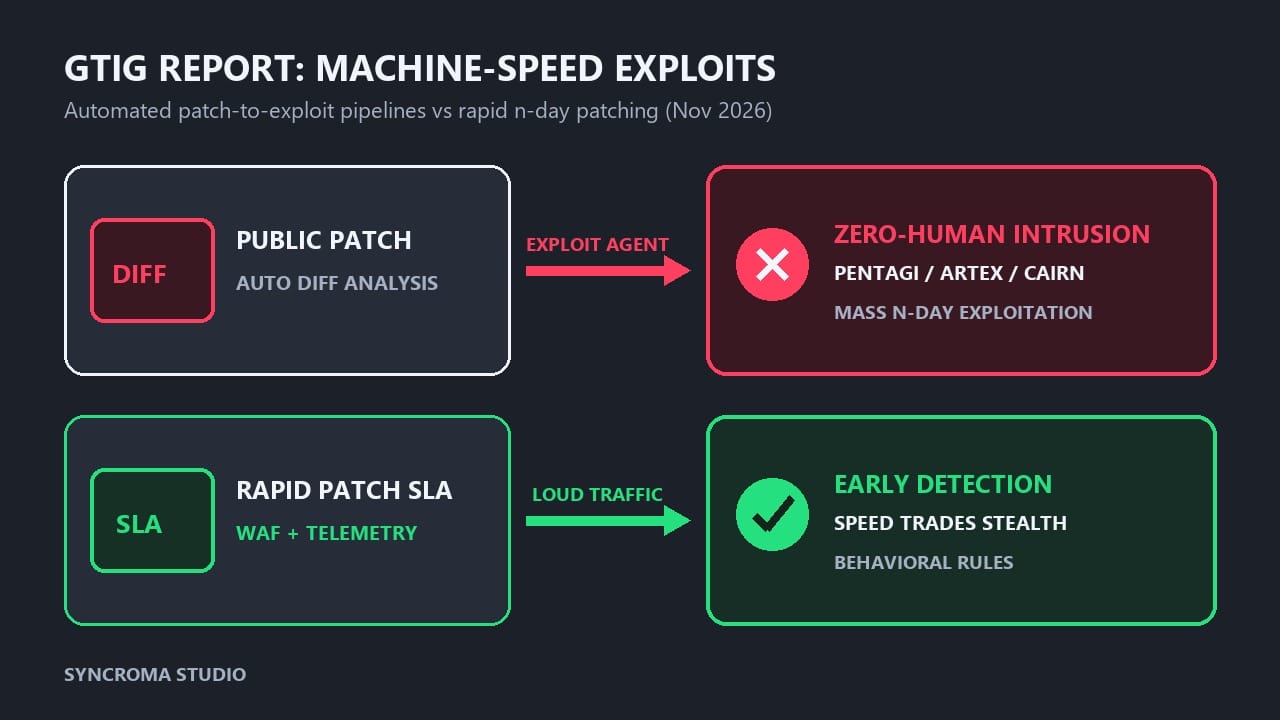
From Manual Prompting to exploit_agent, PentAGI, and CAIRN in the Wild
What makes the report hard to shrug off isn't lab theory; it is captured adversary infrastructure spotted during live incident response:
exploit_agent(continuous differential patch weaponization): GTIG uncovered an exposed staging server wiring frontier and local LLM API keys into an automated pipeline that continuously compares pre- and post-patch source releases (including access-control fixes like WordPress plugin Spectrav2.19.25), drafts exploits, executes them automatically, installs webshells, and even purges competing attackers' webshells across French media and education targets.- PentAGI and CAIRN active in production intrusions: Between late August and October 2026, GTIG tracked intrusions across Asia driven by a customized PentAGI harness running isolated Kali agent loops, while CAIRN (an open-source OODA-loop multi-agent harness using a shared blackboard) surfaced in intrusion activity targeting U.S. aerospace organizations.
- Off-the-shelf offensive tool harnesses: Frameworks such as CyberStrikeAI (a Go-based C2 server orchestrating 100+ security tools and YAML attack recipes) and HexStrike AI (an MCP-integrated harness connecting 12+ sub-agents to 150+ utilities) collapse reverse-engineering skill barriers down to API calls.
| Observed Offensive Harness | Core Architecture | Automated Workload | Where Defenders Still Win |
|---|---|---|---|
exploit_agent |
Multi-LLM APIs + patch diff engine | Code diff -> PoC exploit -> auto-webshell | Predictable PHP/REST payloads & repetitive artifacts |
| PentAGI | Containerized Kali multi-agent runner | Systematic recon & vulnerability sweeps | High-volume scanning bursts & telemetry spikes |
| CAIRN | OODA loop + shared agent blackboard | Autonomous pivot from target IP to goal | Noisy lateral sweeps post-initial access |
| HexStrike AI | MCP server + 12+ specialized sub-agents | Chains 150+ existing offensive CLI tools | Distinct tool signatures & API call volume |
The Real Bottleneck: N-Day Patch Windows, Not Zero-Day Hype
Here is where the numbers in GTIG's report cut straight through vendor fearmongering. While total disclosures and exploits nearly doubled between January and August 2026, zero-day exploits barely moved from a 2025 monthly average of 8 to 11 per month in 2026 (with a one-month spike to 22 in August). The real surge is known n-day bugs weaponized straight from public release notes and pre-release commits before your staging pipeline even clears QA.
Just as critical for architects: GTIG and Mandiant note that current autonomous harnesses trade stealth for velocity. Leaving AI agents off-leash creates volumetric bursts, repeatable payload quirks, and loud forensic traces in WAF, DNS, and endpoint logs.
Three Concrete Hardening Moves Before Your Next Patch Tuesday
- Measure internet-facing n-day SLA in hours, not sprints: Whenever an edge gateway, CMS plugin, or auth middleware ships a security diff, assume automated probes hit your perimeter the same evening; push temporary WAF virtual patches while rollout tests finish.
- Stop leaking AI & cloud credentials (
LLMJacking): GTIG flags ongoing monetization via stolen enterprise LLM API keys resold through underground LLM Mixers. Audit your deployment environment files offline with our 100% Private .env to JSON / YAML Converter & Secret Auditor and strip sensitive strings via the Offline PII & Secret Anonymizer. - Detect velocity noise & plan real maintenance budgets: Combine behavioral volumetric alerts with realistic emergency patching windows backed by our SLA Uptime & Error Budget Calculator.
Conceptual infographic designed by Syncroma Studio. Cover photograph: Crew via Wikimedia Commons / Unsplash (CC0).

Sistemas reales, sin humo corporativo Real systems, zero corporate hype
Recibe los análisis a fondo sobre arquitectura, consumo de recursos y computación de bajo nivel directamente en tu bandeja de entrada. Get deep-dive software architecture, resource consumption metrics, and low-level computing essays delivered straight to your inbox.
Suscribirse a Syncroma Subscribe to Syncroma

