(🇪🇸 Leer la versión en español aquí)
If you have Google Chrome open on Windows, macOS, Linux, or Android — or any Chromium derivative like Microsoft Edge, Brave, or Opera — restart your browser today. On Monday, November 9, 2026, Google pushed an out-of-band update to 157.0.8103.50/.51 on Windows and macOS (157.0.8103.50 on Linux) bundling 9 security fixes, headlined by CVE-2026-125350: Chrome's eighth actively exploited zero-day of 2026, as confirmed in the official Chrome Releases advisory and covered by BleepingComputer and The Hacker News.
The flaw is a high-severity Use-After-Free (CWE-416) in the XML processing component (CVE-2026-125350 record). Simply visiting a crafted HTML or XML document lets a dangling pointer corrupt freed renderer heap memory, opening the door to arbitrary code execution inside the sandbox before the user clicks a single button. CISA promptly added it to the Known Exploited Vulnerabilities (KEV) catalog, triggering urgent enterprise patch deadlines.
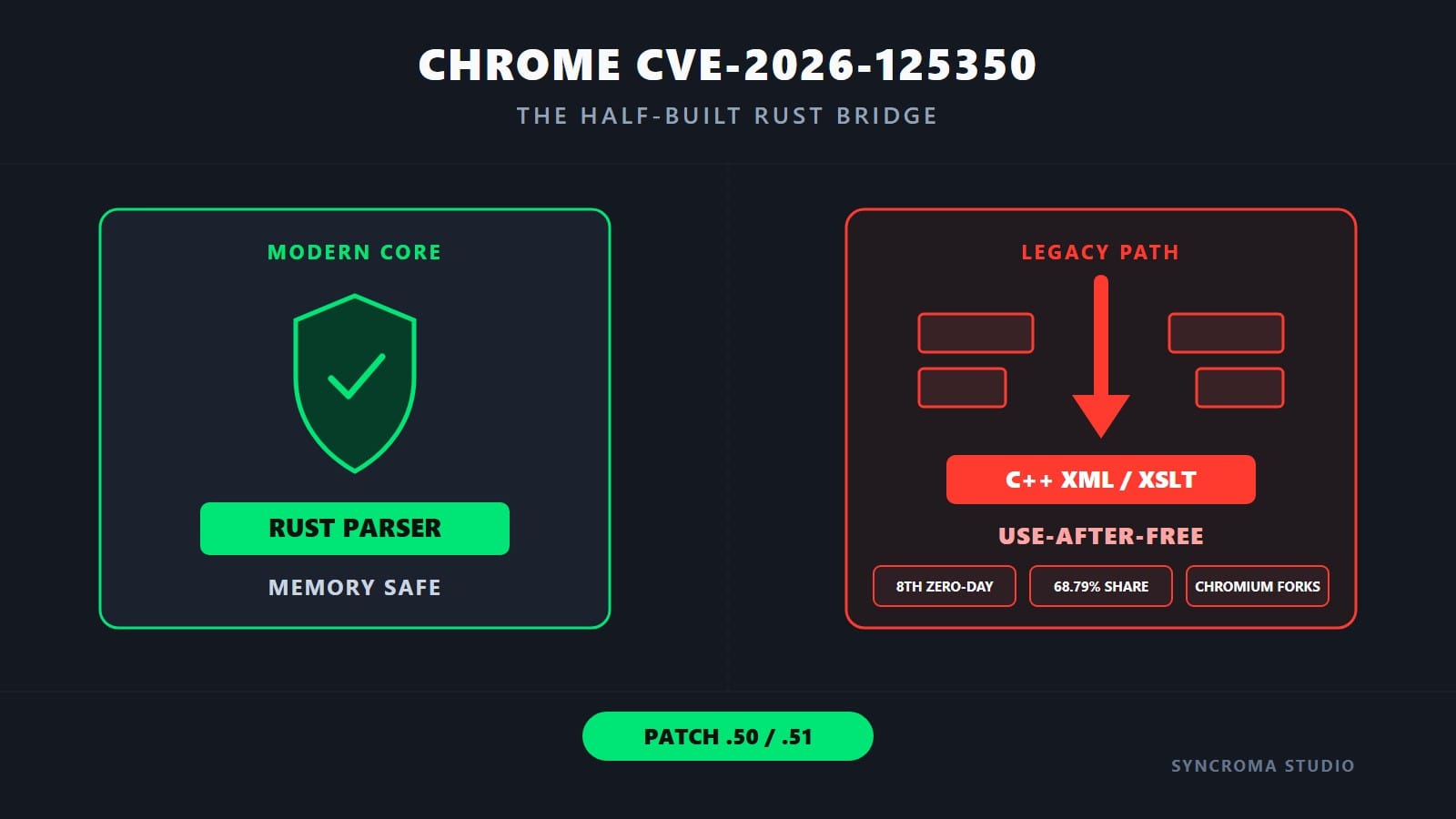
Beneath the usual "update Chrome immediately" headlines sits a brutal architectural irony: Google had already rewritten standard XML parsing in Rust to eliminate this exact class of bugs — yet got hit anyway because the legacy C/C++ XSLT fallback stayed alive one release too long.
From Clean Disclosure to Active Exploitation in 72 Hours
The Chromium bug IDs attached to Google's release notes tell a sharper story than PR statements:
- October 12, 2026: Arni Hardarson (Neonix Security) responsibly files the initial XML memory bug.
- November 6, 2026: An anonymous researcher submits a parallel report showing an exploit already running in the wild, documented in Chrome Releases.
- November 9, 2026: Google ships Stable desktop build
157.0.8103.50/.51— just 72 hours after in-the-wild abuse was confirmed.
And CVE-2026-125350 did not ship alone. Chrome 157 swept up a textbook lineup of C/C++ memory-corruption bugs across critical rendering and engine components:
| CVE ID | Severity | Component | Vulnerability Class | Attribution |
|---|---|---|---|---|
| CVE-2026-125350 | High | XML / XSLT | Use-After-Free (in the wild) | Neonix Security + Anonymous |
| CVE-2026-125344 | High | V8 Engine | Type Confusion | Google internal |
| CVE-2026-125348 | High | GPU Process | Out-of-Bounds Write | Google internal |
| CVE-2026-125343 | High | Compositing | Buffer Overflow | Google internal |
| CVE-2026-125345 | High | WebGL | Uninitialized Resource | Google internal |
| CVE-2026-125347 | High | FileSystem | Incorrect Authorization | Google internal |
(Full patch inventory verified via Chrome Releases Desktop Update and SecurityWeek).
The Half-Built Bridge: Why Rust Couldn't Stop This Round
Chromium's own security metrics establish the baseline problem: roughly 70% of Chromium's high-severity security bugs are memory-safety issues rooted in C and C++ pointer arithmetic (Chromium Security: Memory Safety). That reality pushed Google into aggressively rewriting high-risk parsers in Rust — starting with font rendering (Fontations), image decoders, and XML parsing.
As documented in Chrome Developers' XSLT deprecation roadmap, Chromium replaced libxml2 with a memory-safe Rust XML parser around Chrome 153 for mainstream web APIs (DOMParser, XMLHttpRequest.responseXML, and standalone SVG rendering).
So how did a Use-After-Free in XML still land an active zero-day in November 2026?
Because shipping a memory-safe engine alongside a legacy C fallback leaves the attack surface wide open. To preserve compatibility for legacy XSLTProcessor calls and <?xml-stylesheet type="text/xsl" ...?> directives, Chromium kept C-based XML/XSLT code paths alive all the way until Chrome 158 — slated for this very month, November 2026 — when default XSLT support is finally disabled (ChromeStatus Rust XML feature, Chrome Developers). Attackers never bother attacking your shiny Rust sandbox if they can simply invoke the unretired C path one function call over.
The Monoculture Blast Radius Beyond Google Chrome
In production, a Chromium zero-day never stays politely inside Chrome's desktop binary:
- Global browser dominance: Across desktop, mobile, and tablet combined in October 2026, StatCounter Global Stats places Google Chrome at 68.79% global market share, ahead of Safari (16.59%), Microsoft Edge (5.36%), Firefox (2.57%), Opera (2.16%), and Samsung Internet (2.05%).
- Fork and Electron patch lag: Upstream Chrome ships first; Edge, Brave, Opera, Vivaldi, and dozens of Electron desktop applications (team chat clients, code editors, internal dashboards) lag anywhere from 24 hours to several weeks rebuilding, code-signing, and shipping updated runtimes while exploit primitives circulate in the wild.
- Headless pipelines & CI/CD runners: Any backend service invoking Playwright or Puppeteer against untrusted HTML/XML invoices, feeds, or third-party previews executes the exact same renderer code unless container base images are rebuilt.
Immediate Hardening Checklist
- Desktop & mobile users: Open
Settings > About Chromeand confirm you are running157.0.8103.50or157.0.8103.51, then click Relaunch (a downloaded update waiting on a tab restart still leaves the vulnerable binary mapped in RAM). Apply the same check across Edge, Brave, and Opera. - Engineering & DevOps teams: Rebuild CI containers running headless Chromium/Playwright/Electron, audit any internal credentials stored in unpatched browser profiles using our client-side Password Entropy Auditor, and verify downloaded installer digests locally with the Offline SHA-256 & HMAC Verifier.
Graphics by Syncroma Studio. Cover photograph: Dietmar Rabich / Wikimedia Commons (CC BY-SA 4.0).

Sistemas reales, sin humo corporativo Real systems, zero corporate hype
Recibe los análisis a fondo sobre arquitectura, consumo de recursos y computación de bajo nivel directamente en tu bandeja de entrada. Get deep-dive software architecture, resource consumption metrics, and low-level computing essays delivered straight to your inbox.
Suscribirse a Syncroma Subscribe to Syncroma

