
(🇪🇸 Leer la versión en español aquí)
For nearly two years, the British government enforced one of tech's strangest legal gags: secretly ordering Apple to weaken encryption protections while legally barring Apple from even admitting the order existed. Today, November 19, 2026, the UK's Investigatory Powers Tribunal (IPT) finally punctured that secrecy, as reported by MLQ.ai / Reuters, 9to5Mac, and Privacy International.
The tribunal ordered the Home Office to publicly confirm it issued Apple a Technical Capability Notice (TCN) under the Investigatory Powers Act, rejecting state claims that admitting the order's existence would harm national security after officials had already leaked details in media briefings.
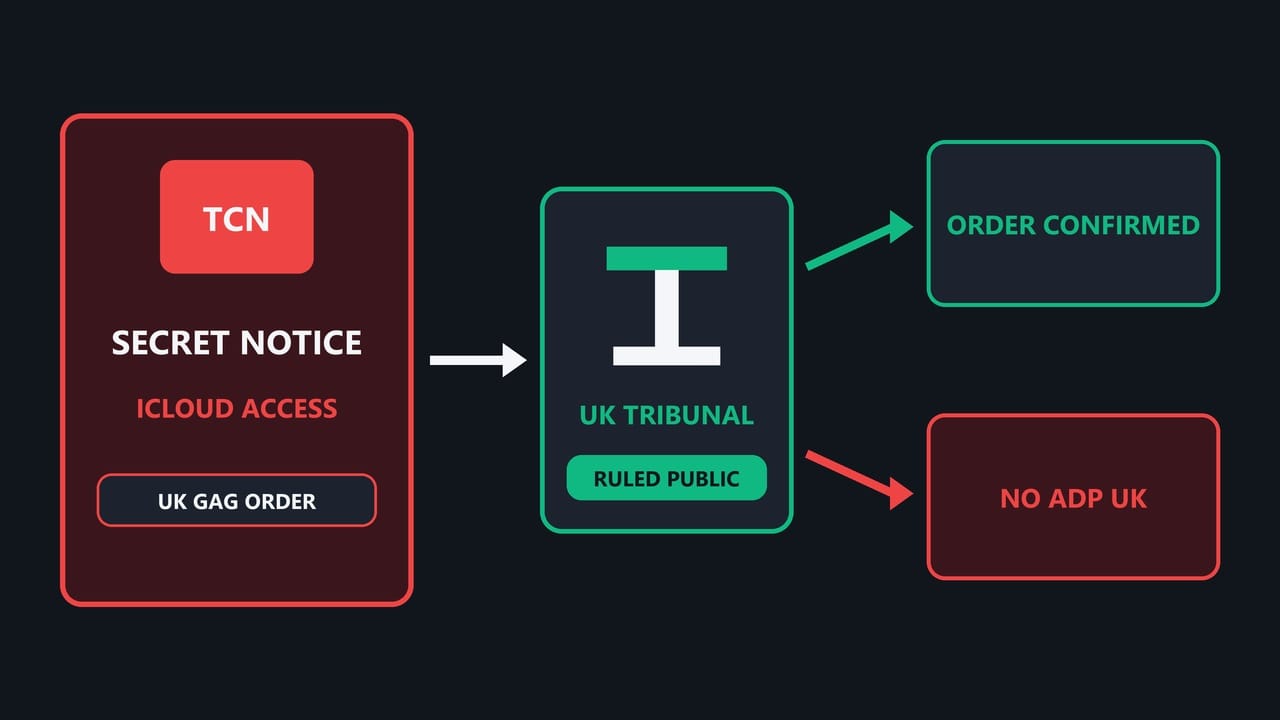
What the secret TCN targets—and the impact on 39–40M UK iCloud users
Cited by civil liberties group Liberty (using Which? estimates via MLQ.ai), roughly 39 to 40 million people in the UK rely on iCloud. The timeline shows how aggressively states have pushed against zero-knowledge cloud backups:
| Case Milestone (Apple vs. UK Home Office) | Legal & Technical Scope | User Encryption Reality |
|---|---|---|
| First TCN Order (Jan 2025) | Demanded global backdoor access to encrypted iCloud backups (US + UK) | Quietly dropped after diplomatic pushback from Washington |
| Apple Countermeasure (Feb 2025) | Pulled Advanced Data Protection (ADP) for new UK accounts | Without ADP, standard backups use Apple-managed keys reachable by warrant |
| Second Active TCN | Narrowed exclusively to Apple's UK customer base | Technical specifics remain sealed pending further tribunal disclosure |
| Transparency Ruling (Nov 19, 2026) | IPT strikes down "neither confirm nor deny" secrecy stance | Sets the stage for open substantive litigation expected in 2027 |
The cryptographic reality: "just one country's backdoor" breaks the math
Politicians routinely pitch sovereign surveillance mandates as surgical exceptions. As we documented when auditing iPhone Lockdown Mode vs. frontier exploits and WhatsApp's encrypted backup key rules, client-side cryptography leaves zero middle ground:
- Zero-knowledge E2EE cannot comply without architectural weakening: When Advanced Data Protection keeps encryption keys strictly on a user's trusted devices, Apple lacks the technical capability to decrypt cloud snapshots—forcing regulators to demand structural downgrades or disable ADP outright.
- Standard iCloud vs. ADP confusion remains widespread: Most everyday iPhone owners assume all iCloud data is end-to-end encrypted; once ADP is blocked for UK signups, cloud device backups and photos fall back to provider-held encryption keys.
- Every nation-state watches what London extracts: If any Western democracy successfully enforces regional encryption downgrades under statutory gag orders, other governments will demand identical server-side visibility.
Whenever you need verifiable client-side encryption without trusting third-party cloud key escrow, encrypt payloads directly in your browser using our Offline AES-256-GCM Encryptor and verify file integrity with our SHA-256 & HMAC Checksum Auditor.
Image credits: Cover photograph via Wikimedia Commons (CC0). Localized 2D dark-mode infographic by Syncroma Studio.
Sistemas reales, sin humo corporativo Real systems, zero corporate hype
Recibe los análisis a fondo sobre arquitectura, consumo de recursos y computación de bajo nivel directamente en tu bandeja de entrada. Get deep-dive software architecture, resource consumption metrics, and low-level computing essays delivered straight to your inbox.
Suscribirse a Syncroma Subscribe to Syncroma

