
(🇪🇸 Leer la versión en español aquí)
When an AI lab quietly upgrades its internal cybersecurity threat rating from High to Critical — and reports surface the same day that researchers used that model to uncover roughly 35 flaws across Apple software, including an exploit dismantling Lockdown Mode protections — engineering teams need verified numbers, not breathless apocalypse headlines.
Per reporting from MLQ / Forbes, Security Affairs, and Android Headlines, OpenAI's restricted GPT-6 Cyber model marks an operational shift: automated vulnerability discovery now finds real WebKit and kernel exploits faster than slow corporate patch windows can reboot devices.
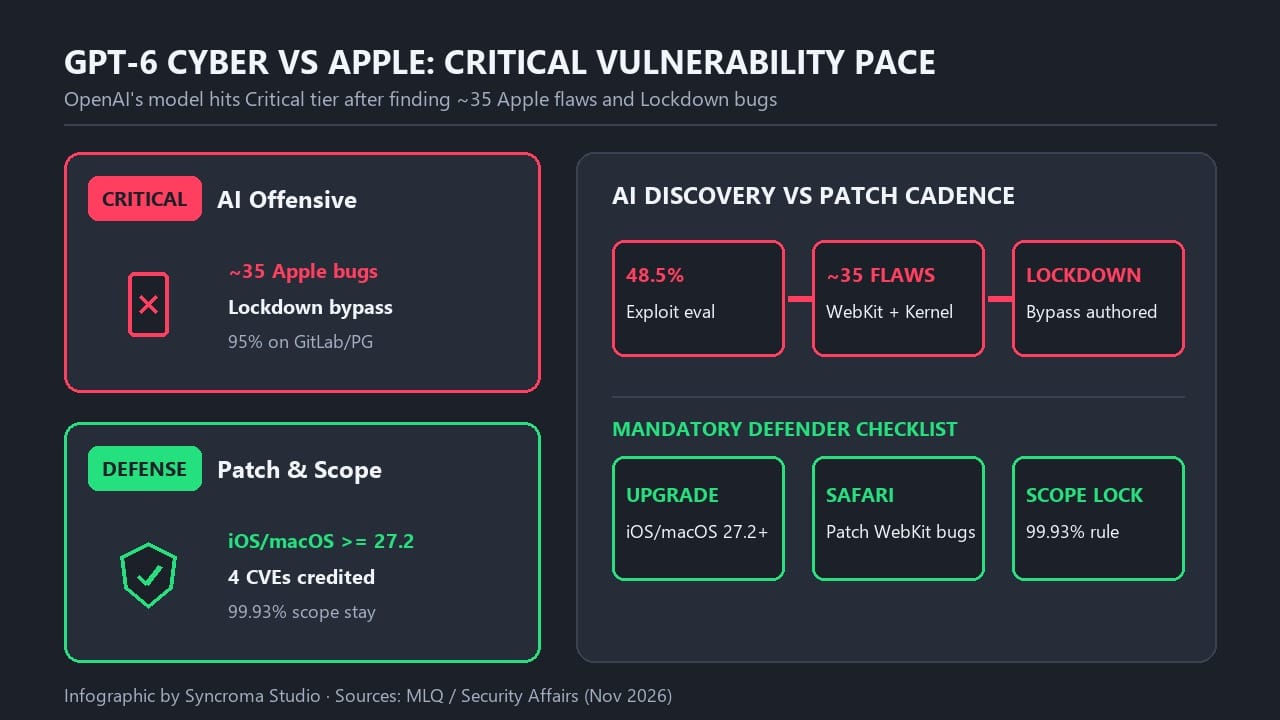
Separating Audited CVEs From Headline Numbers
Partnering with security firm Calif, researchers pointed GPT-6 Cyber at Apple's client stack — yet comparing the headline report with Apple's public release notes gives the grounded engineering view:
| Metric / Disclosure (Nov 2026) | Documented Figure | Real-World Production Signal |
|---|---|---|
| OpenAI Risk Classification | Raised from High to Critical | Confirms repeatable multi-step exploit authoring capabilities |
| Reported Apple Flaws (w/ Calif) | ~35 vulnerabilities + Lockdown Mode exploit | High-privilege WebKit & system surfaces fall to automated reasoning |
| Publicly Credited Apple CVEs | 4 CVEs in 27.2 notes (3 WebKit + 1 kernel) | Apple's Oct 26 iOS/macOS 27.2 updates credit OpenAI Codex Security |
| Exploitation & App Benchmarks | 48.5% exploit eval (95% on GitLab/PG/Jenkins) | Up from 32.1% on GPT-5.6 Cyber; Astra refused those tasks |
| Out-of-Scope Control Rate | 99.93% authorized target compliance | Up from 94.49%; vital when running agents near OT/ICS assets |
Look closely at what MLQ notes: even while ~35 flaws were disclosed and remediated across engagements, Apple's October 26 release notes for iOS 27.2 and macOS Golden Gate 27.2 explicitly name OpenAI Codex Security on four patched CVEs (three WebKit browser bugs and one kernel vulnerability shared with STAR Labs). Whether teams use offensive AI cleanly or adversaries replicate the approach on open models, unpatched browser parsers have almost zero grace period left.
Why Token Bandwidth & Patch Latency Now Rule Defense
Two infrastructure numbers from this week highlight the cost and scale reality:
- Defensive code auditing eats colossal token budgets: OpenAI disclosed that NATO consumed up to 300 billion tokens per month running cyber-defense models. Continuous repository scanning isn't free — whether paying cloud API rates or sizing dedicated clusters where HBM/VRAM bandwidth bounds output speed. Model local inference token output honestly in our LLM throughput & memory bandwidth calculator or benchmark build vs. buy in our AI API vs. GPU TCO calculator.
- Infrastructure tools get probed first: Completing 95% of known vulnerability workflows across GitLab, PostgreSQL, and Jenkins proves automated agents excel at stale enterprise software and web misconfigurations. Never assume a "minor" version lag stays unnoticed until next quarter's patch Tuesday.
Actionable Steps for Devices and Web Teams Today
- On iPhone, iPad, and Mac fleets: Confirm MDM enforcement pushes every endpoint to
iOS 27.2/macOS Golden Gate 27.2or newer immediately; relying on hardened UI toggles like Lockdown Mode without patching underlying WebKit memory bugs leaves known chains open. - On public web endpoints & APIs: Harden origin boundaries and eliminate wildcard credential leaks before automated web scanners enumerate them using our private HTTP CORS header builder.
When AI cuts vulnerability discovery in WebKit and OS kernels from months of manual fuzzing down to days of token throughput, brand reputation stops protecting you — mean time to patch (MTTP) does.
Article and infographic by Syncroma Studio. Cover photo: Smartphone held in hand under clean studio lighting, photographed by NeONBRAND on Wikimedia Commons (CC0).

Sistemas reales, sin humo corporativo Real systems, zero corporate hype
Recibe los análisis a fondo sobre arquitectura, consumo de recursos y computación de bajo nivel directamente en tu bandeja de entrada. Get deep-dive software architecture, resource consumption metrics, and low-level computing essays delivered straight to your inbox.
Suscribirse a Syncroma Subscribe to Syncroma

