(🇪🇸 Leer la versión en español aquí)
When midnight hits in Madrid (00:00 CET, Nov 19) for a massive coordinated digital unlock like GTA 6 — riding atop pre-load packages reaching 210–212 GB on PS5 and up to 225 GB compressed on Xbox according to Rockstar’s official Pre-Load FAQ and Rock Paper Shotgun — millions of 1 Gbps FTTH households assume the bottleneck sits on publisher authentication servers or home Wi-Fi. In reality, launch-night stalls usually happen inside Layer-3 BGP peering policy, IXP port saturation, and residential PPPoE/CGNAT limits.
As late patch bursts, encrypted entitlement handshakes, and simultaneous 4K Twitch streams stack onto the exact same 30-minute window, European ISPs behave very differently depending on where their Autonomous System Numbers (ASNs) exchange traffic.
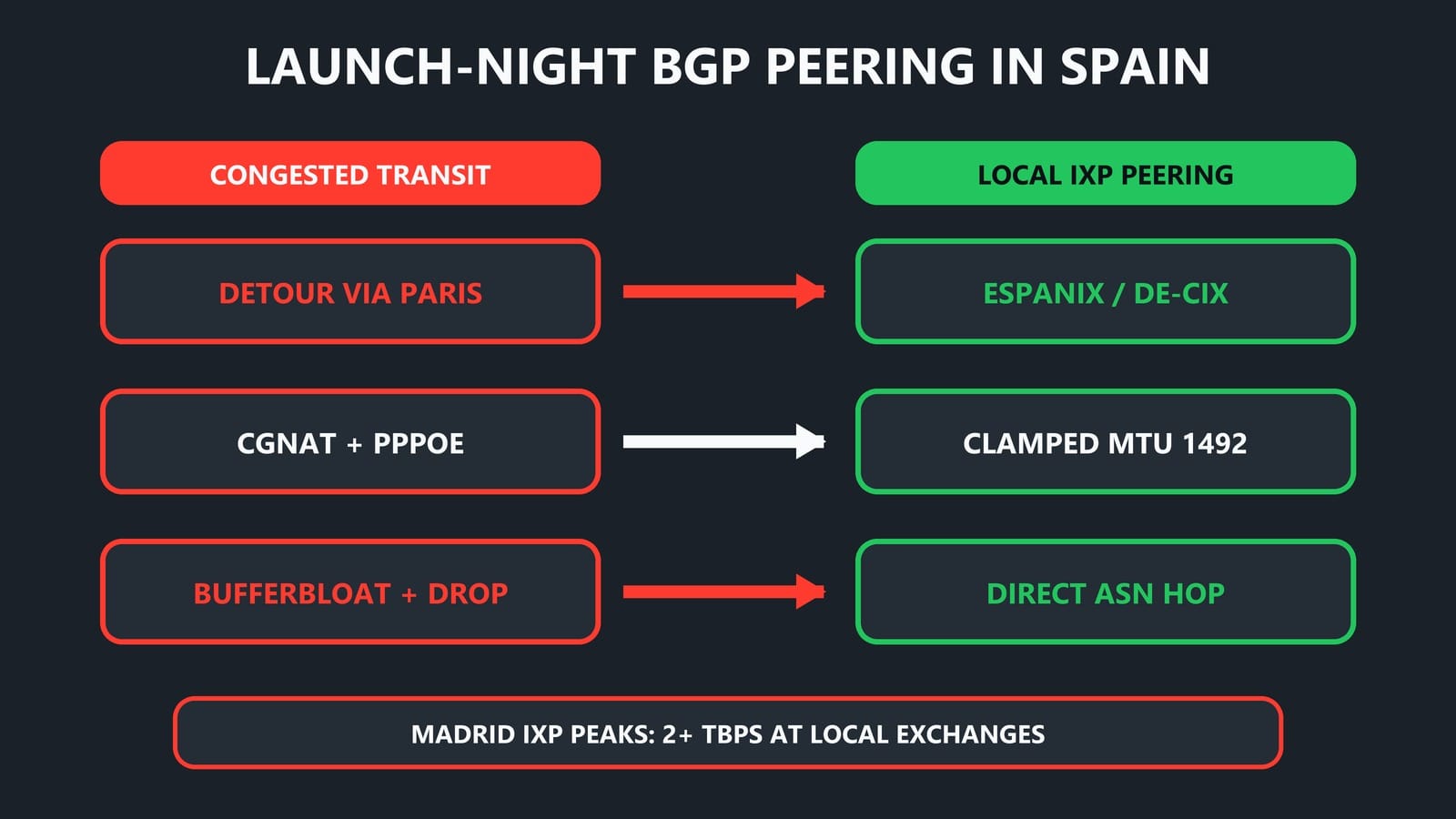
ESpanix & DE-CIX Madrid: Local Exchange Capacity vs Cross-Border Detours
Across Spain and Portugal, local Internet Exchange Points (IXPs) determine whether bulk CDN traffic stays inside Madrid or routes halfway across Western Europe:
- ESpanix, Spain’s primary neutral exchange connecting Madrid, Barcelona, and Portugal, routinely handles nightly switched peaks above 2 Tbps, detailed in its network infrastructure overview.
- DE-CIX Madrid has scaled through 1.36–1.4 Tbps evening traffic milestones according to telemetry reported by BandaAncha.
The difference between holding steady 900+ Mbps patch throughput at midnight versus plummeting to erratic speeds and +70 ms RTT spikes comes down to settlement-free peering vs congested paid transit. When ISPs maintain ample IXP port headroom and embed on-net CDN caches inside Madrid, packets traverse only a handful of hops. When peering ratios turn asymmetric and two ASNs postpone port upgrades, BGP falls back to cross-border transit through Paris, Frankfurt, or London — turning a local launch peak into international border congestion.
| Network Layer | Launch-Night Failure Mechanism | Symptom Users Blame on Servers | Engineering Fix |
|---|---|---|---|
| BGP / Transit Edges | Asymmetric peering disputes forcing Paris/Frankfurt detours | Throughput collapse + sudden 60–110 ms RTT jump | Wire Ethernet; local ISP DNS often pins closer on-net caches |
| CGNAT (RFC 6598) | Ephemeral port exhaustion across shared public IPv4 pools | PSN/Xbox auth timeouts or strict NAT party drops | Request unshared IPv4 or dual-stack IPv6 if available |
| PPPoE + FTTH VLAN | 1492-byte MTU without TCP MSS clamping on third-party routers | Stalled TLS entitlement handshakes during heavy bursts | Clamp TCP MSS to 1452 B (IPv4) / 1432 B (IPv6) |
| Router Bufferbloat | Unmanaged FIFO queues choking ACK traffic under load | Heavy latency spikes whenever another device updates | Cap shaper at 90–95% line rate with fq_codel or CAKE |
The Silent Last-Mile Drag: PPPoE MTU 1492, CGNAT & Bufferbloat
Even with pristine local peering in Madrid, home fiber stacks quietly stack overhead onto every packet:
- PPPoE Encapsulation (RFC 2516) over Tagged VLANs: major Spanish FTTH deployments add an 8-byte PPPoE header inside standard 1500-byte Ethernet frames, capping usable IP MTU at 1492 bytes (and lower still once WireGuard tunnels wrap around it). Running an aftermarket router without proper TCP MSS clamping causes silent Path MTU Discovery (
PMTUD) blackholes on large TLS records. You can inspect exact byte limits and wire efficiency with our MTU, MSS Clamping, PPPoE & WireGuard calculator. - CGNAT Port Starvation: sharing one IPv4 address across dozens of households limits concurrent NAT translations right when consoles, PC updaters, and voice servers spike simultaneously.
- Bufferbloat During Parallel Downloads: saturating a 1 Gbps download pipe fills oversized router buffers with queued frames, delaying tiny interactive ACK and UDP control packets unless Smart Queue Management (
fq_codel/CAKE) is enabled. Measure that impact directly in our ping, jitter & bufferbloat calculator, and revisit the CDN staging side in our breakdown of 210 GB Day-1 staggered console preloads.
Three Sanity Checks Before Midnight Peak Hour
- Bypass shared 5 GHz apartment Wi-Fi with Cat 6 Ethernet: neighbors pulling concurrent pre-loads saturate shared airtime long before your ONT laser hits capacity.
- Avoid overriding ISP resolvers blindly if your carrier hosts on-net caches: third-party Anycast resolvers lacking EDNS Client Subnet (
ECS) locality frequently steer CDN downloads out of country. - Verify router MSS clamping (1452/1432 B on PPPoE) once now: prevents stalled HTTPS/TLS unlocks right when authentication queues hit peak load.
What users write off as "the game servers are melting" frequently begins inside BGP routing tables before packets ever leave the city.
Credits: Syncroma Studio. Cover photo: fiber-optic cable drums and conduits (Wikimedia Commons, CC0); original editorial infographic by Syncroma Studio.
Sistemas reales, sin humo corporativo Real systems, zero corporate hype
Recibe los análisis a fondo sobre arquitectura, consumo de recursos y computación de bajo nivel directamente en tu bandeja de entrada. Get deep-dive software architecture, resource consumption metrics, and low-level computing essays delivered straight to your inbox.
Suscribirse a Syncroma Subscribe to Syncroma

