
(🇪🇸 Leer la versión en español aquí)
When tens of millions of households try to pull a single 210-gigabyte archive ahead of a synchronized midnight launch, a video game stops being entertainment news and becomes one of the largest stress tests residential broadband ISPs, IXPs, and CDN edges ever face.
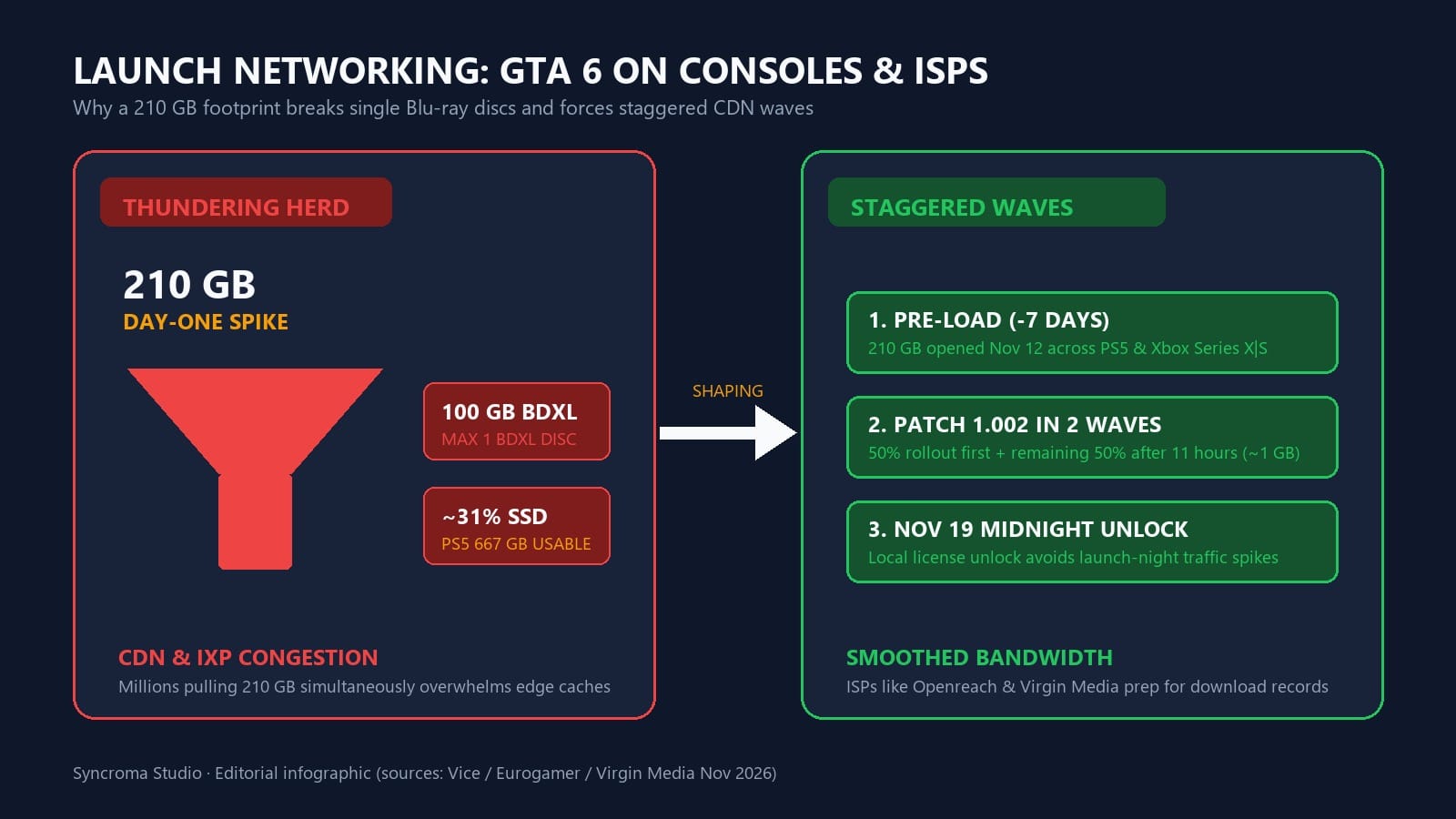
Less than a week ahead of Grand Theft Auto VI’s official global launch on Thursday, November 19, 2026 at midnight local time per Eurogamer, the PlayStation Store lists the game at around 210 GB on PS5, according to Virgin Media O2, with pre-loading opening on November 12. Then on November 13, VICE reported via PlayStation Game Size that Sony pushed day-one patch 01.002.000 (~1 GB) in two staggered buckets: the first 50% of users immediately, and the remaining 50% roughly 11 hours later.
Why split a ~1 GB patch six days before unlock? Because at global consumer scale, thundering-herd retry loops—not just raw byte volume—are what knock storefront metadata services and regional edge caches flat on launch week.
210 GB Meets Optical Physics and Console SSD Budgets
In living-room hardware, a 210 GB package collides with two hard physical limits that explain why digital pre-loading is mandatory even when physical editions sit on store shelves:
- The 100 GB BDXL ceiling: A triple-layer Ultra HD Blu-ray disc tops out at 100 GB. Shipping 210 GB purely on optical media means multi-disc pressing logistics or falling back to broadband downloads anyway.
- Nearly a third of a base console SSD: A standard PS5 ships with roughly 667 GB of usable storage after system formatting. One ~210 GB install immediately claims ~31.5% of the entire console drive before save states or future patches even arrive.
| Delivery Medium / Broadband Tier | Effective Throughput / Cap | Time for 210 GB (Sustained Estimate) | Bottleneck in Practice |
|---|---|---|---|
| Single BDXL Blu-ray Disc (3-layer) | 100 GB max capacity | Cannot fit on one disc | Forces multi-disc split or mandatory network pull |
| 100 Mbps Fiber (~90 Mbps net) | ~11.25 MB/s | ~5 hr 11 min | Sleep timers or crowded 2.4 GHz Wi-Fi drag this out further |
| 300 Mbps Fiber (~270 Mbps net) | ~33.75 MB/s | ~1 hr 44 min | Home Wi-Fi interference drops TCP window scaling vs Cat6 |
| 1 Gbps Fiber (~850 Mbps net) | ~106 MB/s | ~33 min | Moves bottleneck from ISP loop to CDN peering and SSD write queues |
You can model how latency and packet loss throttle sustained transfer speeds using our Data Transfer & TCP Bandwidth-Delay Product Calculator.
Why Telecom Engineers Tracked GTA 6 Months Ahead
To a national telecom network, a 210 GB console pre-load behaves nothing like streaming video. A 4K movie pulls 15–25 Mbps in short, periodic buffer chunks; a digital game pre-load pins a home router’s TCP/HTTP connection at 100% line rate continuously across entire city blocks.
As Eurogamer reported, Openreach network technology director Trevor Linney noted that "GTA 6 has been on our radar for a long time" and will be watched closely for a new download record. Both Sony and Microsoft have issued pointed advisories urging players to pre-load days ahead of release rather than waiting for November 19.
Three Distribution Lessons Every Systems Team Can Steal
Console storefront operators rely on the exact same traffic-shaping playbook enterprise SaaS and OTA firmware teams should use during massive binary rollouts:
- Decouple payload transfer from feature unlock: Shipping encrypted 210 GB assets seven days early turns release midnight on November 19 into a tiny local license-key verification instead of a simultaneous petabyte stampede.
- Stage even small patches in waves (
50%+11 hours): Phasing01.002.000lets CDN operators verify manifest integrity and smooth edge-cache warming before opening the floodgates to everyone else. - Wire the console before pre-loading: Above 300 Mbps, wireless retransmissions silently crush TCP throughput; plugging in Ethernet consistently cuts hours off multi-hundred-gigabyte pulls.
Waiting until launch night to hit download on 210 GB ignores basic network queuing math—even gigabit fiber slows down when every neighbor drains the same regional cache at midnight.
Infographic and analysis by Syncroma Studio. Cover photo: "InclusiveGameLab Person-with-PS5-Controller 6 CC-BY-SA" by InclusiveGameLab (CC BY-SA 4.0 via Wikimedia Commons).
Sistemas reales, sin humo corporativo Real systems, zero corporate hype
Recibe los análisis a fondo sobre arquitectura, consumo de recursos y computación de bajo nivel directamente en tu bandeja de entrada. Get deep-dive software architecture, resource consumption metrics, and low-level computing essays delivered straight to your inbox.
Suscribirse a Syncroma Subscribe to Syncroma

