
(🇪🇸 Leer la versión en español aquí)
Millions of enterprise websites drop third-party marketing and experimentation tags into production every day on blind trust: embed a CDN <script>, forget about it, ship conversions. On November 16–17, 2026, that blind trust blew up in the face of the global web with OPTIMJACK—a sprawling third-party supply chain compromise targeting Optimizely Web, investigated by StepSecurity, Report URI, and acknowledged on Optimizely's status page.
The verified blast radius reads like a Fortune 500 roll call: 178 breached organizations (188 out of 1,611 Optimizely snippets scanned by Scott Helme), spanning 32 banks and financial institutions, 23 tech & SaaS vendors, 20 retailers, 12 streaming giants, and 10 news networks—including CNN, BBC, Fox News, Zoom, Salesforce, GitLab, HSBC, IKEA, Air France-KLM, Equifax, Ledger, and Peacock, plus Optimizely's own domains.
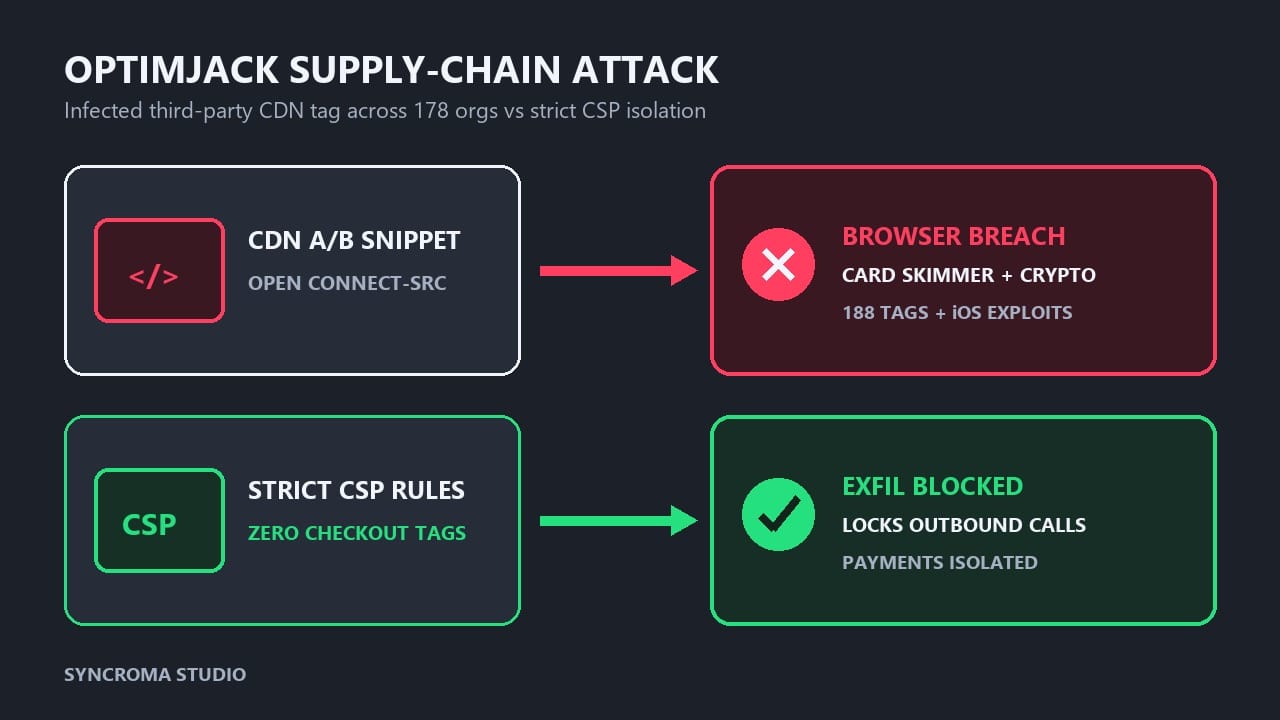
How Attackers Weaponized cdn.optimizely.com Without Breaching Any Victim Server
Hackers didn't have to pop Salesforce or BBC individually. According to Optimizely's confirmation and forensic breakdowns from StepSecurity and Report URI, attackers abused a flaw in Optimizely's account signup workflow to overwrite the Project JavaScript field inside live customer accounts—injecting a stealth loader pointing to 1688360[.]cc (plus a Base64-encoded obfuscated variant):
| Attack Layer | Browser Behavior on Victim Sites | Why Perimeter Defenses Missed It |
|---|---|---|
Signed delivery via cdn.optimizely.com |
Served with Optimizely's legitimate TLS cert | Explicitly allowlisted inside corporate script-src policies |
| Card skimmer & session hijacking | Hooks payment forms, cookies, and captures screenshots | Executes with unrestricted first-party DOM authority |
| Multi-chain crypto clipper | Swaps copied BTC, ETH & LTC wallet addresses on clipboard | Silently edits UI/clipboard contents mid-session |
Mobile exploit delivery (Coruna/DarkSword) |
Drops hidden iframes targeting iOS browsers | Blends directly into normal analytics/ad beacons |
While domain registrars suspended 1688360[.]cc early on November 17 UTC and Optimizely purged the injected scripts after the attackers swept their BTC/ETH/LTC wallets, the structural takeaway echoes what we just saw in the Cursor supply-chain breach via Fireworks AI: your effective attack surface is the weakest vendor holding script execution rights inside your users' browsers.
Three Production Fixes That Actually Stop the Next OPTIMJACK
- Strip marketing and A/B testing tags off login, wallet, and checkout routes: Zero conversion uplift justifies shipping mutable third-party JavaScript alongside passwords, JWTs, or credit-card fields.
- Lock down
connect-srcandframe-srcvia Content Security Policy (CSP): Because per-tenant A/B CDN snippets change dynamically across experiments, static Subresource Integrity (SRI) hashes break constantly. Lockingconnect-srcandframe-srcdown to strictly vetted first-party/API origins in CSP stops an injected script from beaconing stolen cards to rogue.ccor.icudomains even whencdn.optimizely.comis hijacked. - Keep client-side verification & personal security hygiene tight: Audit static deliverables offline with our private SHA-256 & HMAC checksum verifier, lock down crawler exposure via the private robots.txt & AI bot blocker generator, or compare sovereign T-Bills vs bank deposit net returns cleanly with our new Spain Treasury Bills vs Bank Deposits after-tax calculator.
Verdict
OPTIMJACK proves once and for all that adding an external vendor CDN to script-src hands full client-side admin privileges to an upstream compromise you can't patch yourself. Neither enterprise WAFs nor valid TLS badges protect end users when marketing platforms can deploy arbitrary Project JavaScript onto banking portals and checkout flows. Isolate sensitive routes completely, lock outbound connections in CSP, and treat every third-party script as untrusted code.
Visual credits: Cover photograph "Adult-coding-collaborate-1181472" via Wikimedia Commons (CC0 Public Domain). Infographic by Syncroma Studio.

Sistemas reales, sin humo corporativo Real systems, zero corporate hype
Recibe los análisis a fondo sobre arquitectura, consumo de recursos y computación de bajo nivel directamente en tu bandeja de entrada. Get deep-dive software architecture, resource consumption metrics, and low-level computing essays delivered straight to your inbox.
Suscribirse a Syncroma Subscribe to Syncroma

