
(🇪🇸 Leer la versión en español aquí)
What started on October 29 as a mysterious malicious extension inside Cursor just got a remarkably candid root-cause breakdown — and every software org piping developer sessions to cloud AI vendors should study it closely. On November 13, 2026, Cursor published its full security incident update explaining how an intruder moved from a single exposed third-party key all the way into poisoning cached builds of Anthropic's Claude Code extension (Anthropic.claude-code versions 2.1.312 and 2.1.313) for roughly 11 hours, potentially serving trojanized builds to up to 5,000 developers.
Strip away the PR wrapping and the timeline reveals a brutal systems lesson: none of the individual building blocks looked "production-critical" on paper, yet chaining them together handed attackers the keys to the extension cache.
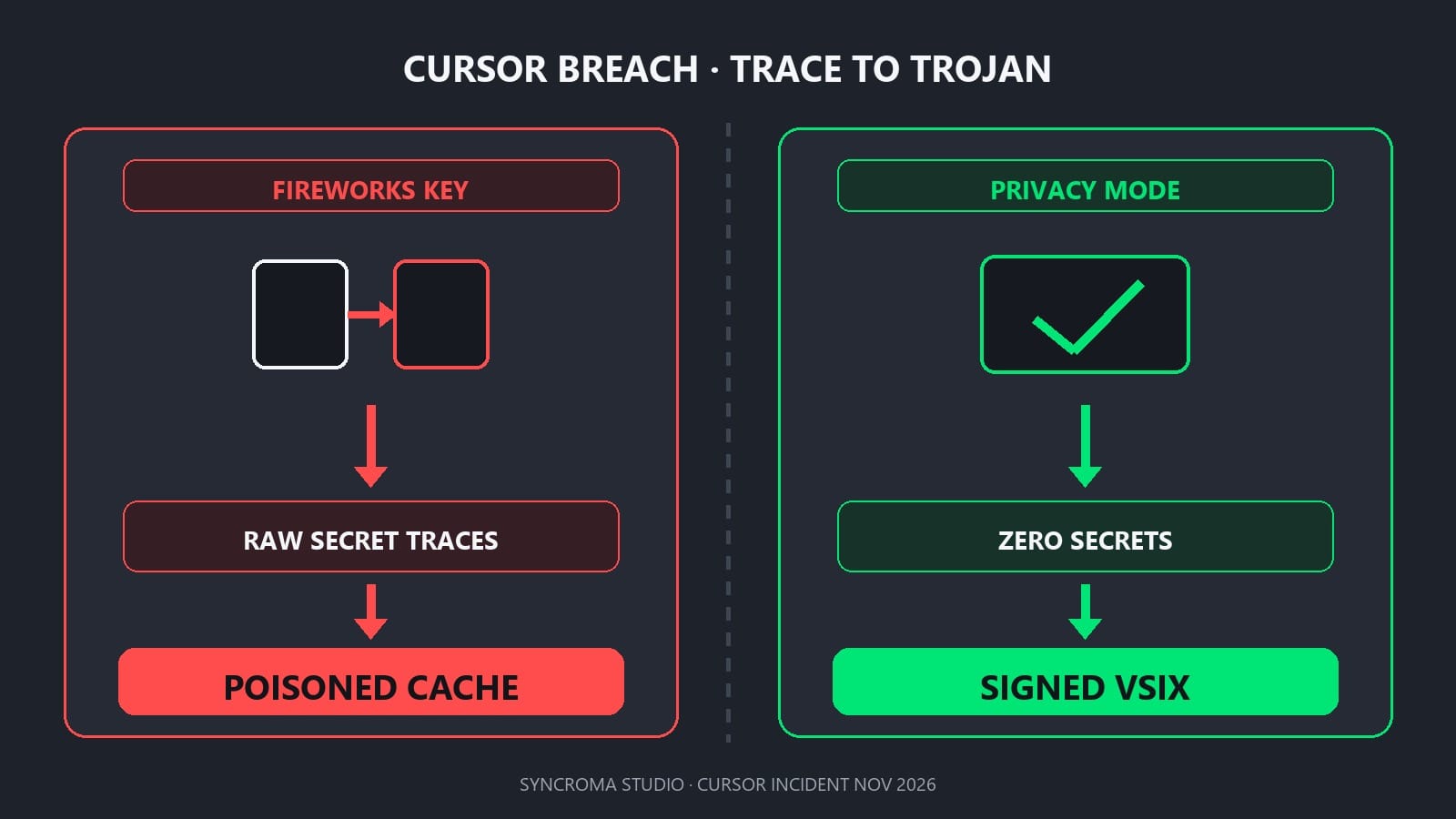
The Attack Chain: From a Vendor Bucket to Persistent SSH Attempts
Per Cursor's November 13 post-mortem and the original IOC advisory:
- Vendor key exposure at Fireworks: Attackers obtained an access key Cursor had issued to AI inference/training partner Fireworks, exposed on the vendor side.
- "Read-only" training traces carrying live secrets: That key read a shared bucket holding older coding-agent traces (mostly from 2025) logged outside Privacy Mode (impacting
<0.05%of users). A fraction (<0.01%of customers) contained unredacted API credentials sitting inside raw agent history. - Lateral pivot into internal SaaS & support logs: Using live credentials harvested from those traces, attackers accessed internal SaaS tools, archived non-production repos, support ticket threads (some holding keys customers pasted to support), and a credential capable of writing directly to Cursor's VS Code extension marketplace cache.
- Cache poisoning while upstream stayed clean: Neither Anthropic nor upstream Open VSX were breached. The attacker injected trojanized builds
2.1.312and2.1.313right into Cursor's serving cache (~2:27am PT to 1:35pm PT on Oct 29), attempting to exfiltrate host/user/IP/Git email/env-var names, write an attacker SSH key intoauthorized_keys, and spawn a 60-second reverse SSH loop via macOSLaunchAgentor Windows scheduled task (SYSTEM/startup script) before Cursor killed the cache and worked with cloud hosts to shut down the C2 server.
Three Classic Engineering Assumptions That Broke in Production
In its post-incident actions (detailed on Cursor Security), Cursor migrated inference off Fireworks, rotated internal secrets, rebuilt its marketplace, and expanded secret scanning. For engineering teams watching from the sidelines, three hard rules stand out:
| Common Assumption | How Reality Punished It | Non-Negotiable Architecture Fix |
|---|---|---|
| "It's just read-only training traces" | Agent telemetry captures diffs, .env snippets & terminal tokens |
Enforce Privacy Mode org-wide + deterministic secret scrubbing before disk/bucket write |
| "The upstream registry verifies packages" | Open VSX was clean; the attacker overwrote the serving cache layer | Validate end-to-end cryptographic VSIX signatures inside the editor client |
| "Devs only leaked low-risk metadata" | Support emails and trace dumps contained live third-party API secrets | Scrub secrets automatically before paste/prompt (try our Offline Log Anonymizer) |
And if you're hardening network boundaries cleanly in your browser with zero external tracking, try our new 128-bit IPv6 Subnetting & CIDR Prefix Calculator or explore the full Syncroma Tools Suite.
60-Second Checklist If Your Team Uses Cursor
- Audit endpoints touched on October 29 (2:27am–1:35pm PT): Check
authorized_keys, macOSLaunchAgententries, and Windows scheduled tasks per Cursor's remediation notice — uninstalling the extension alone does not scrub persistence. - Mandate zero-retention / Privacy Mode by policy for every commercial codebase so agent prompts and terminal stderr never land in shared vendor buckets.
- Never share unredacted credentials with support or AI chats: Treat every logged token as compromised the moment it leaves your machine.
Cover photo credit: Tirza van Dijk via Wikimedia Commons / Unsplash (CC0). Technical infographic by Syncroma Studio.
Sistemas reales, sin humo corporativo Real systems, zero corporate hype
Recibe los análisis a fondo sobre arquitectura, consumo de recursos y computación de bajo nivel directamente en tu bandeja de entrada. Get deep-dive software architecture, resource consumption metrics, and low-level computing essays delivered straight to your inbox.
Suscribirse a Syncroma Subscribe to Syncroma

