(🇪🇸 Leer la versión en español aquí)
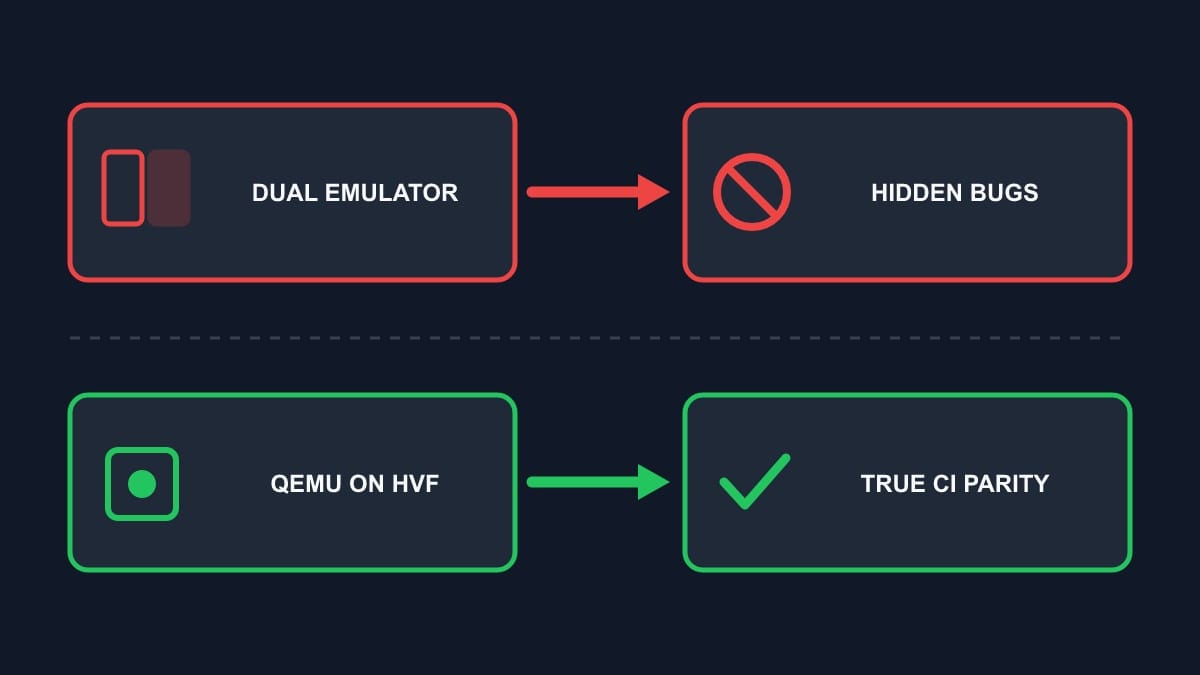
Anyone who has shipped non-phone Android platforms knows the silent tax of emulator fragmentation: app developers iterate on Apple Silicon MacBooks using lightweight Goldfish emulators, while platform teams and Linux CI pipelines validate with Cuttlefish booting the exact system images destined for real silicon. Inevitably, hardware-adjacent bugs hide in the fidelity gap between the two.
On November 13, 2026, Meta Reality Labs engineers Hadrien Zalek, Joe Knox, Alex Chong, and Marcel Apfelbaum revealed how they ported Cuttlefish and its QEMU backend natively to macOS on Apple Silicon, releasing both their maintained QEMU fork (qemu-wearables) and AOSP patch series (cuttlefish-wearables) targeting Android 16 (android-16.0.0_r1 / BP2A.250325.001).
Under the Hood: Breaking Cuttlefish's Hardcoded Linux Assumptions
On Linux, Cuttlefish normally pairs with crosvm on KVM. To bring identical virtual devices—complete with Bluetooth, Wi-Fi, cellular stacks, OTA tests, Fastboot, 3D graphics, and repeatable snapshots—to Apple arm64 laptops, Meta revived dormant QEMU support running on macOS Hypervisor.framework (HVF) and tore out three deeply embedded Linux-only bottlenecks:
| Subsystem | What Broke on macOS / Apple Silicon | Meta's Engineering Fix | Production Payoff |
|---|---|---|---|
vhost-user IPC |
Frontends, libvhost-user, and vhost-user-blk gated strictly to Linux |
Relaxed OS gates + leveraged vsock-user |
Passes Cuttlefish virtio backends natively to QEMU |
| HVF Memory Slots | QEMU's HVF backend tracked too few memory regions for big configs | Raised HVF tracked memory-region slot limits | Prevents boot failures on complex wearable images |
| Native Cocoa UI | Clunky WebRTC path; BGRA / input quirks on Apple Silicon | Native Cocoa display: BGRA fix, click-to-touch, -g, unstable rutabaga/gfxstream |
Snappy local display parity without browser overhead |
Darwin arm64 Build |
Missing macOS packaging, JIT, and signing setup | Darwin build targets, JIT entitlement, signing & notarization | Deployable across managed developer Mac fleets |
That push to keep heavy iteration local rather than bouncing everything through slow remote farms mirrors a broader 2026 engineering shift—whether evaluating unified workstation memory vs cloud or modeling break-even on local hardware in our Cloud Storage vs Home NAS TCO Calculator.
Read the Fine Print Before Ditching Your Test Lab
Meta's open-source release is serious systems engineering, not an instant one-click Android Studio toggle. Checking cuttlefish-wearables on GitHub surfaces three real caveats:
- Floating patch stack across 274 AOSP projects: You are not installing a finalized upstream Google binary yet. Building it requires syncing a reduced manifest of 274 repositories pinned around
android-16.0.0_r1and applying sequential patches viaapply.sh(git am --3way) while Meta works toward upstreaming commits to QEMU and AOSP. - Fork-first release with external PRs closed: Meta explicitly notes that the repository is shared as a fork plus patch series ("we do not accept pull requests at this time"), expecting teams to follow upstream contribution paths later.
- Platform-level scope: This shines for wearable OS engineers, embedded/AI-glasses builders, and autonomous coding agents needing rapid snapshot resets with CI parity—overkill if you only test standard Play Store APKs.
Ground-Level Verdict
Unboxing vhost-user from Linux-only build gates and fixing QEMU's HVF memory-slot ceiling proves you no longer need a split-brain emulator stack just because developers prefer Apple Silicon laptops while CI lives on Linux. As automated AI coding and testing agents increasingly execute against virtual hardware snapshots rather than scarce desk prototypes, unifying dev laptops and CI onto a single high-fidelity Cuttlefish stack removes an entire class of "works on my Mac emulator" surprises. Explore more infrastructure and hardware sizing tools at Syncroma Tools.
Visual Credits: Editorial photograph and localized technical infographic by Syncroma Studio.
Sistemas reales, sin humo corporativo Real systems, zero corporate hype
Recibe los análisis a fondo sobre arquitectura, consumo de recursos y computación de bajo nivel directamente en tu bandeja de entrada. Get deep-dive software architecture, resource consumption metrics, and low-level computing essays delivered straight to your inbox.
Suscribirse a Syncroma Subscribe to Syncroma

