Leer la versión en español aquí
The LinkedIn Hype vs. Silicon Physics
Tech feeds this week have been flooded with the exact same breathless headline: Lisa Su announced at the AMD CES 2025 Keynote that the future of AI isn't in the cloud—it's on your desk. The marketing pitch: a compact workstation capable of running models with up to 200 billion parameters locally, powered by 128GB of unified memory.
It sounds like developer nirvana: cancel your OpenAI team plans, tear down your AWS GPU clusters, and run a completely sovereign AI powerhouse inside an aluminum box sitting quietly under your monitor.
On paper, the spec sheet of the new AMD Ryzen AI Max+ 395 (Strix Halo) is undeniably impressive: 16 Zen 5 cores, an integrated RDNA 3.5 GPU with 40 Compute Units (matching a mobile discrete RTX 4070), a wide 256-bit memory bus, and up to 128GB of shared LPDDR5X memory, of which you can dynamically allocate up to 96GB directly to graphics via Variable Graphics Memory (VGM).
Yet in systems engineering, between corporate marketing and production reality lies an unforgiving physical roadblock: the Memory-Wall.
Before you budget three grand on this hardware to run a local 200B monster and fire your cloud providers, let's examine the underlying math.
The Capacity Trap: Fitting in RAM Doesn't Mean It’s Usable
When running Large Language Models (LLMs) on local silicon, developers frequently conflate two completely independent variables:
- Capacity (VRAM / RAM in GB): Does the serialized model weights file fit inside system memory?
- Memory Bandwidth (GB/s): How fast can the memory bus stream those gigabytes into compute cores to generate each successive token?
Fitting a massive 200-billion-parameter model into 128GB of unified memory is mathematically trivial. If you download an open-weights model like Qwen 2.5 or Command R+ and crush it down with 4-bit quantization using llama.cpp's GGUF format, the footprint lands between 95GB and 105GB. It fits within AMD's 128GB envelope with 20GB of headroom left over for the OS and application buffers.
The real engineering question isn't whether it fits. It is: how fast does it generate tokens?
The Invariable Ingestion Equation
During the autoregressive generation phase of an LLM (streaming the answer one token at a time), inference is strictly memory-bandwidth bound, not compute bound.
As researcher Tim Dettmers detailed in his analysis on Deep Learning GPU Architecture, to generate a single token, the processor must read every single parameter weight from RAM and pass it through the matrix engines. There are no caching shortcuts around foundation model weights during generation.
The theoretical generation ceiling is governed by an unyielding formula:
$$\text{Generation Speed (tokens/sec)} \approx \frac{\text{Memory Bandwidth (GB/s)}}{\text{Model Size in RAM (GB)}}$$
Let's look at the cold accounting on AMD Strix Halo's memory subsystem:
- Strix Halo utilizes a 256-bit wide bus running LPDDR5X at 8,000 MT/s.
- Peak theoretical throughput lands at 273 GB/s.
Now calculate the speed of running that 200B INT4 model (100GB in memory):
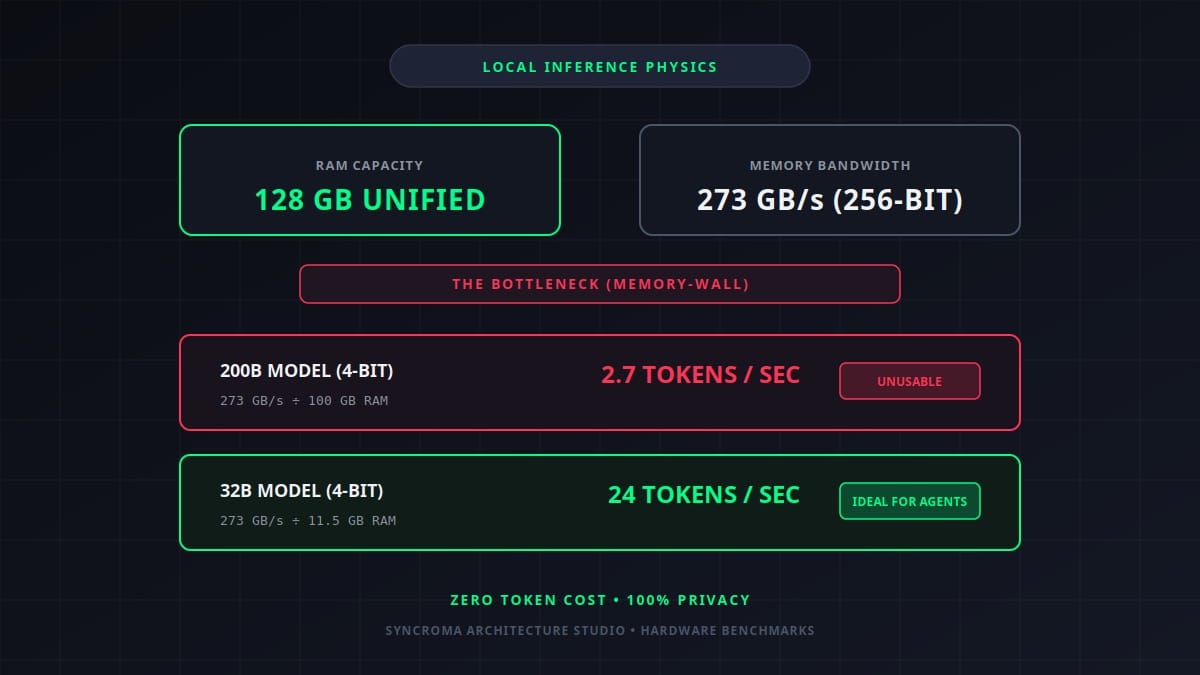
$$\text{Speed} \approx \frac{273 \text{ GB/s}}{100 \text{ GB}} \approx \mathbf{2.73 \text{ tokens per second}}$$
2.7 tokens per second.
That is not an interactive software engineering tool. That is watching paint dry. A developer skimming documentation reads at 5 to 8 words per second. An autonomous coding agent outputting an 800-line Python module would take nearly five minutes to return a single function call. In real-world developer workflows, a 200B model on this architecture is an unmitigated productivity failure.
The Production Hardware Landscape
To understand where AMD's new APU truly sits in the silicon ecosystem, we must compare unified memory bandwidth across consumer and workstation architectures:
| Hardware Platform | Max Memory | Memory Bandwidth | 70B Model Speed (INT4) | 32B Model Speed (INT4) |
|---|---|---|---|---|
| Nvidia GeForce RTX 4090 | 24 GB (GDDR6X) | 1,008 GB/s | OOM (Exceeds VRAM) | OOM (Exceeds VRAM) |
| Apple M4 Max | 128 GB (LPDDR5X) | 546 GB/s | ~15 tokens/sec | ~47 tokens/sec |
| Apple M2 Ultra | 192 GB (LPDDR5X) | 800 GB/s | ~22 tokens/sec | ~69 tokens/sec |
| AMD Ryzen AI Max+ 395 | 128 GB (LPDDR5X) | 273 GB/s | ~7.8 tokens/sec | ~24 tokens/sec |
Nvidia delivers blistering memory bandwidth (over 1,000 GB/s), but traps developers behind a commercial ceiling: 24GB of VRAM on consumer flagships. Breaking past 24GB in Team Green's ecosystem requires buying enterprise A100s or H100s for $30,000 or renting cloud instances by the hour.
Apple solved the VRAM bottleneck with unified memory architectures, but extracts a massive price premium on RAM upgrades and locks engineers into macOS, where ROCm and custom CUDA-compatible kernels remain a porting hurdle.
The True Revolution: The 14B–32B Parameter Sweet Spot
Does the memory bandwidth reality make AMD's Strix Halo a failure? Far from it: it is a massive breakthrough for open-source development.
Marketing executives invariably anchor on the wrong number (200B) to impress non-technical audiences. The genuine disruption of the Ryzen AI Max+ 395 lies in medium-sized foundation models between 14B and 32B parameters (such as Qwen 2.5 32B or Llama 3.3 70B).
Consider running an INT4 quantized 32B model (consuming roughly 11.5GB of RAM):
$$\text{Speed} \approx \frac{273 \text{ GB/s}}{11.5 \text{ GB}} \approx \mathbf{23.7 \text{ tokens per second}}$$
At 24 tokens per second, local generation flies. And this is where the economics of software development fundamentally shift:
- Infinite Agent Loops with Zero Marginal Cost: Autonomous development tools like Aider or Claude Code loop recursively through multi-turn tool calling: reading 40 files, running a test suite, catching an error, and executing 80 shell commands. On commercial cloud APIs, a 3-hour debugging run routinely burns $20 to $40 in token credits. On local silicon, it costs 3 cents of wall-socket electricity.
- Absolute Data Sovereignty: Proprietary source code, customer databases, clinical records, and financial statements never traverse a public network. Zero compliance friction under GDPR, and zero risk of your IP leaking into an external provider’s training corpus.
- Zero Rate-Limiting (HTTP 429): No more Monday-morning API outages or token-per-minute throttling when commercial cloud platforms suffer infrastructure degradation.
The Verdict
AMD's Strix Halo is a masterful strategic stroke: it dismantles Apple's monopoly on high-capacity unified memory and opens the open-source x86 Linux ecosystem to serious local AI without begging Nvidia for VRAM scraps.
Just don't buy into the marketing brochure: you are not going to run an interactive 200B model on your desk with 273 GB/s of memory bandwidth.
The future of local AI isn't running bloated, glacier-slow mega-models on a single socket. The future is running lean, razor-sharp 14B to 32B models at 25+ tokens per second—powering autonomous agentic loops with zero token tax and complete data sovereignty.
For that workload, this silicon changes the game completely.
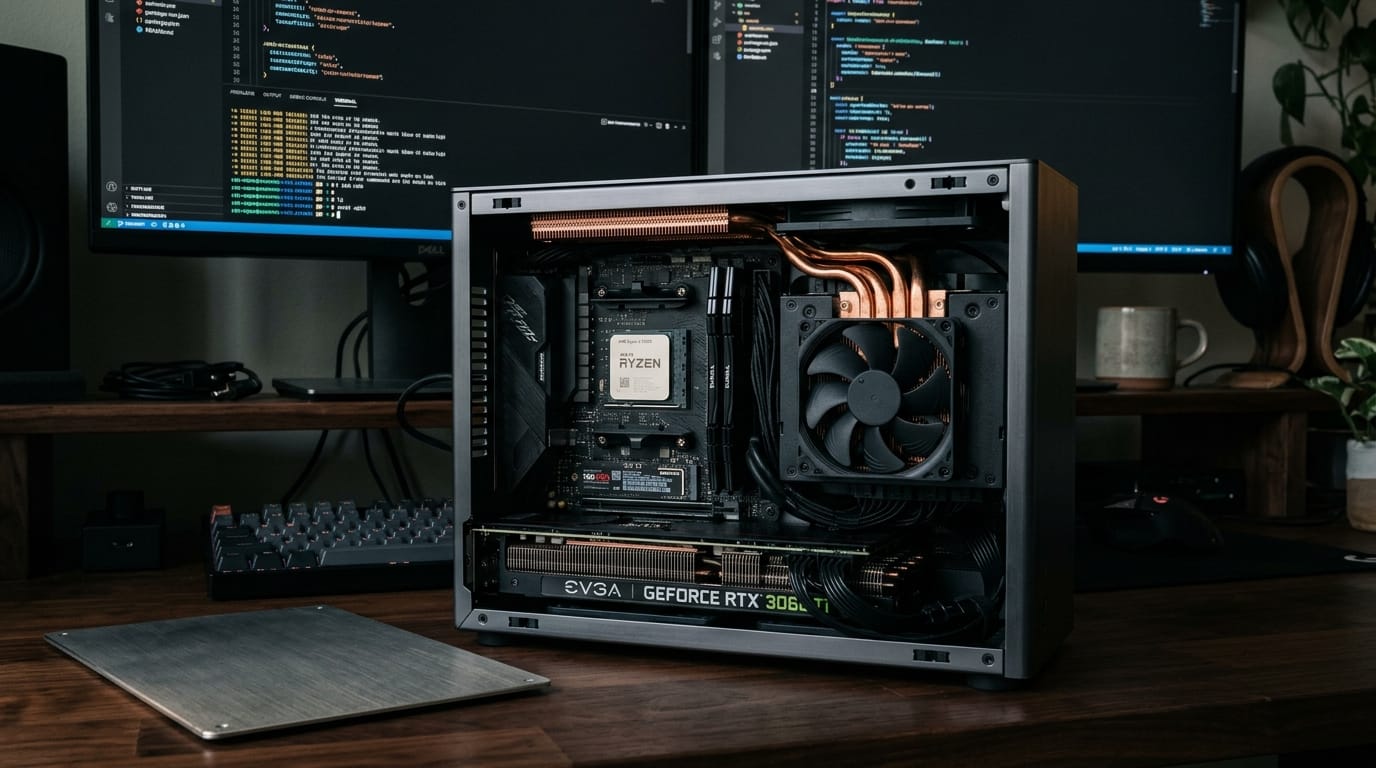
Visual Credits: Industrial aluminum chassis and silicon photography by Syncroma Studio. Minimalist 2D conceptual infographic by Syncroma Studio.
Sistemas reales, sin humo corporativo Real systems, zero corporate hype
Recibe los análisis a fondo sobre arquitectura, consumo de recursos y computación de bajo nivel directamente en tu bandeja de entrada. Get deep-dive software architecture, resource consumption metrics, and low-level computing essays delivered straight to your inbox.
Suscribirse a Syncroma Subscribe to Syncroma

