(🇪🇸 Leer la versión en español aquí)
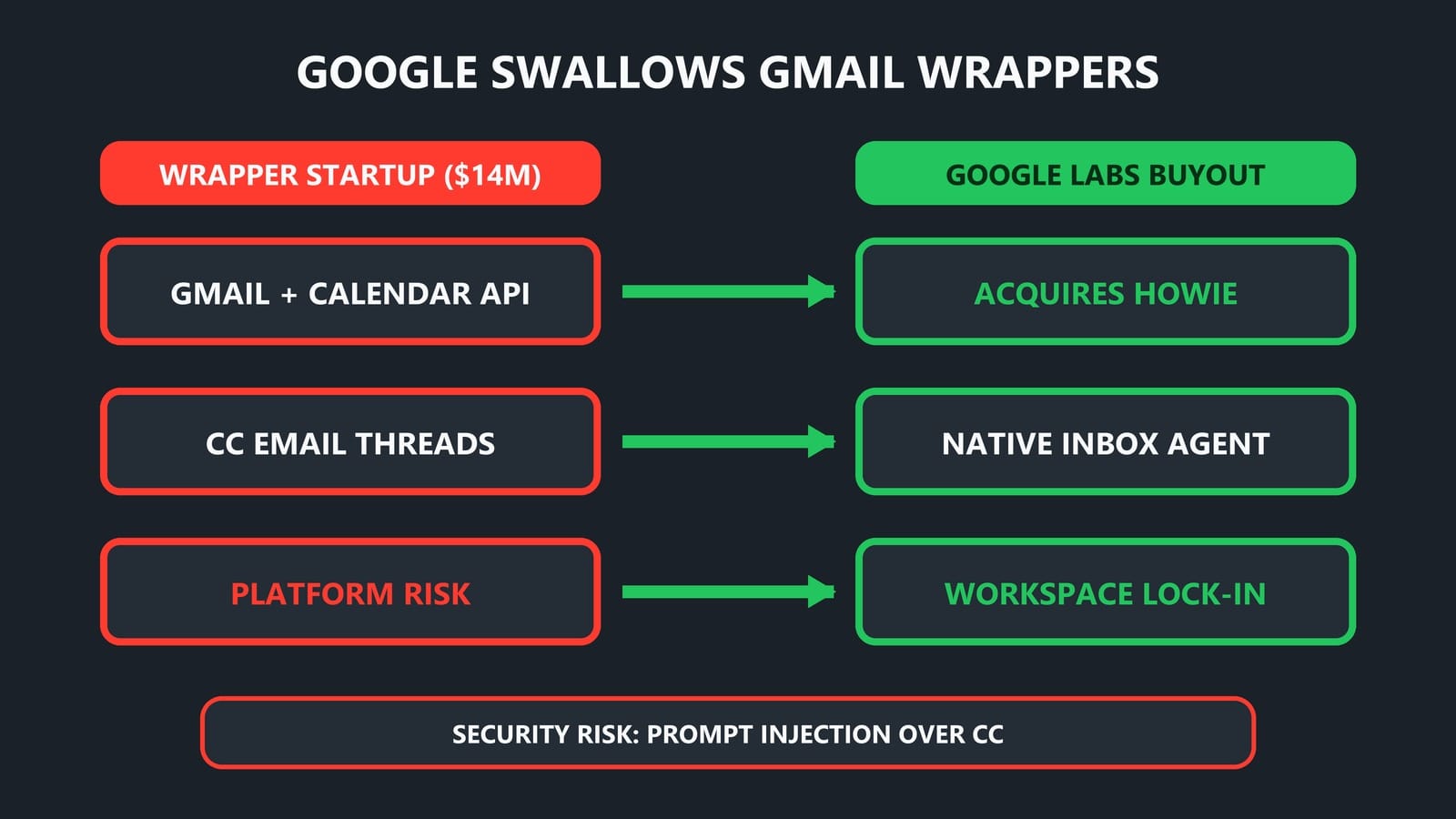
Looping an AI bot onto a Gmail thread via CC so it negotiates meeting slots on your behalf feels slick right up until you ask where the state actually lives. Google just confirmed the acquisition of Howie, the Seattle-based startup co-founded by Austin Petersmith and Dave Newman whose product let users treat an AI assistant like a human executive coordinator right inside ordinary email chains, checking calendars, resolving time-zone conflicts, and enforcing scheduling preferences, as reported by GeekWire.
Financial terms were kept under wraps according to The Next Web, though GeekWire notes the startup had previously raised a $6 million seed round, and Investing.com reports the team is folding into Google Labs — Alphabet’s experimental product arm — while continuing to support current users and expand SMB-focused automation workflows cited by PYMNTS.
Strip away the upbeat small-business press copy and you are left with the single harshest architectural lesson in AI product engineering: if your core product sits on top of Gmail and Google Calendar OAuth tokens with no proprietary infrastructure or distribution moat, you are not building a fortress — you are running investor-funded UX R&D for the platform owner.
The Structural Trap of Inbox & Calendar API Wrappers
From a systems perspective, a CC howie@ scheduling loop is clean to prototype and brutal to defend at scale:
- Webhook / SMTP thread ingestion: every reply on an active thread pulls full RFC 5322 headers, quoted HTML chains, corporate signatures, and messy relative time expressions into context.
- External Calendar graph lookups: availability checks hit Google Calendar or Microsoft Graph APIs via broad OAuth grants reading attendee metadata and free/busy slots across organizations.
- LLM state reconciliation: long email chains bloat prompt token volume on every turn, driving up marginal inference cost and tail latency (P95) while waiting on round-trip email parsing and draft generation.
The issue is never whether the code works cleanly. The issue is that Alphabet already owns the canonical mail graph, server-side timezone resolution, Workspace billing relationship, and internal TPU capacity — without paying third-party token markups or surviving restricted Gmail API verification audits every few months. We already tracked how Google is pulling standalone automations inward in our breakdown of Google Gemini Spark Tasks limits and architecture.
| Architectural Dimension | Email-CC Wrapper Startup | Native Google Labs / Workspace Agent |
|---|---|---|
| Mailbox & Calendar Access | External OAuth tokens subject to strict scope audits | First-party RPC access inside Google infrastructure |
| Context Window Coverage | Limited to threads where users remember to CC the bot |
Full consented Workspace context across mail, calendar, Drive |
| Marginal Inference Unit Cost | Commercial model API calls + polling/webhook pipeline | Amortized internal inference without external API markup |
| Platform Survival Risk | One native sidebar feature wipes out standalone acquisition | Team absorbed into native stack; standalone roadmap sunsets |
The Quiet Security Nightmare: OAuth Sprawl & Indirect Prompt Injection Over CC
Business risk aside, CC-triggered email agents inherit one of the nastiest untrusted-input boundaries in modern software. The moment an autonomous calendar assistant sits on an email chain with outside vendors, leads, or random senders, an external adversary can embed untrusted instructions inside quoted HTML blocks, hidden styling, or zero-width Unicode sequences (indirect prompt injection).
Left unguarded, tricked email agents can leak executive availability patterns, overwrite invitations, or fire off social-engineered replies from a legitimate corporate thread. Whenever engineers test untrusted snippets, email payloads, or AI-generated copy before pasting them downstream, stripping hidden control codepoints and HTML entities offline with tools like our invisible AI watermark & Unicode cleaner or client-side PII & log anonymizer prevents silent payload leakage.
Pulling Howie inside Google Labs makes architectural and security sense too: native Workspace agents can sit directly behind enterprise DLP policies, centralized IAM boundaries, and first-party abuse filtering instead of handing broad read/write OAuth scopes to external startups.
Three Concrete Takeaways for Engineering Teams & Founders
- Audit
gmail.modifyand full Calendar OAuth grants today: whenever a lightweight productivity SaaS gets acquired, data-retention boundaries, subprocessors, and roadmap priorities shift overnight. - Never wire untrusted inbound email straight into write-capable calendar tools without explicit user confirmation: separate read-only slot proposals from state-mutating API commits behind deterministic auth checks.
- Stop building standalone products whose entire state fits inside someone else's inbox: if Gmail can absorb your flagship UX with one native agent toggle, your ceiling is either an acqui-hire exit or quiet churn.
Google did not acquire Howie because Mountain View couldn't parse dates or call the Calendar API. It bought Howie because the real 2026–2027 AI interface battle isn't a separate chatbot tab — it is owning the daily operational inbox before anyone else does.
Credits: Syncroma Studio. Cover photo: Google Mountain View campus Building 43 by Ashstar01 (CC BY-SA 3.0) via Wikimedia Commons; original editorial infographic by Syncroma Studio.
Sistemas reales, sin humo corporativo Real systems, zero corporate hype
Recibe los análisis a fondo sobre arquitectura, consumo de recursos y computación de bajo nivel directamente en tu bandeja de entrada. Get deep-dive software architecture, resource consumption metrics, and low-level computing essays delivered straight to your inbox.
Suscribirse a Syncroma Subscribe to Syncroma

