
(🇪🇸 Leer la versión en español aquí)
At first glance, today's AI headlines sound generous: Google is opening up its autonomous personal AI agent to free-tier Gemini users. Read past the headline into the actual deployment rules, however, and three hard walls appear immediately: Gemini Spark has been rebranded to Tasks, free access is gated behind dynamic 5-hour rolling compute windows, and the European Union and UK remain completely excluded.
As outlined on the official Google Blog and detailed by ZDNet and Android Central, Tasks runs on Gemini 4 Hydrogen inside hardware-isolated virtual machines on Google Cloud's Agent Compute Engine—executing multi-step chores like grocery orders, utility-bill audits, booking appointments, and background phone calls in the US.
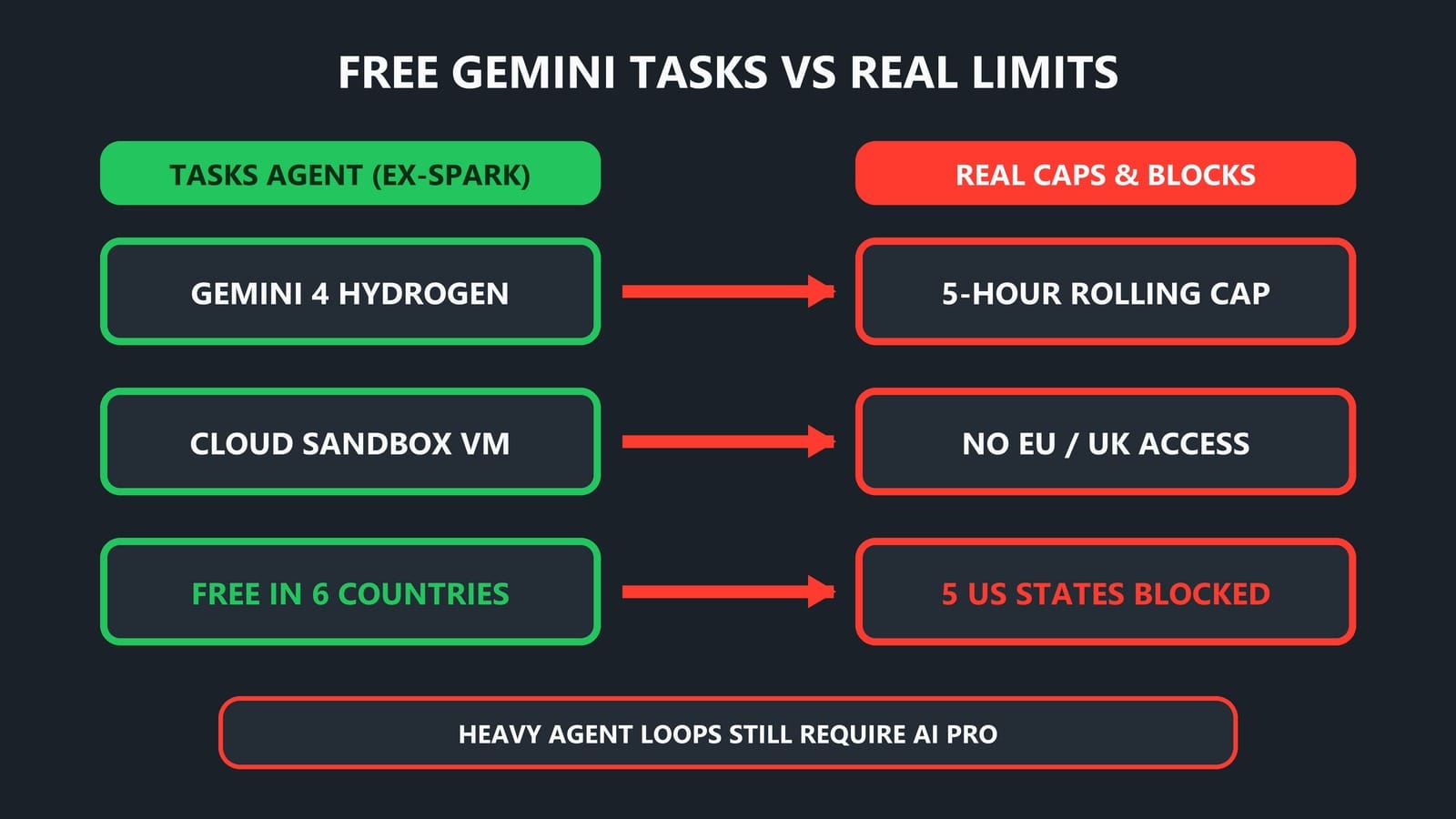
Free Tier Marketing vs. Real Infrastructure Limits
Running an autonomous agent inside a cloud VM costs an order of magnitude more than streaming a 500-token chat answer—which explains every cap baked into the rollout:
| Service Layer | Headline Pitch | Real Production Constraint (Nov 2026) |
|---|---|---|
| Underlying Engine | Autonomous Gemini 4 Hydrogen personal agent | Isolated per-session VM sandbox (Google Cloud Agent Compute Engine) |
| Free Country List | "Now available on free accounts" | Only 6 countries: US, Canada, South Korea, Japan, Australia & India (EU/UK omitted) |
| Session & Quota Limits | Toggle directly in standard Gemini chat | 5-hour rolling compute windows + weekly caps; multi-step loops exhaust free quota fast |
| AI Phone Calling | Calls local businesses for you (US) | Legally blocked across 5 US states: Indiana, Louisiana, Minnesota, Montana & Nebraska |
| Power-User Path | Full daily automation workflows | Still pushes heavy users onto Google AI Pro ($19.99+/mo) or AI Ultra |
Think about why Google limits free tasks to rolling 5-hour compute windows: a text answer returns in two seconds and frees the TPU slice immediately, whereas an agent spinning up an isolated cloud sandbox, parsing utility PDFs, navigating checkouts, and retrying DOM clicks holds compute and long-context memory open for minutes at a time (echoing the cost structure we analyzed in Gemini 4 Hydrogen's reasoning pricing).
Don't Upload Private Financial Docs Just for Basic Math
- Keep sensitive financial & utility numbers off cloud VMs: Google markets Tasks heavily around auditing personal utility bills and financial decisions. You don't need a remote VM ingesting your bank statements just to run clean amortization math—test revolving APR traps privately in your own browser via our Credit Card Minimum Payment & Revolving APR Calculator or model tariff changes in our Electric Bill Rate Simulator.
- Builders: measure multi-step token loops before copying the hype: If you build custom agent pipelines on API rather than consumer toggles, price long-context cache reuse first with our LLM Token Cost & Prompt Caching Calculator and scrub PII locally via our Private Offline PII Anonymizer.
Bottom Line
Rebranding Spark to Tasks with a free teaser quota across six countries is a classic top-of-funnel play for Google AI Pro ($19.99+/mo). Once an autonomous workflow spins up a real cloud sandbox VM and hits complex multi-step actions, 5-hour rolling caps quickly remind users of 2026's iron law of AI: deterministic chat is cheap; spinning up cloud VMs on your behalf never is.
Technical analysis infographics by Syncroma Studio. Editorial cover photograph via Wikimedia Commons (SimonWaldherr, CC BY-SA 4.0).

Sistemas reales, sin humo corporativo Real systems, zero corporate hype
Recibe los análisis a fondo sobre arquitectura, consumo de recursos y computación de bajo nivel directamente en tu bandeja de entrada. Get deep-dive software architecture, resource consumption metrics, and low-level computing essays delivered straight to your inbox.
Suscribirse a Syncroma Subscribe to Syncroma

