(🇪🇸 Leer la versión en español aquí)
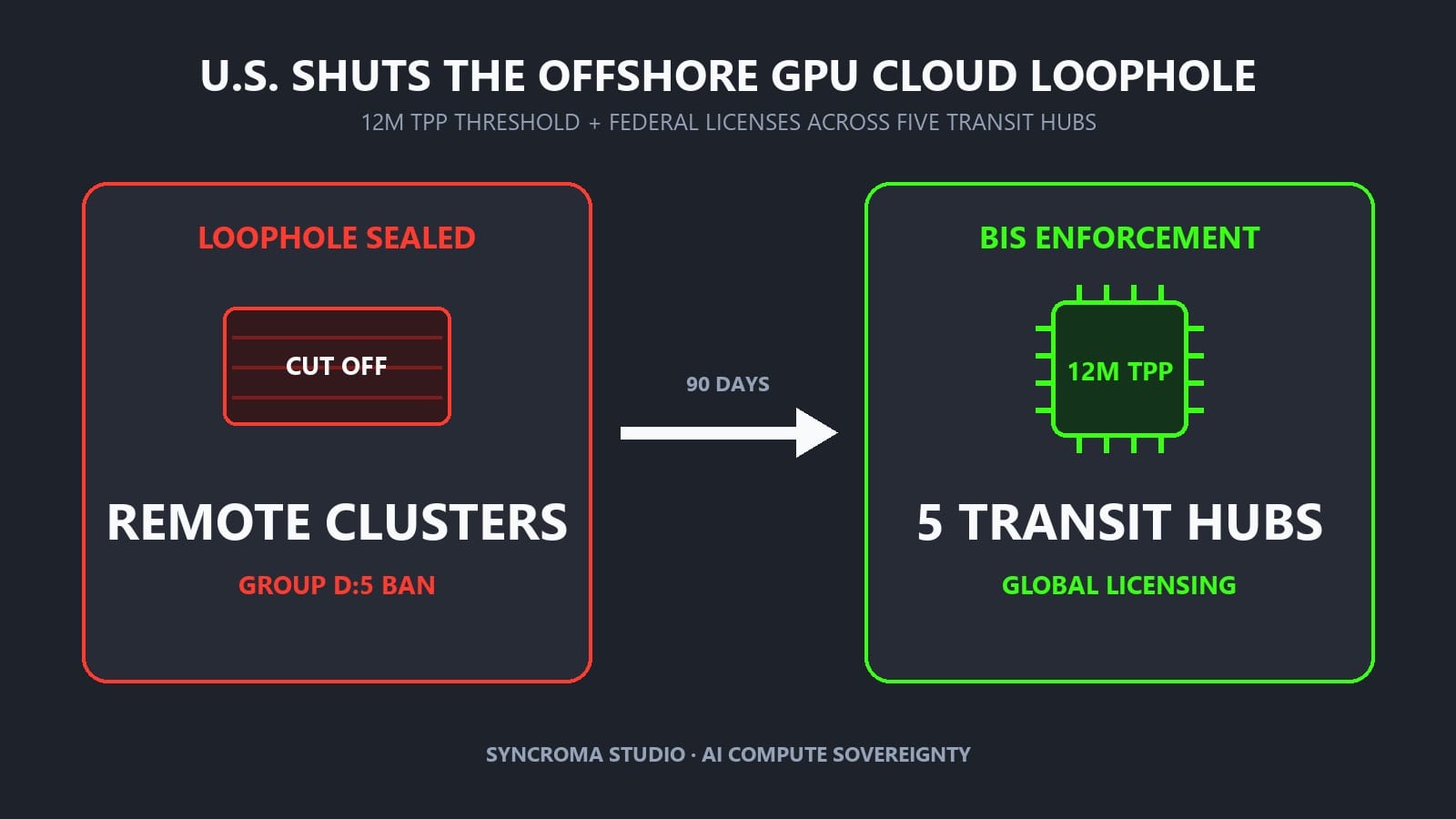
Until this week, U.S. semiconductor export bans carried a glaring architectural backdoor: if Washington wouldn't let restricted labs ship Nvidia racks inside China, those labs could simply rent SSH terminals and inference APIs running on the exact same GPUs inside foreign cloud data centers. That backdoor just slammed shut. As confirmed by TechCrunch and CyberScoop, the U.S. Commerce Department's Bureau of Industry and Security (BIS) issued an interim final rule requiring global federal licenses whenever AI hardware transferred abroad could supply remote compute to entities headquartered in Country Group D:5—including China, Russia, Iran, and North Korea.
Formulated at the direct instruction of the U.S. Treasury and National Security Council, the rule attaches hard aggregate compute thresholds and compliance deadlines directly to international data center racks.
What BIS Actually Mandates for Overseas GPU Providers
For cloud builders and colocation hosts operating anywhere outside the United States, export jurisdiction now follows the silicon even when compute is sold purely over HTTPS or SSH:
| Rule Parameter | Trigger / Mandate | Practical Infra Consequence |
|---|---|---|
| Compute Threshold | Facilities exceeding 12 million TPP (Total Processing Performance) | Hits medium-to-large clusters packing hundreds of flagship GPUs |
| Compliance Runway | 90-day grace period for existing overseas data centers | Forces tenant KYC audits and offboarding of Group D:5 accounts |
| Five Tracked Transit Hubs | Strict chip export licenses for Malaysia, Singapore, Thailand, Indonesia & Brazil | Blocks diversion routes unless vetted U.S.-headquartered buyers maintain tracking |
| Remote Cloud Enforcement | Covers exports, reexports & remote compute access | Kills offshore shell-company GPU rental proxies targeting Nvidia hardware |
This clampdown lands in a week when top Chinese labs are already locking down flagship checkpoints behind proprietary walls—witness Alibaba shipping Qwen4-Max (2.4T) strictly closed behind managed cloud APIs.
Why Global Neoclouds and Dev Teams Feel the Blast Radius
Even if your engineering org sits cleanly in Europe, North America, or Latin America, turning every 12M-TPP data center into a customs checkpoint brings immediate operational friction:
- No more frictionless GPU spin-up: Bare-metal neoclouds in transit hubs or global colos will have to verify beneficial ownership and enforce strict tenant screening just to stay eligible for U.S. chip allocations, slowing down anonymous credit-card cluster provisioning.
- Audit real infrastructure unit economics: With compliance overhead rising on offshore GPU rentals across hubs like Singapore and Brazil, engineering buyers need tighter visibility into local electricity, PUE, and capex vs. managed APIs—model exact racks with our GPU cluster power, PUE & TCO calculator and AI API vs. GPU cost calculator.
- Lock down your own crawl surface: While states fight over remote FLOP access, website operators can at least control which AI training spiders ingest their documentation using our new private robots.txt AI crawler blocker & RFC 9309 tester.
Verdict
Shutting the offshore AI compute loophole turns every global data center above 12M TPP into an export-compliance gatekeeper. It cuts off easy workaround rentals across Southeast Asia and Brazil for restricted Group D:5 firms, gives existing providers 90 days to clean up tenant registries, and makes hardware supply-chain sovereignty a permanent line item in every non-U.S. AI architecture review going into 2027.
Visual Credit: U.S. Department of Commerce headquarters cover photo adapted from "Herbert C. Hoover Building" by APK (Wikimedia Commons, CC BY-SA 4.0). Infographic created by Syncroma Studio.

Sistemas reales, sin humo corporativo Real systems, zero corporate hype
Recibe los análisis a fondo sobre arquitectura, consumo de recursos y computación de bajo nivel directamente en tu bandeja de entrada. Get deep-dive software architecture, resource consumption metrics, and low-level computing essays delivered straight to your inbox.
Suscribirse a Syncroma Subscribe to Syncroma

