(🇪🇸 Leer la versión en español aquí)
Alibaba just dropped a major pricing and architecture salvo into the frontier model race with Qwen4-Max. On the spec sheet, the engineering looks formidable: a 2.4 trillion parameter Mixture-of-Experts (MoE) architecture activating roughly 70B–71B parameters per token, a 1-million-token context window, native multimodal input across text, image, and video, and API rates aimed directly at undercutting OpenAI and Anthropic.
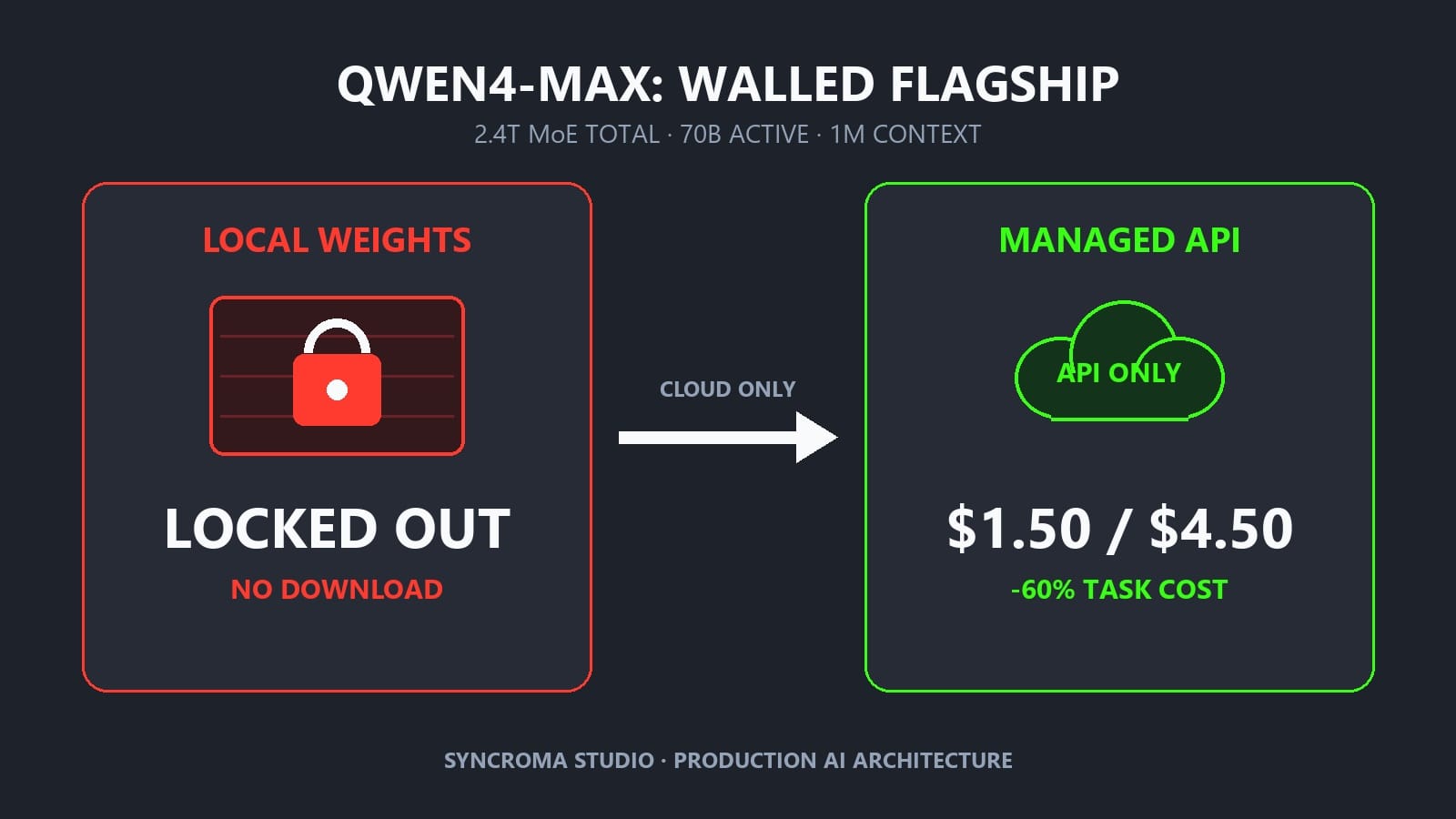
Before celebrating on engineering Slack channels, look closely at the deployment catch: the 2.4T flagship ships strictly as a closed-weight, cloud-only endpoint. If your infra roadmap assumed downloadable checkpoints on day one, that safety net is gone for the top tier.
Inside the 2.4T MoE + 328B N-gram Engineering Shift
Architecturally, Alibaba is tackling the two worst killers of agentic production budgets: bloated reasoning loops and idle dense compute. Per technical details shared in the official Qwen4-Max announcement and breakdown reports from BigGo Finance, the MoE backbone pairs sparse expert routing with 328 billion N-gram embedding parameters, offloading repetitive syntax and boilerplate lookup without burning full layer FLOPs.
Independent hands-on testing from MindStudio's Qwen4-Max review showed the model catching subtle boundary bugs—like a < operator accidentally dropping the fourth judge in a four-judge SQL leaderboard—generating clean standalone HTML simulations, and holding steady against frontier Western models on long-horizon coding and structured reasoning.
Meanwhile, enterprise benchmark numbers reported by Constellation Research highlight why token efficiency matters far more than headline list price:
| Spec / Benchmark | Qwen3.8-Max | Qwen4-Max (2.4T MoE) | Production Impact |
|---|---|---|---|
| Total / Active Parameters | Prior gen | ~2.4T total / ~70B–71B active | Sub-linear compute cost per token |
| N-gram Embedding Layer | N/A | 328B N-gram parameters | Faster syntax & boilerplate recall |
| Context Window | Smaller tier | 1M tokens | Whole codebases without brittle RAG |
| Work360 Score | 47.74 | 52.69 | Measurable agentic lift |
| Token Consumption | Baseline | -35% to -50% fewer tokens | Lower tail latency & fewer retries |
| Average Task Cost | $4.43 | $1.67 (-60%) | Real margin relief at scale |
| Model Weights | Mixed tiers | Closed (Cloud-only) | Zero self-hosting for flagship |
The Catch: Your Open-Weight Escape Hatch Just Shrank
For the past two years, pragmatic infra teams treated Qwen as a clean hedge against vendor lock-in: prototype fast on managed endpoints, and if unit economics sour or compliance clamps down, pull the open weights onto vLLM or SGLang inside your own VPC.
With Qwen4-Max, Alibaba splits the strategy cleanly down the margin line:
- API-first economics: International API billing lands around $1.50 per million input tokens and $4.50 per million output tokens, dropping to ~$0.075/M on implicit cache hits (around a 70% discount on repeated context), with entry-level QwenCloud plans starting near $3/month. That makes it ruthless on unit economics—as long as you stay inside their API perimeter.
- Staged smaller open drops only: Smaller Qwen4 open-weight models are slated for staggered releases later, leaving the flagship behind the paywall. And frankly, hosting a 2.4T-parameter checkpoint—even aggressively quantized—sits far outside the VRAM budget of normal self-hosted GPU clusters anyway.
- Data residency trade-offs: Regulated healthcare, fintech, or air-gapped enterprise codebases still cannot ship proprietary payloads off-box just because a per-task benchmark dropped 60%. Before committing traffic, model your exact cache hit ratio with our LLM token cost and prompt caching calculator.
Production Verdict
Qwen4-Max is not an open-source milestone; it is a cloud margin weapon. Slashing agentic token burn by 35% to 50% moves the needle way harder than trimming raw per-million pricing, because every wasted retry loop compounds latency and inference spend.
If your workload allows external API calls and depends on massive 1M-token context with tight agentic loops, run an isolated A/B evaluation on Qwen4-Max right away (and if you ship developer docs or web products, keep your organic CTR tight locally with our Google SERP pixel width and meta tag checker). Just stop assuming Alibaba's best flagship model comes with downloadable safetensors—for true data sovereignty on private iron, you are still waiting on the smaller open-weight Qwen4 releases.
Visual Credit: Cover photo adapted from "Alibaba Chaoyang Technology Park" by HoweyYuan (Wikimedia Commons, CC BY-SA 4.0). Infographic created by Syncroma Studio.

Sistemas reales, sin humo corporativo Real systems, zero corporate hype
Recibe los análisis a fondo sobre arquitectura, consumo de recursos y computación de bajo nivel directamente en tu bandeja de entrada. Get deep-dive software architecture, resource consumption metrics, and low-level computing essays delivered straight to your inbox.
Suscribirse a Syncroma Subscribe to Syncroma

