(🇪🇸 Leer la versión en español aquí)
The Myth of the Magic Button
In executive boardrooms and slick vendor pitches, a seductive myth continues to circulate: that artificial intelligence connects to your ERP, CRM, or accounting databases by pure magic. You enter your credit card, click a button, and the AI agent instantly begins querying inventory records, cross-referencing customer contracts, and sending proposals.
It is complete corporate fiction.
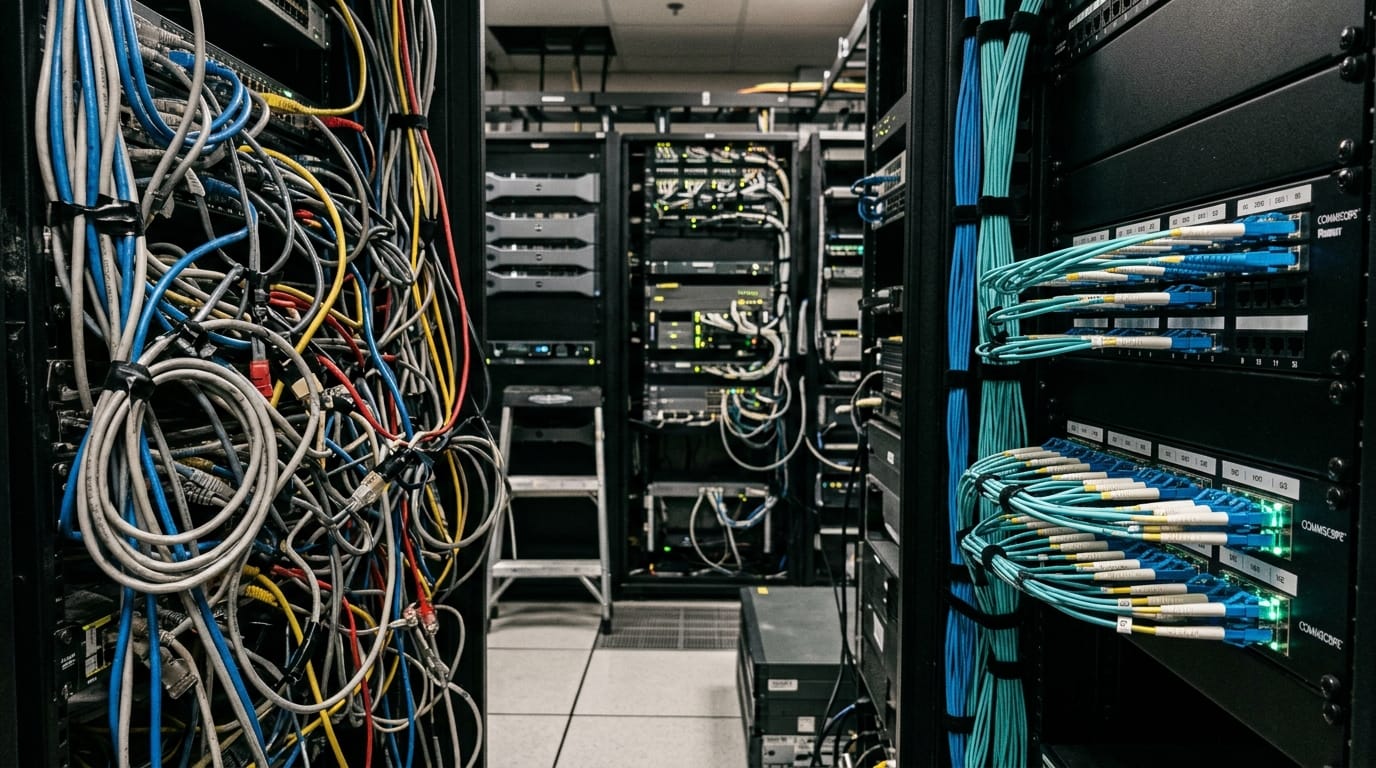
Anyone who manages engineering budgets or operations knows that behind that polished interface lies an expensive, brittle labyrinth of digital plumbing.
For the past twenty years, the universal mortar holding business software together has been the API (Application Programming Interface). Yet, since late 2024, a new three-letter acronym has dominated enterprise architecture conversations: MCP (Model Context Protocol).
If you are not a software engineer, these two terms sound like interchangeable technical jargon. But they represent two fundamentally opposing paradigms: APIs were engineered for human developers to read; MCP was engineered for AI agents to operate.
Understanding this distinction is not an academic exercise for tech geeks: it is the exact dividing line between lighting tens of thousands of dollars on fire with custom, throwaway glue code, or building durable, modular infrastructure that scales.
The Classic API: Technical Manuals and Bespoke Wiring
To understand what an API actually is without looking at lines of code, imagine purchasing a complex industrial machine for your production floor.
The machine arrives alongside a dense, two-hundred-page paper manual. The manual details every exact technical requirement: what voltage each socket expects, which hydraulic levers must be toggled in sequence, and what specific blinking lights indicate an error. That instruction manual is the API.
Can the machine wire itself into your factory? Absolutely not. To make it work, you have to hire an engineer who sits down, reads the manual from cover to cover, strips copper wire, solders specialized connectors, and builds a bespoke, handcrafted cable connecting that specific machine to your factory's main power grid.
When finished, the machine operates smoothly. But consider what happens as your company grows:
- If your sales team runs on Salesforce, you solder a custom cable for Salesforce.
- If your warehouse relies on SAP, you solder a completely different custom cable for SAP.
- If your finance department collects payments through Stripe, you solder a third custom cable for Stripe.
If your organization uses ten software platforms, your engineering department has had to build ten handcrafted cables. And the real expense is not building them—it is maintaining them. Every time Salesforce or SAP updates their software and rearranges an internal circuit, your bespoke cable snaps, forcing developers into emergency weekend firefighting to re-solder connections.
Traditional APIs work, but they are bespoke artisanal crafts designed for patient human beings who read slowly, test cautiously, and maintain custom wiring.
The AI Bottleneck: Demanding That Robots Solder Cables on the Fly
When frontier Large Language Models (ChatGPT, Claude, and their peers) hit the market, enterprises attempted the obvious playbook: hand the AI the standard APIs.
The executive logic seemed unassailable: "If the AI model is so intelligent, let it read the API manual and call the systems directly."
In production, the result was an unmitigated disaster:
- Rampant Token Waste and Latency: Shoving hundreds of pages of complex API documentation into an LLM's context window on every query burns an astronomical amount of token spend and slows user response times to a crawl.
- Hallucinations and Data Corruption: An AI model does not reason with the defensive skepticism of an experienced engineer. If an API schema requires a date formatted as
YYYY-MM-DD, the model might unpredictably outputMM/DD/YYYY, causing database writes to fail silently or corrupt billing tables. - Extreme Fragility: The moment a vendor tweaked a single parameter name in an upstream response, the AI agent lost its footing, entered infinite retry loops, and incinerated API budgets in minutes.
Forcing an AI agent to read technical manuals and manufacture bespoke cables on the fly for every legacy system is like asking a racecar driver to rebuild the transmission while driving down the highway at 100 mph. The system collapses by design.
The MCP Standard: The Universal Modular Toolbox
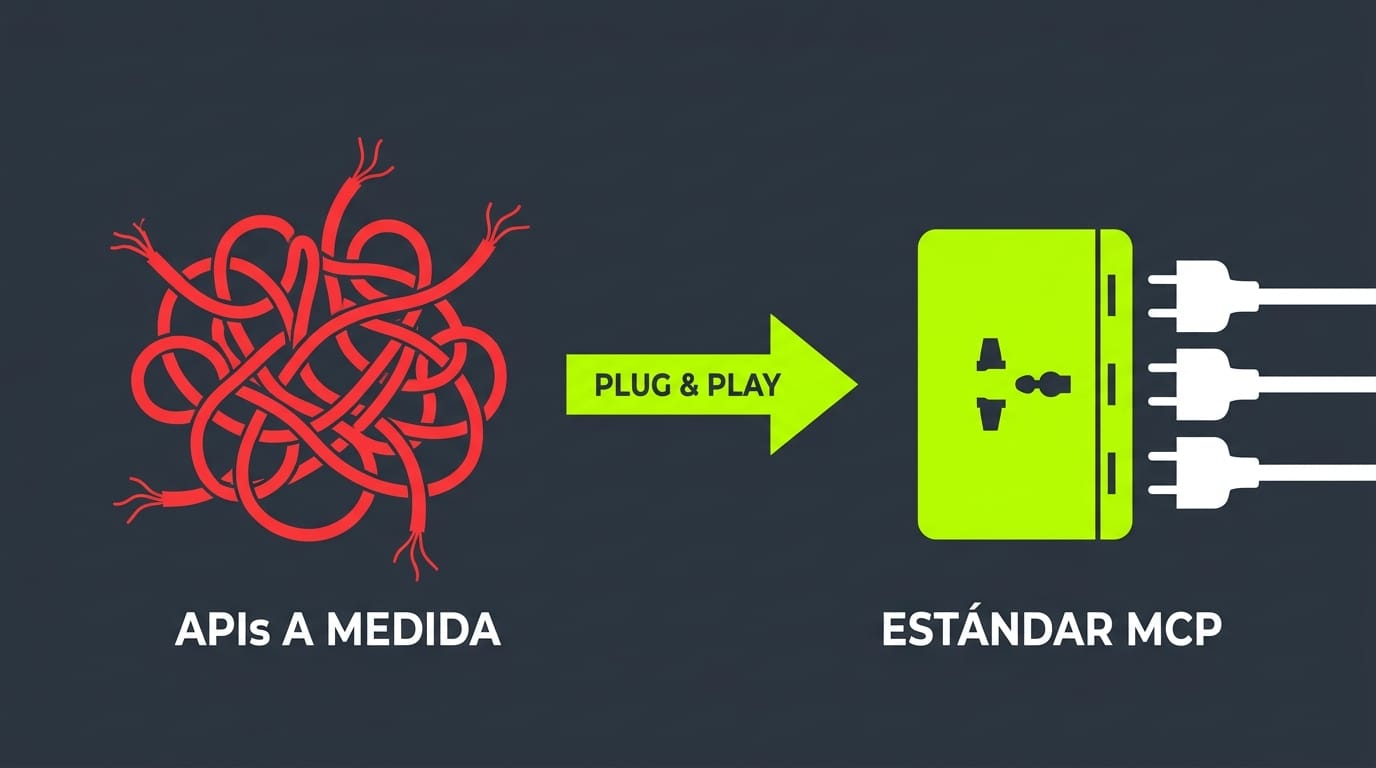
To break this structural deadlock, in late 2024 Anthropic released an open standard known as the Model Context Protocol (MCP).
Rather than forcing the artificial intelligence to build handcrafted cables, MCP acts as a neatly organized, modular universal toolbox.
The architectural dynamic shifts entirely:
- Instead of connecting the AI directly into raw API endpoints, your organization deploys a lightweight MCP server alongside each system (an MCP server for your database, another for your file storage, another for your messaging platform).
- When the AI agent needs to perform an action, it connects to the MCP standard and asks a dead-simple question: "What tools are available here?"
- The MCP server immediately responds with an inventory of standardized, machine-readable capabilities: "I have a tool to look up customer account balances, a tool to extract text from PDFs, and a tool to dispatch transactional emails."
- The AI does not need to know what wires exist beneath the floorboards or how the database is structured: it simply selects the standardized tool, feeds in the required parameters, and executes the task.
It is the exact real-world evolution from the chaos of early mobile phone chargers to USB-C: you no longer need a barrel plug for Nokia, a proprietary pin for Sony, and a distinct cable for Apple. Today, you have a single universal port, and any modern device plugs in and functions instantly.
The Golden Rule: MCP Does NOT Replace APIs
A dangerous misconception frequently surfaces in vendor presentations: the idea that MCP was created to destroy or obsolete traditional APIs.
This is completely false. MCP does not replace APIs; it sits directly on top of them.
APIs continue to exist beneath the surface because they remain the fundamental way software systems expose their underlying operations. What MCP does is act as an abstraction translator:
- Beneath the surface, the MCP server continues speaking the dense, complicated technical language of the vendor's traditional API.
- Above the surface, the MCP server presents the AI agent with a clean, validated catalog of standardized tools that any frontier model understands natively without hallucinating and without burning thousands of wasted tokens.
The API is the car's internal combustion engine; MCP is the universal steering wheel and pedal layout that allows any driver—human or artificial—to operate the vehicle without redesigning the drivetrain.
The Critical Question Every Business Leader Must Ask
The next time an enterprise software vendor, consulting firm, or integration agency walks into your office promising that their AI platform "connects with everything in your business in a single click," ignore the marketing demo.
Ask them one precise, uncomfortable question:
“Are you charging us to solder bespoke, custom cables for each of our APIs that will break the moment a vendor updates their system, or are you architecting this on the open Model Context Protocol standard?”
If they hesitate, evade the topic, or pitch proprietary connectors that only their agency can maintain, they are selling you a technical mortgage that will bleed your engineering budget for years.
If they confirm they are decoupling your systems using open MCP servers, you will know you are investing in clean, modular architecture engineered to endure.
Behind the digital curtain, there was never any magic: only cables and toolboxes. The difference between sustainable efficiency and a budget black hole is knowing which of the two you are paying for.
References and Sources Consulted
- Model Context Protocol Official Specification: modelcontextprotocol.io — Open technical specification establishing standard connectivity between models and tools.
- Anthropic Engineering Announcements: Introducing the Model Context Protocol — Official release whitepaper detailing the context protocol.
- GitHub Organization — Model Context Protocol: github.com/modelcontextprotocol — Reference implementations, open-source server repositories, and official SDKs.
- OpenAPI Initiative: openapis.org — The industry standard for describing traditional RESTful APIs engineered for human developers.
- Syncroma Archive: MCP: Giving Hands to the Brain in a Jar — Foundational conceptual teardown regarding language model isolation and external tool interfaces.
Visual Credits: Cover by Syncroma Studio (hyper-realistic interconnect hardware and adapters photography). Body: Minimalist 2D conceptual infographic by Syncroma Studio.
Sistemas reales, sin humo corporativo Real systems, zero corporate hype
Recibe los análisis a fondo sobre arquitectura, consumo de recursos y computación de bajo nivel directamente en tu bandeja de entrada. Get deep-dive software architecture, resource consumption metrics, and low-level computing essays delivered straight to your inbox.
Suscribirse a Syncroma Subscribe to Syncroma

