
(🇪🇸 Leer la versión en español aquí)
You can invest tens of billions of dollars constructing state-of-the-art supercomputing datacenters, procure hundreds of thousands of NVIDIA H100 accelerators, and market frontier artificial intelligence models capable of superhuman reasoning.
Yet if the humble relational SQL database verifying whether a user paid their monthly $20 subscription locks up, your multi-billion-dollar AI infrastructure abruptly degenerates into an exorbitantly priced silicon paperweight.
That is precisely what transpired during OpenAI's severe 3.5-hour global service disruption: a failure rate that peaked at 75% across the consumer ChatGPT web interface and enterprise API tiers, greeting millions of engineers, enterprises, and everyday users with blank screens and cascading HTTP 500 and 503 gateway errors.
The culprit was neither an LLM alignment hallucination nor a state-sponsored DDoS offensive: it was a cascading synchronization failure across OpenAI's PostgreSQL read replicas.
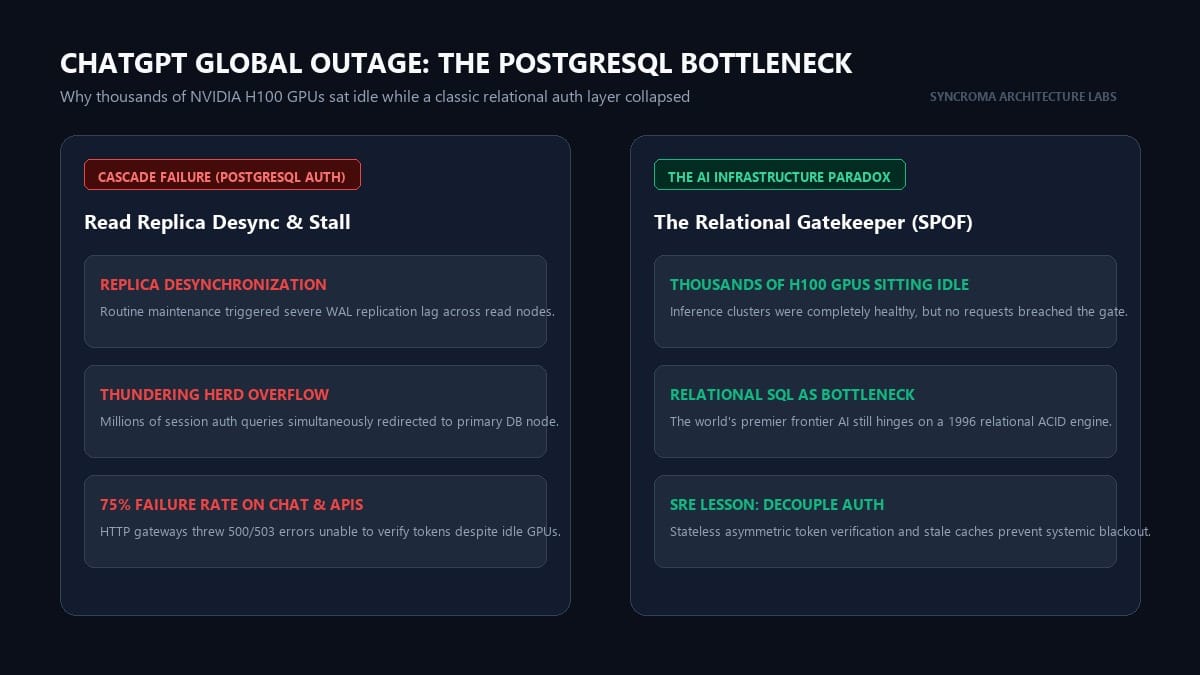
The AI Infrastructure Paradox: Thousands of H100s Idle as the Bouncer Stalls
Throughout the 3.5-hour service blackout, OpenAI's GPU inference nodes were neither overheating nor crashing. On the contrary: thousands of tensor cores were operating at near-zero percent utilization.
To diagnose how a frontier AI platform collapses, software reliability engineers must trace the ingress lifecycle of a ChatGPT request:
- Perimeter Ingress: When an end-user hits enter on chat.openai.com or a background microservice dispatches a POST to
/v1/chat/completions, the payload terminates at Cloudflare and internal ingress load balancers. - The Authentication Gatekeeper: Long before any prompt tokens reach GPU high-bandwidth memory (HBM3), the platform must answer foundational billing questions: Is this bearer token authentic? Does the organization possess available billing credits? Is this request bound to a Pro, Plus, or Enterprise subscription tier?
- The Traditional Relational Store: That user entitlement metadata does not reside on specialized vector databases or GPU clusters. It lives inside classical PostgreSQL clusters managed by connection poolers like PgBouncer, configured with a primary read-write node and a distributed fleet of read replicas handling hundreds of thousands of lookup queries per second.
If the bouncer faints at the front door, it matters very little that the dance floor is pristine and the world's greatest performers are waiting inside: nobody gains entry.
Anatomy of the Collapse: WAL Lag, Failover Desync, and Thundering Herd
According to preliminary engineering incident telemetries, the failure cascaded during a scheduled maintenance window in the authentication database subsystem:
1. Write-Ahead Logging (WAL) Replication Lag
During node restarts and routine database maintenance, lock contention and transient I/O spikes caused multiple read replicas to accumulate severe replication lag. Once the lag exceeded strict consistency safety thresholds, connection poolers marked those replicas as unhealthy and evicted them from the active rotation.
2. The Primary Node Thundering Herd
With the majority of read replicas removed from service, proxy routing middleware executed its default fallback logic: redirecting incoming authentication read queries to the sole primary PostgreSQL database.
The consequence was instantaneous and catastrophic. Tens of thousands of concurrent backend workers hammered the single primary instance. Active connections shattered the configured max_connections limit, CPU utilization pegged at 100%, and query execution latency spiked past 30 seconds.
3. Cascading Gateway Timeouts
Starved of authentication responses, OpenAI's API gateways exhausted their connection pools. Clients began receiving 504 Gateway Timeout and 500 Internal Server Error responses, triggering automated retry loops that amplified incoming request pressure by an order of magnitude.
Architectural Comparison: Inference Cluster vs. Authentication Plane
| Architectural Dimension | GPU Inference Cluster | Identity & Billing Plane |
|---|---|---|
| Underlying Tech Stack | Thousands of NVIDIA H100s / Blackwell | PostgreSQL + PgBouncer + Redis |
| Computational Model | Massively parallel and stateless | Strictly relational & transactional (ACID) |
| Degradation Pattern | Graceful degradation (Higher per-token latency) | Binary catastrophic drop (0% or 100%) |
| Single Point of Failure (SPOF) | Low (Partitioned across independent clusters) | Critical (Every API request must pass auth) |
| Operational State During Outage | Completely healthy but unreachable | Saturated at 100% CPU lock contention |
Production Takeaways for Modern SRE Architectures
The architectural takeaway from this incident is definitive: the identity verification layer must never represent a synchronous runtime bottleneck for operational traffic.
To prevent database failovers from neutralizing critical application availability, modern distributed architectures enforce:
- Asymmetric Cryptographic Token Verification: By utilizing public-key signature schemes (such as Ed25519 or RS256), edge gateways can validate JWT signatures and permissions in local memory without dispatching a database query on every request.
- Degraded Stale-While-Revalidate Caching: If database replicas fail health checks, systems should serve stale cached entitlement states for a 15-minute grace period rather than terminating valid sessions with HTTP 500 errors.
- Aggressive Upstream Circuit Breakers: Clamping retry storms before they can saturate and collapse recovered primary database nodes.
To model thermal heat loss and evaluate insulation performance across industrial and data center facilities, explore our U-Value Thermal Transmittance & Insulation Calculator to optimize facility enclosures.
Visual credits: Original tech journalism photograph of a smartphone displaying the ChatGPT interface beside an open laptop via Wikimedia Commons. 2D technical vector infographic created by Syncroma Architecture Labs.
Sistemas reales, sin humo corporativo Real systems, zero corporate hype
Recibe los análisis a fondo sobre arquitectura, consumo de recursos y computación de bajo nivel directamente en tu bandeja de entrada. Get deep-dive software architecture, resource consumption metrics, and low-level computing essays delivered straight to your inbox.
Suscribirse a Syncroma Subscribe to Syncroma

