(🇪🇸 Leer la versión en español aquí)
Handing a shiny consumer AI agent your bank credentials sounds like peak automation right up until you read the updated liability clause. As TechCrunch reported on November 18, 2026 — alongside coverage from Unite.AI and TokenPost — major U.S. banks including Citibank and PNC (following earlier clamps by JPMorgan Chase, Bank of America, and Citizens Bank) updated their Terms of Service to spell out one blunt rule: if you connect a third-party AI agent to your bank account, every mistake, transfer, or hack is legally your loss.
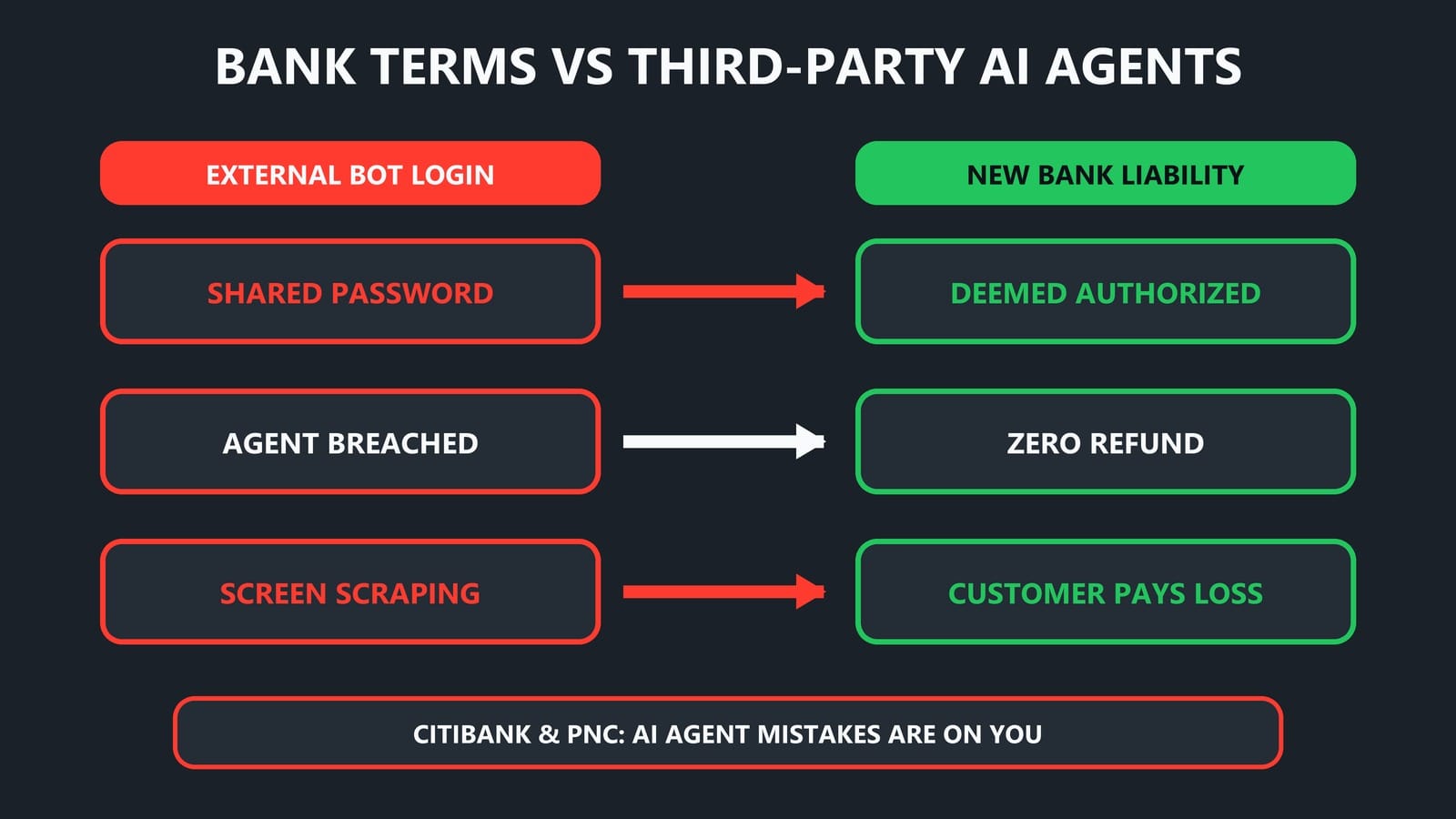
Under Citibank’s revised agreement, any action triggered by an authorized external assistant is deemed customer-authorized, and the bank explicitly warns that if a third-party AI vendor suffers a data breach or leaks your login credentials, you bear the financial loss — not the bank.
Why Agentic Browser Bots Break Traditional Bank Fraud Protections
Strip out the PR spin and this is an architectural collision. Most hyped consumer "AI CFO" apps and autonomous computer-use agents still bypass fine-grained read-only Open Banking OAuth scopes, relying instead on shared passwords, stored cookies, or automated headless browser sessions inside your live banking portal.
| Access Architecture | Technical Permission Boundary | Fraud & Hack Liability Under 2026 Terms |
|---|---|---|
| Third-party AI agent with shared login / scraping | All-or-nothing web session capable of reading & moving funds | Customer bears 100% of loss, even if the AI vendor is breached |
| Bank's own first-party in-app AI tools | Confined within internal banking auth & deterministic guardrails | Standard consumer fraud protections apply per Unite.AI and TokenPost |
Proper architecture: Scoped read-only OAuth + out-of-band 2FA |
Agent reads ledgers or drafts actions; transfers require hardware/biometric sign-off | Limits blast radius if the AI wrapper gets popped |
Worse, an autonomous browser or finance agent reading invoices, emails, or web pages while holding an authenticated bank session opens the textbook indirect prompt-injection vector we highlighted in our analysis of why Google absorbed Gmail wrapper Howie: an attacker doesn't need to crack bank cryptography if poisoned external text tricks your own bot into transferring funds.
Three Concrete Guardrails for Builders & Everyday Account Holders
- Never enter real bank usernames, passwords, or MFA tokens into autonomous browser agents: if an app asks for raw credentials instead of an audited read-only bank API connector, you forfeit traditional zero-liability protections overnight.
- Isolate data ingestion from money movement: if you want AI analysis on cash flow or recurring bills, feed exported CSV/OFX statements processed strictly offline — via client-side tools like our private CSV-to-JSON/SQL converter or annual subscription spend auditor — or cap exposure inside a low-balance sandbox checking account.
- Keep sensitive secrets encrypted on-device before cloud sync: whenever storing financial exports or automation configs, encrypt payloads in local browser memory first with tools such as our offline AES-256-GCM encryptor.
Banks just called the AI wrapper industry's bluff: let bots analyze your spreadsheets, not hold keys to your vault.
Credits: Syncroma Studio. Cover photo: Citibank branch exterior (Wikimedia Commons, CC BY 2.0); original editorial infographic by Syncroma Studio.
Sistemas reales, sin humo corporativo Real systems, zero corporate hype
Recibe los análisis a fondo sobre arquitectura, consumo de recursos y computación de bajo nivel directamente en tu bandeja de entrada. Get deep-dive software architecture, resource consumption metrics, and low-level computing essays delivered straight to your inbox.
Suscribirse a Syncroma Subscribe to Syncroma

