(🇪🇸 Leer la versión en español aquí)
If you manage enterprise on-premise datacenters, private clouds, or VMware-backed virtualization clusters, your weekend was just cancelled. On November 19, 2026, Broadcom issued an emergency security advisory designated VMSA-2026-0009, disclosing a maximum-severity remote authentication bypass rated CVSS 9.8 (Critical) and tracked as CVE-2026-123890.
This vulnerability is not a theoretical proof-of-concept uncovered by an academic team. Disclosures from Google Threat Intelligence and Mandiant confirmed that sophisticated China-nexus espionage actors (tracked as Armory Castle or UNC5221) have been actively weaponizing this flaw as an in-the-wild zero-day since early September 2026 using a proprietary Golang post-exploitation framework named BONESAW.
Below, we dissect the underlying cryptographic state machine failure in the VMware Directory Service, demonstrate how it grants root hypervisor compromise with zero credentials, and highlight Broadcom’s controversial decision to withhold public patches from legacy production environments.
1. The Low-Level Flaw: Breaking SRP-6a over DCE/RPC
The root cause resides in vmdird (VMware Directory Service), the core background daemon responsible for LDAP identity management, SSO synchronization, and authorization metadata within vCenter Server, binding on TCP ports 2012 and 2014.
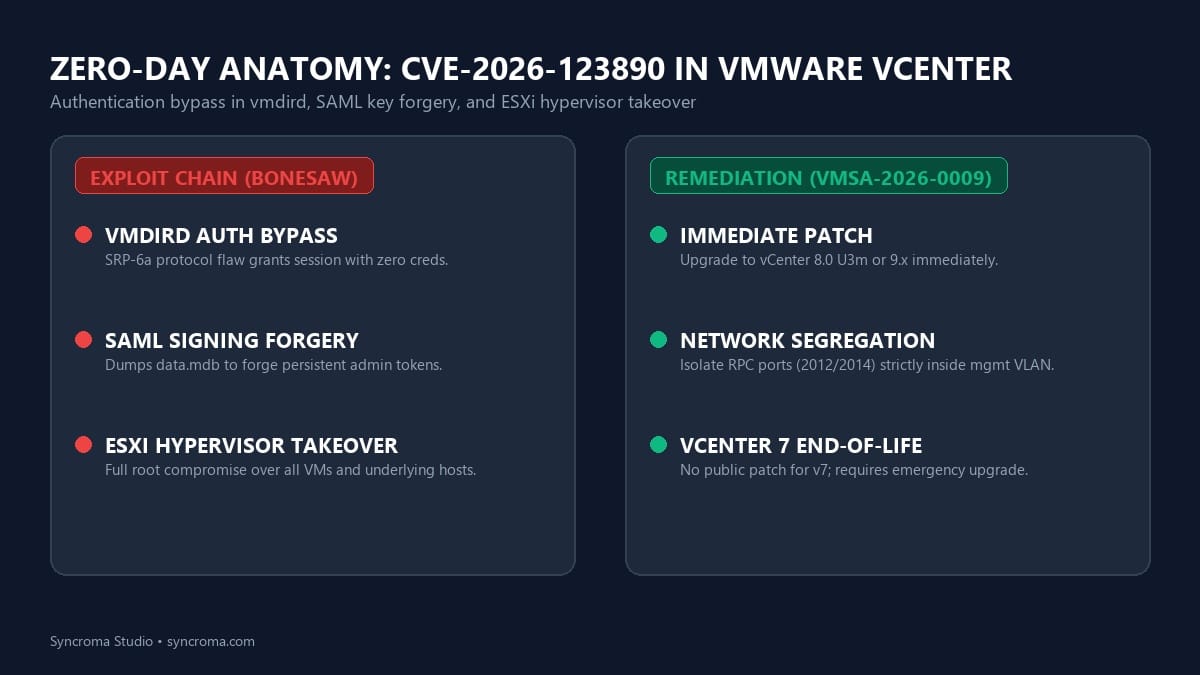
Figure 1: BONESAW exploit chain versus network isolation and patching remediation. Credits: Syncroma Studio.
To authenticate management clients across internal network segments, vmdird exposes the SRP-6a (Secure Remote Password) cryptographic protocol encapsulated over DCE/RPC remote procedure calls:
- Flawed State Machine Handling: During the ephemeral key exchange sequence between client and server, an alternate channel validation flaw (CWE-288) in the
vmdirdverification routine permits a remote adversary to inject a malformed RPC packet that skips the client-side proof validation mathematical check. - Unchecked Root Session Promotion: Upon parsing the malformed payload, the daemon erroneously assumes that identity negotiation succeeded against the local security domain, returning an authorized administrative context handle with full
administrator@vsphere.localprivileges. - Zero Credentials Required: The attacker requires no knowledge of user passwords, requires no Active Directory machine account, and bypasses web-tier multi-factor authentication (MFA) mechanisms entirely because the handshake executes at the raw RPC directory transport layer.
2. The BONESAW Exploit Chain: From vCenter to Bare-Metal ESXi
Armed with an administrative session inside vmdird, the BONESAW utility utilized by Armory Castle executes a structured lateral movement pipeline that completely compromises the virtualized datacenter fabric:
[Compromised Internal Subnet / Corporate VPN]
       │
       ▼  (DCE/RPC ports 2012 / 2014)
[vmdird: CVE-2026-123890 Exploit Triggered]
       │
       ├─► Direct dump of /storage/db/vmware-vmdir/data.mdb
       │
       ├─► Exfiltration of SAML Identity Provider private signing keys
       │
       ▼  (Forged Golden SAML Assertions)
[vCenter API & vSphere Client (HTTPS 443)]
       │
       ▼  (Authorized internal vpxuser instructions)
[Underlying ESXi 8.0 / 9.0 Hypervisor Hosts]
       │
       └─► Full VMDK disk exfiltration, live VM memory dumping, and ESXi persistence backdoors
Once attackers access data.mdb, they extract the core cryptographic signing keys powering VMware's Security Token Service (STS). From that moment on, the adversary can forge arbitrary SAML assertion tickets for any virtual machine or service in the datacenter. Even if administrators apply the Broadcom patch hours later, threat actors retain persistent golden keys unless the entire internal Security Token Service certificate chain is manually revoked and regenerated.
3. Patch Matrix & Version Vulnerability Status
Broadcom issued patches strictly for supported release branches:
| vCenter Release Line | Vulnerability Status | Fixed Version Build | Mandatory Action |
|---|---|---|---|
| vCenter 9.1.x | Vulnerable (CVSS 9.8) | 9.1.1.0200 |
Immediate Patch |
| vCenter 9.0.x | Vulnerable (CVSS 9.8) | 9.0.2.0200 |
Immediate Patch |
| vCenter 8.0 | Vulnerable (CVSS 9.8) | 8.0 U3m |
Immediate Patch |
| vCenter 7.0 (EOL) | Vulnerable (CVSS 9.8) | NO PUBLIC PATCH | Forced Upgrade / Custom Support |
The Corporate Reality for vCenter 7.0 Deployments
Thousands of healthcare networks, financial institutions, and enterprise datacenters worldwide continue to operate VMware vCenter 7.0 due to lengthy qualification cycles.
Under Broadcom's revamped enterprise licensing model, no public security update was provided for vCenter 7.0. Organizations on legacy agreements that have not purchased expensive extended support contracts are left completely exposed to an actively exploited zero-day vulnerability in production.
4. Emergency Hardening Checklist for Systems Engineers
If vCenter instances are running in your infrastructure, immediate remediation is required:
- Deploy Advisory VMSA-2026-0009 Patches: Upgrade vulnerable instances to build
8.0 U3m,9.0.2.0200, or9.1.1.0200immediately. - Hard Network Segregation: Directory RPC ports (TCP 2012 and 2014) and the vCenter management interface must never be accessible from developer subnets, office LANs, or external perimeters. Enforce strict firewall rules restricting access exclusively to an isolated Out-of-Band (OOB) management VLAN with physical hardware token MFA.
- Mandatory STS Certificate Rotation: If your vCenter instance was accessible over internal networks without the patch during the past two months, treat the environment as potentially compromised: rotate all SAML STS certificates and audit directory logs for newly created accounts inside
vsphere.local.
To evaluate long-term infrastructure expenses of on-premise SAN and NVMe storage arrays versus migrating workloads to cloud volumes, use our Storage TCO Calculator.
Sistemas reales, sin humo corporativo Real systems, zero corporate hype
Recibe los análisis a fondo sobre arquitectura, consumo de recursos y computación de bajo nivel directamente en tu bandeja de entrada. Get deep-dive software architecture, resource consumption metrics, and low-level computing essays delivered straight to your inbox.
Suscribirse a Syncroma Subscribe to Syncroma