(🇪🇸 Leer la versión en español aquí)
Among software engineers, systems architects, digital nomads, and homelab enthusiasts, GL.iNet hardware (devices like the Beryl AX, Flint 2, or Slate AX) has long been considered the gold standard of technical sovereignty.
They ship with OpenWrt out of the box, let you compile custom Linux packages, set up WireGuard and Tailscale meshes with a single click, and hand you unfettered SSH root access without bowing to ISP restrictions. It is the go-to gear for developers who refuse to trust closed-source carrier modems.
Yet, in modern edge networking, convenience is a dangerous drug: centralized cloud management.
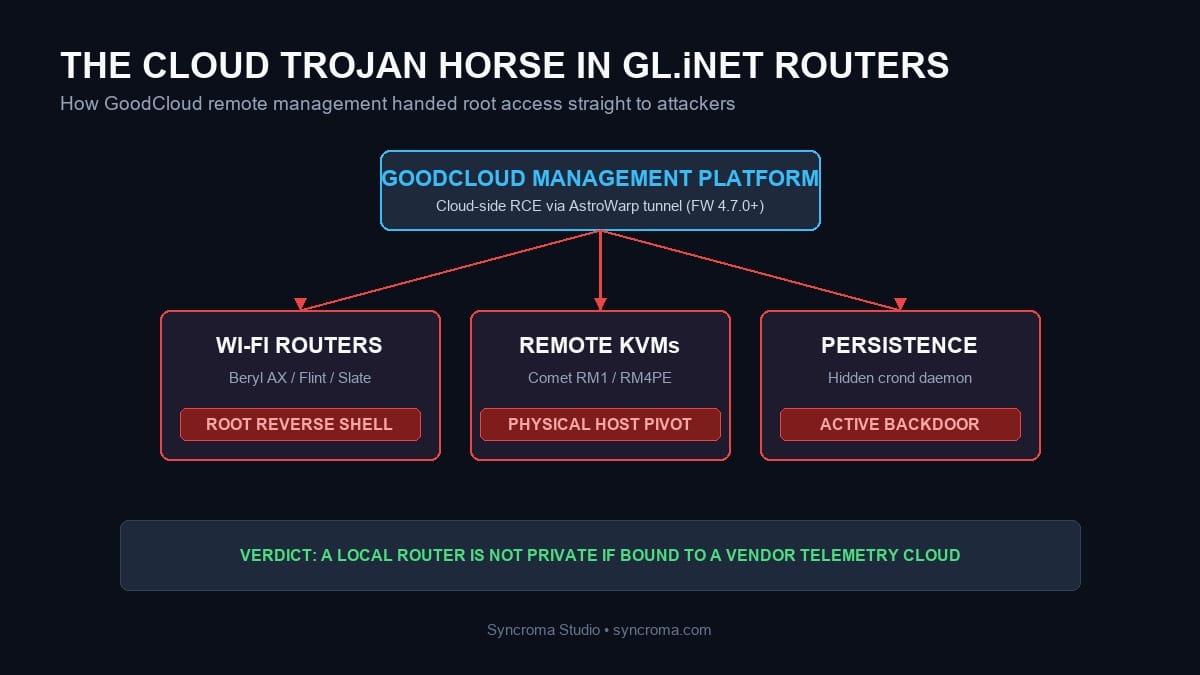
The vendor has officially confirmed an edge network administrator's worst nightmare: attackers breached their central management cloud platform —GoodCloud— and turned it into a mass-distribution megaphone to push backdoors, persistence cron scripts, and encrypted root reverse shells into thousands of routers and IP-KVM devices globally.
1. Attack Anatomy: From Cloud API to an Obfuscated Daemon in /tmp
The breach, mitigated at the cloud tier around November 20, 2026, required zero WAN-port scanning and zero brute-forced Wi-Fi handshakes against target home or branch routers.
The entry vector was the legitimate reverse telemetry socket that every linked device continuously maintains with GoodCloud (specifically via the AstroWarp daemon on firmware branches 4.7.0 and later):
- Server-Side Request Injection: A parameter validation flaw on the GoodCloud backend allowed threat actors to dispatch arbitrary batch management instructions to linked device IDs.
- Payload Delivery Under Vendor SSL: Connected devices pulled the instructions over legitimate manufacturer domains, downloading an obfuscated payload script into
/tmp/.logor/var/run. - Multi-Stage Daemon Persistence: The script installed itself via crontab (
crond -i /tmp/.log) or modified OpenWrt boot scripts (/etc/rc.local), opening encrypted reverse tunnels to attacker command-and-control (C2) infrastructure.
In less than five seconds, an unauthenticated threat actor possessed an interactive root terminal behind firewalls, NATs, and private ISP subnets.
2. The IP-KVM Nightmare: Physical Host Hop
While a root reverse shell on a travel router is an immense privacy disaster (allowing DNS snooping, Man-in-the-Middle injection, and LAN host discovery), the real panic in production environments centers on GL.iNet’s KVM-over-IP products (such as the Comet RM1 and RM4PE).
An IP-KVM is not a dumb network switch. It is a dedicated Linux SBC physically connected via HDMI and emulated USB to mission-critical infrastructure: production bare-metal servers, GPU cluster heads, or developer engineering workstations.
- Unrestricted Hardware Keyboard Injection: With root access on the KVM, the attacker simulates raw hardware keystrokes (HID emulation) directly into the target machine, completely bypassing software host firewalls, VPNs, and network ACLs.
- HDMI Framebuffer Interception: Access to the KVM's video capture pipeline allows attackers to record display streams in real time, harvest live console sessions, and monitor master encryption password inputs.
- Blind Lateral Pivoting: Enterprise SOCs monitor network interface traffic on server NICs, but almost no automated agent monitors keystrokes typed by what the kernel perceives as a generic USB keyboard plugged into the motherboard.
3. The Architectural Lesson: The Fallacy of the "Sovereign" Router
This incident dismantles a comforting myth across engineering circles: the belief that running OpenWrt guarantees autonomy if you leave proprietary vendor telemetry running.
Engineers bought GL.iNet hardware specifically to avoid carrier lock-in, yet many turned GoodCloud on "just to reboot the router from an iPhone app" or "to easily access home VPN endpoints from airport Wi-Fi."
In doing so, they created an unresolvable security contradiction:
- You maintained an outbound reverse socket to a closed-source central cloud backend over which you possess zero code visibility or audit control.
- You granted that client daemon superuser privileges (
uid=0) inside your router's Linux kernel. - You placed blind faith in the vendor's API gateway never suffering authentication bypasses or command injection flaws.
The moment a root-level daemon connects to a third-party server to receive execution instructions, your internal network perimeter ceases to exist.
4. Remediation & Hardening Checklist
If your homelab, remote branch, or data rack runs GL.iNet hardware, execute this hardening procedure immediately:
- Sever GoodCloud Connection: Log into the Admin Panel or LuCI and disable GoodCloud completely under
Applications -> GoodCloud. Block outbound DNS resolution and TCP traffic to*.goodcloud.xyzacross your upstream firewall. - Flash Patched Vendor Firmware: GL.iNet has deployed emergency firmware patches that purge known backdoor signatures and restrict cloud command parsing. Apply the official security patch immediately.
- Audit Hosts Physically Tethered to IP-KVMs: If you manage machines via Comet KVMs, treat the physical host as potentially compromised. Inspect
/var/log/auth.log(Linux) or Windows Security Event Logs (Event ID 4624) for anomalous interactive logins delivered via local keyboard hardware.
Audit Active Memory & Persistence Schedulers: SSH into the device and inspect running processes:
ps | grep -E "(tmp|\.log|crond|nc|sh)"
crontab -l
cat /etc/rc.local
If you detect unfamiliar background scripts or references to /tmp/.log, assume full system compromise.
True sovereignty does not phone home to manufacturer servers. If you want a secure router, cut the vendor umbilical cord.
Technical analysis and cybersecurity coverage by Syncroma Studio.
Sistemas reales, sin humo corporativo Real systems, zero corporate hype
Recibe los análisis a fondo sobre arquitectura, consumo de recursos y computación de bajo nivel directamente en tu bandeja de entrada. Get deep-dive software architecture, resource consumption metrics, and low-level computing essays delivered straight to your inbox.
Suscribirse a Syncroma Subscribe to Syncroma