(🇪🇸 Leer la versión en español aquí)
When a critical remote code execution (RCE) vulnerability drops late on a Friday afternoon, every infrastructure on-call engineer faces the same nightmare: the dreaded patch gap. In the window between public exploit disclosure and the days required to compile, regression-test, and deploy permanent software patches across production clusters, your services remain completely vulnerable.
To bridge this operational exposure, OpenAI and Cisco—collaborating closely with Cisco’s Isovalent team (the creators behind Cilium and Tetragon)—have unveiled and open-sourced Shirudo (the Japanese term for shield) under a BSD-2 license. Shirudo is an eBPF-powered security runtime designed to dynamically attach in-memory upatches to live Linux processes, intercepting vulnerable execution paths without rebooting services or dropping client connections.
The marketing pitch claims AI agents will automatically hot-patch zero-days in flight. But examining low-level kernel requirements and production constraints reveals a very different engineering reality.
1. What Happened: The Java4Shell Production Demonstration
The technical proof-of-concept for Shirudo centers around an active exploit mitigation drill:
- The Target Vulnerability: The demonstration focused on Java4Shell (CVE-2026-114938), a severe heap corruption flaw inside OpenJDK's Base64 decoding routines.
- The Target Service: An active Elasticsearch production node running on Linux, serving live search queries and indexing data.
- Shield Synthesis: An OpenAI Codex agent ingested the proposed upstream OpenJDK source fix and automatically compiled a targeted micro-shield into eBPF bytecode.
- Live Kernel Interception: Shirudo injected the bytecode directly into the Linux kernel and hooked into user space at the
Base64::decodesymbol within the running Elasticsearch JVM process. When the exploit payload hit the cluster, the eBPF shield dropped the malformed input with sub-2-microsecond latency, allowing legitimate search queries to proceed uninterrupted without bouncing the JVM.
Unlike traditional Web Application Firewalls (WAFs) inspecting perimeter HTTP traffic, Shirudo operates directly at the operating system kernel and process memory boundary.
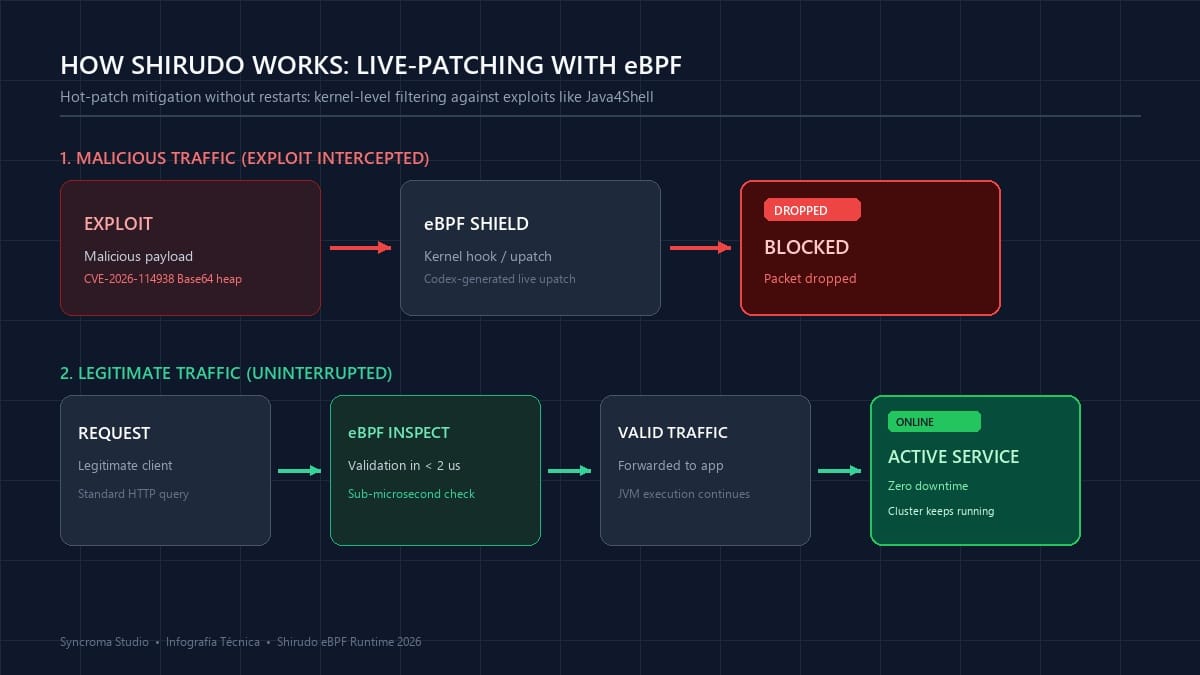
Credits: Syncroma Studio
2. Usman's Take: AI-Generated Live Patches in the Kernel
By Usman Hussain Bashir
"Whenever developer marketing promises an AI agent will 'self-heal' production servers on the fly without restarts, any seasoned on-call engineer feels an instinctive chill.
Would I ever permit an LLM-synthesized live patch into the Linux kernel of a cluster handling millions in daily revenue? Not a chance.
The core computer science behind eBPF hot-patching is brilliant, and Isovalent possesses world-class engineering credibility. But delegating live in-memory patch generation to an AI model introduces a terrifying failure mode: a subtle race condition, a faulty memory bounds check, or an unexpected locking conflict inside an upatch will trigger a kernel panic or obliterate P99 tail latency for clean traffic.
The real hazard isn't just the exploit—it’s an AI hallucination taking down your infrastructure before an attacker does. Furthermore, an immutable law of systems engineering applies: a temporary hot-shield never replaces a certified upstream release. If your organization relies on automated in-memory patching because deployment pipelines take three weeks to roll out a container rebuild, the root vulnerability isn't Java; it's crushing technical debt in your deployment architecture."
3. Proprietary Insight: Can You Run Shirudo Today?
Stripping away press release enthusiasm, Shirudo's hardware and operating system prerequisites demonstrate that it remains an experimental pre-release research project, far removed from out-of-the-box enterprise fleet deployments:
| Technical Requirement | Shirudo Specification | Standard Fleet Reality (Ubuntu / Debian / RHEL) | Production Viability Today |
|---|---|---|---|
| Hardware Attestation | Mandatory TPM 2.0 for cryptographic logging | Common in modern cloud VMs; often unconfigured on legacy bare-metal | Conditional |
| Linux Kernel Branch | Custom kernel with signed-loader ABI from bpf-next |
Ubuntu 24.04 LTS and Debian 12 run stable trees lacking these experimental patches | NO (requires custom kernel rebuilds) |
| Cryptographic Signatures | Dedicated internal PKI for signing verified shields | Requires dedicated HSM key management to prevent malicious bytecode injection | Complex |
| Human-in-the-Loop | Mandatory human sign-off before shield activation | If human operators must audit eBPF bytecode line-by-line, response times climb | Partial |
| Release Maturity | Pre-release codebase under BSD-2 license | Zero enterprise SLAs, no upstream Linux mainline guarantees | NO (research lab only) |
The strict dependency on the unstable bpf-next kernel branch alongside hardware-level TPM 2.0 enforcement confirms that Shirudo is an architectural prototype, not software you can deploy with apt install on production fleets next week.
4. What You Should Do: Three Practical Hardening Rules
Cutting through the AI hype cycle, these are the pragmatic steps your engineering team should take:
- Maintain Standard Patching Discipline: Do not delay routine patching cycles under the assumption that AI agents will safeguard vulnerable workloads in memory. Immutable container rebuilds, automated regression suites, and canary deployments remain your strongest defense.
- Audit Exposure to Java4Shell and Legacy Runtimes: If your workloads run Java dependencies (Elasticsearch, Kafka, Flink, Spark), immediately verify OpenJDK patch levels against CVE-2026-114938 and related parsing vulnerabilities such as PHP2Shell.
- Sandbox Shirudo in Isolated Lab VMs: If your security architecture team wants to evaluate live eBPF memory interception, spin up an isolated virtual machine equipped with vTPM and compile a
bpf-nextkernel. Run the official test fixtures, but strictly isolate the host from customer-facing subnets.
5. What We Still Don't Know
Critical operational questions must be answered by OpenAI and Cisco before Shirudo can be considered production-grade:
- Resilience Against Polymorphic Evasion: If an exploit payload is structurally mutated to bypass the eBPF hook conditions while still triggering memory corruption downstream, the shield will fail silently.
- Lock Contention Under Heavy Load: While single-hook execution runs in under 2 microseconds, real-world benchmarks exploring memory lock contention under sustained hundreds of thousands of requests per second are not yet public.
- Mainline Kernel Acceptance: Whether the Linux kernel community will merge Shirudo’s required
signed-loaderpatches into the official kernel tree or leave it as a proprietary Cisco branch remains unresolved.
6. Primary Sources and Technical Documentation
Sistemas reales, sin humo corporativo Real systems, zero corporate hype
Recibe los análisis a fondo sobre arquitectura, consumo de recursos y computación de bajo nivel directamente en tu bandeja de entrada. Get deep-dive software architecture, resource consumption metrics, and low-level computing essays delivered straight to your inbox.
Suscribirse a Syncroma Subscribe to Syncroma