
(🇪🇸 Leer la versión en español aquí)
The AI software development landscape just shifted on two fronts simultaneously. In less than 48 hours, Anthropic made decisive moves across both agent tooling and continuous integration pipelines: on one side, declaring general availability (GA) for MCP Tasks and Elicitation, alongside the public beta of Skills over MCP. On the other side, rolling out Claude Ship, a suite of GitHub-native agents built to review pull requests, commit automated fixes when continuous integration fails, and issue policy-driven automated approvals.
If your team runs autonomous agents or integrates LLMs into production build pipelines, the contract between models, servers, and code repositories has fundamentally evolved. Here is the unvarnished engineering breakdown: what changed, where production footguns lie, and what you need to audit in your repositories today.
1. What Happened: Claude Ship and the MCP Protocol Evolution
The rollout encompasses two distinct architectural layers:
Claude Ship (November 23)
Targeted at organizations on Team and Enterprise tiers, Claude Ship embeds Claude directly into GitHub team workflows across three core capabilities:
- Code Review (GA): Inspects incoming pull requests, audits code diffs against repository guidelines, and leaves contextual line-by-line comments.
- PR Steward (Public Beta): An active background worker that monitors continuous integration (CI) failures or human review feedback, writes code patches, and pushes commits back to the pull request branch. Notably, it has zero merge authority.
- Claude Approvals (Public Beta): A rule-based sign-off engine governed by a declarative policy file (
.claude/approvals.yml). When a diff strictly satisfies configured criteria (such as documentation-only edits or green-lighted minor dependency bumps), Claude can sign off on the pull request approval gate.
Crucially, token usage consumed by Claude Ship is billed independently from standard seat subscriptions, introducing variable operational compute costs directly into engineering pipelines.
MCP Tasks, Elicitation, and Skills (November 24)
In parallel, Anthropic announced major core specification updates to the Model Context Protocol (MCP):
- MCP Tasks (GA): Legacy MCP tool calls were strictly synchronous and blocking: clients waited on a single request-response lifecycle until completion. MCP Tasks introduce an asynchronous execution model featuring persistent task IDs (
task_id), progress polling, and background execution for long-running workflows (heavy builds, data transformations, static analysis suites). - Elicitation (GA): Enables an MCP server to actively pause execution midway through a call and prompt the user or orchestrator for additional inputs, missing configuration flags, or interactive security confirmations without dropping the session.
- Skills over MCP (Public Beta): Standardizes reusable, modular capabilities packaged and discovered directly over MCP server endpoints, bridging the gap between disconnected local bash scripts and coordinated tool chains.
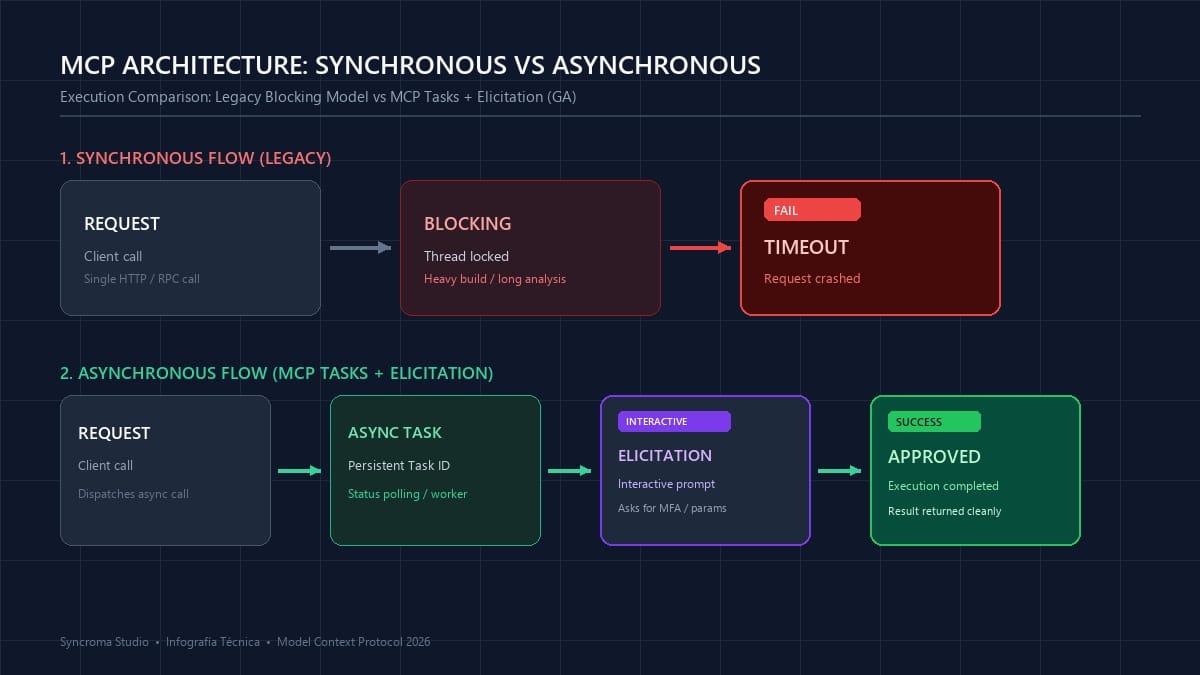
Credits: Syncroma Studio
2. Usman's Take: Letting AI Bots Approve Production Code
By Usman Hussain Bashir
"For two years, developer tooling companies have pushed the narrative that LLMs should write boilerplate faster. Now the corporate hype cycle wants us to hand over the repository keys and let agents approve changes. Anyone with scars from production on-call duty knows where this goes.
Would I ever let an autonomous AI agent approve pull requests on a critical production repository? Not a chance.
The real danger with Claude Approvals and PR Steward isn't syntactical compilation errors; it is blind feedback loops. If an integration test suite suffers from flaky timing or a subtle concurrency bug, an agent like PR Steward can easily trigger a runaway commit storm—stripping out assertions, padding timeouts with sleep statements, and burning $200 in token spend across forty minutes while the team sleeps.
Even worse is human review fatigue. When developers see that Claude has already inspected and stamped an approval under a YAML ruleset, human diligence erodes. In distributed systems security, a false positive wastes an engineer's afternoon, but a false negative takes down the entire production cluster.
Protected branches and human sign-offs aren't organizational red tape—they are the final sanity barrier against hallucinated logic. Treat Claude Ship as an advanced contextual linter on steroids, never as a senior engineer with deployment privileges."
3. Proprietary Insight: MCP Server Architecture Before and After November 24
To appreciate how drastically the operational surface has expanded, here is how an MCP server functioned prior to November 24 versus what it can execute today:
| Capability | Legacy MCP (Pre-Nov 24) | Modern MCP (Post-Nov 24 GA) | Production Impact |
|---|---|---|---|
| Execution Model | Synchronous blocking (Request / Response) | Asynchronous with task_id & status polling |
Prevents HTTP/RPC timeout crashes on heavy workloads |
| Interactive Prompts | Impossible mid-execution | Active Elicitation: server pauses for input | Safely queries MFA tokens or confirms DROP TABLE calls |
| Lifecycle & State | Stateless per tool invocation | Persistent lifecycle states (pending, running, done) |
Native auditability, tracing, and observability |
| Modular Logic | Fragmented system prompts and ad-hoc scripts | Skills over MCP: packaged reusable definitions | Drastically reduces tool definition duplication |
| Cost & Token Burn | Discrete per-message chat turns | Continuous background polling and worker cycles | Demands strict spending budgets and rate quotas |
This architectural upgrade evolves MCP from a basic RPC tool router into an asynchronous background orchestration bus. However, as documented in our breakdown of APIs versus MCP protocols, giving tools background runtime power increases operational risk, particularly in light of incidents like credential leaks in local Claude Code configuration files.
4. What You Should Do: Three Actionable Hardening Steps
If your organization uses Claude locally or plans to pilot Claude Ship on GitHub, implement these three controls before turning on integrations:
- Audit Local MCP Server Permissions: Inspect your
claude_desktop_config.jsonand agent configuration files. Verify which servers have read or write access to the local filesystem, and strictly block access to directories containing.envfiles, SSH keys, or.git/configtrees. - Enforce Rigid Branch Protection Rules on Main: In GitHub, navigate to
Settings > Branches > Branch protection rulesfor your primary branches. Ensure "Require approvals" strictly mandates human code owner reviews. Never grant bypass rights to bot accounts or GitHub Action service tokens. If you experiment with.claude/approvals.yml, restrict its scope exclusively to documentation markdown files or locale string updates. - Configure Anthropic Spend Limits Immediately: Because Claude Ship commits and asynchronous background tasks consume tokens outside fixed seat subscriptions, set hard monthly spending caps and real-time usage notifications in the Anthropic admin console. Unmonitored automation across repos can trigger unexpected surprises, similar to the operational shifts seen when GitHub scheduled Dependabot alert pauses on inactive repositories.
5. What We Still Don't Know
Despite the marketing releases, several critical production questions remain unproven under load:
- Roundtrip Latency in Elicitation: Pausing an autonomous workflow to solicit user interaction introduces substantial friction in automated CI/CD runners. How client SDKs handle dropped connections or stale pauses remains to be seen.
- Ecosystem SDK Fragmentation: Thousands of community MCP servers across TypeScript and Python rely on the original synchronous protocol. Porting them to background Task lifecycles will require substantial refactoring.
- Compliance and Liability: If an automated Claude Approval rubber-stamps code that introduces a subtle security defect or regulatory breach, establishing audit trails and accountability between the pull request author and the AI policy configuration will create complex compliance friction.
6. Primary Sources and Official Documentation
Sistemas reales, sin humo corporativo Real systems, zero corporate hype
Recibe los análisis a fondo sobre arquitectura, consumo de recursos y computación de bajo nivel directamente en tu bandeja de entrada. Get deep-dive software architecture, resource consumption metrics, and low-level computing essays delivered straight to your inbox.
Suscribirse a Syncroma Subscribe to Syncroma