(🇪🇸 Leer la versión en español aquí)
Under the European Commission’s July 16 Digital Markets Act (DMA) enforcement decision, Brussels is forcing Google—citing decades of holding more than 90% of European search share—to hand over "anonymized" European search queries, rankings, clicks, and views to rival search engines and AI chatbot makers (CyberInsider).
When tested against real production telemetry rather than regulatory theory, that anonymization collapses. Privacy and cybersecurity researcher Lukasz Olejnik—who first flagged flaws in the April draft independently and was later commissioned by Google with full editorial autonomy—tested the final rulebook against hundreds of billions of real Google Search records (analyzing 26 billion August 2026 searches across five EU member states in depth) and cleanly broke it (Olejnik Report, CyberInsider).
How Unmasked Browser Language Shatters the k = 1,000 Crowd
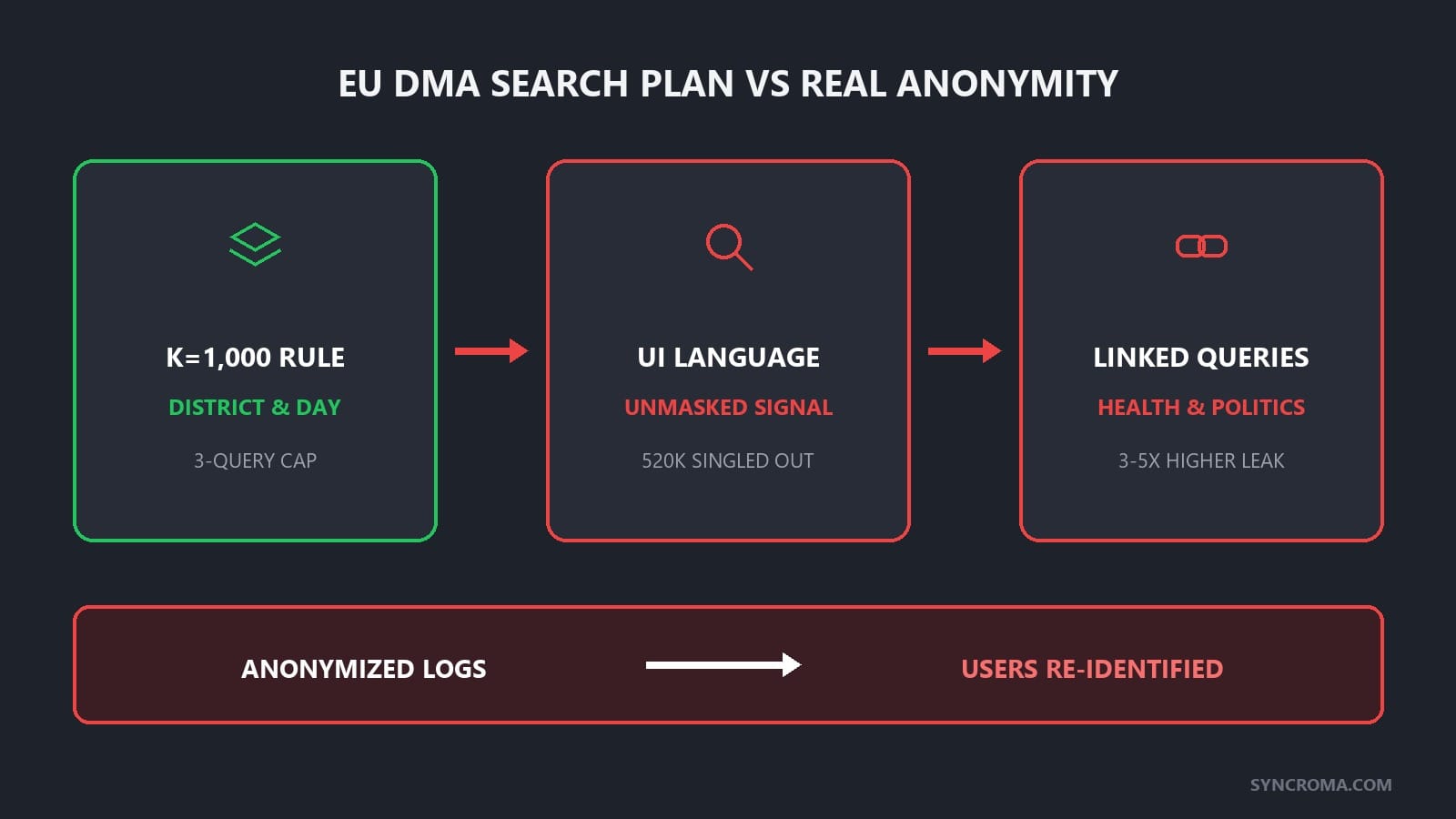
On paper, Brussels’ scheme applies classic k-anonymity (k ≥ 1,000): a record keeps its district location only if at least 1,000 signed-in users searched there on the same day, in the same query language, on the same device class (desktop or mobile); smaller buckets fall back to country-level or get dropped (Olejnik Report).
The engineering oversight is painfully familiar: the pipeline groups by the query text language while still preserving results-page tab labels tied to the user’s persistent Google interface display language (CyberInsider). Intersecting those unmasked dimensions instantly isolates users:
- Liège, Belgium: A mobile English query stood completely alone among 92,990 records because the search results interface was set to Filipino (CyberInsider).
- Cross-border EU users: In Bavaria’s Oberallgäu district, a German search rendered with Romanian UI labels was unique out of 479,463 records; in Kalisz, Poland, a Polish query displayed in Hungarian stood out across 2.2 million records (Olejnik Report).
- Massive monthly isolation: Across Belgium, France, Germany, Ireland, and Poland in August 2026 alone, single tab labels singled out over 520,000 search records—and 85,553 records remained uniquely distinguishable even after fallback generalization to the entire country (CyberInsider).
Bypassing the Three-Search Cap and Inferring National Security Risks
To prevent profiling, the EU rules split search trails into mini-sessions capped at three searches per ID. On real telemetry, linkage inside the same dataset defeated the cap repeatedly:
| DMA Privacy Safeguard | Empirical Failure in Real Logs (August 2026) | Privacy & Security Fallout |
|---|---|---|
District grouping (k ≥ 1,000) |
Leaves screen UI language labels unmasked (>520,000 isolated). |
Direct GDPR record isolation (singling out) (Olejnik Report). |
| Country-level fallback | 85,553 search records remained unique nationwide per day. | Expats, diplomats, and travelers remain trivially traceable (CyberInsider). |
| Three-query session limit | Almost 230,000 linked sets exceeded the cap in Germany alone. | Cross-device mobile/PC linking surfaces 3–5× more sensitive topics (CyberInsider). |
| Sensitive geographic zones | Clusters around NATO/US bases (Ramstein, Mons, Powidz, Poznań) and Geneva. | Narrowed an EU intelligence agency applicant down to just 3 possible individuals (Olejnik Report). |
Even without rare UI languages, typing a specific numeric medical lab value twice cleanly stitched mobile queries to follow-up desktop queries, exposing health conditions, religious beliefs, sexual interests, and political views three to five times more frequently than isolated three-search snippets (Olejnik Report).
Both Sides Have Homework Here
Take neither Brussels’ assurances nor Big Tech’s legal posture at face value:
- Google isn’t merely an altruistic bystander: Google challenged the EU sharing order in September and funded Olejnik’s independent audit as ammunition (CyberInsider). Yet the entire reason cross-device linkage and UI-language isolation work so sharply is that production search telemetry ties screen language, district granularity, and signed-in behavior together in the first place.
- Regulators are fighting 2026 LLMs with 2014 privacy math: Olejnik notes that even modern European Data Protection Board (EDPB) guidance focuses primarily on joins across external databases rather than intra-dataset inference powered by modern AI models (EDPB, Olejnik Report).
For engineering teams shipping logs or training corpora to AI partners, the lesson is unforgiving: dropping explicit user_id columns while leaving high-entropy metadata (Accept-Language / UI tags, coarse district buckets, rare search tokens) does not anonymize records—it merely forces anyone running an LLM script to connect the dots for free. When scrubbing logs or text before sending prompts externally, strip sensitive identifiers locally first using our Private Offline Text & Log Anonymizer or harden access tokens with our Password Entropy & Breach Auditor. Anonymity is a mathematical property of the output data, not a checkbox in a legal decree.
Visual credits: Syncroma Studio (technical infographic). Cover photograph: Ank Kumar — European Commission headquarters, The Berlaymont Building, Brussels via Wikimedia Commons (CC BY-SA 4.0).

Sistemas reales, sin humo corporativo Real systems, zero corporate hype
Recibe los análisis a fondo sobre arquitectura, consumo de recursos y computación de bajo nivel directamente en tu bandeja de entrada. Get deep-dive software architecture, resource consumption metrics, and low-level computing essays delivered straight to your inbox.
Suscribirse a Syncroma Subscribe to Syncroma

