
(🇪🇸 Leer la versión en español aquí)
You can operate the most heavily guarded semiconductor foundries on earth, pull in $122.4 billion in annual revenue shipping 15 million 12-inch equivalent wafers, and supply over 70% of the global contract foundry market for Apple and Nvidia—and still watch 46,000 employees get auctioned on an underground forum because an external cloud vendor got popped.
That is the blunt reality inside TSMC's new U.S. Securities and Exchange Commission (SEC) disclosure, reported by BleepingComputer and The Record: zero internal TSMC production networks or customer silicon IP were touched, yet leaked employee records match data hosted inside an unnamed third-party cloud service provider.
Breach Breakdown: Bulletproof Fabs, Soft SaaS Underbelly
Notice the uncomfortable lesson for every CTO banking on vendor compliance badges:
| Incident Dimension | Verified Details from Filing & Reporting | Production Reality Check |
|---|---|---|
| Scale & Auction Volume | 6.9 GB archive allegedly spanning 46,000 employee records (499-row sample posted Nov 8) | Prime fuel for targeted spear-phishing, payroll redirection, and identity fraud |
| Exposed Fields Claimed | Names, contact info, addresses, national IDs, and banking details | Permanent PII—unlike an API token, staff cannot rotate government IDs overnight |
| Extortion Timeline | Threat actor SmithBianl opened bidding at 3 BTC, threatening full dump on Nov 15 |
Forced public SEC disclosure signed by TSMC CFO Wendell Huang |
| Blast Origin | Breached third-party cloud service provider (vendor name undisclosed) | Internal fab infrastructure and customer chip designs stayed untouched |
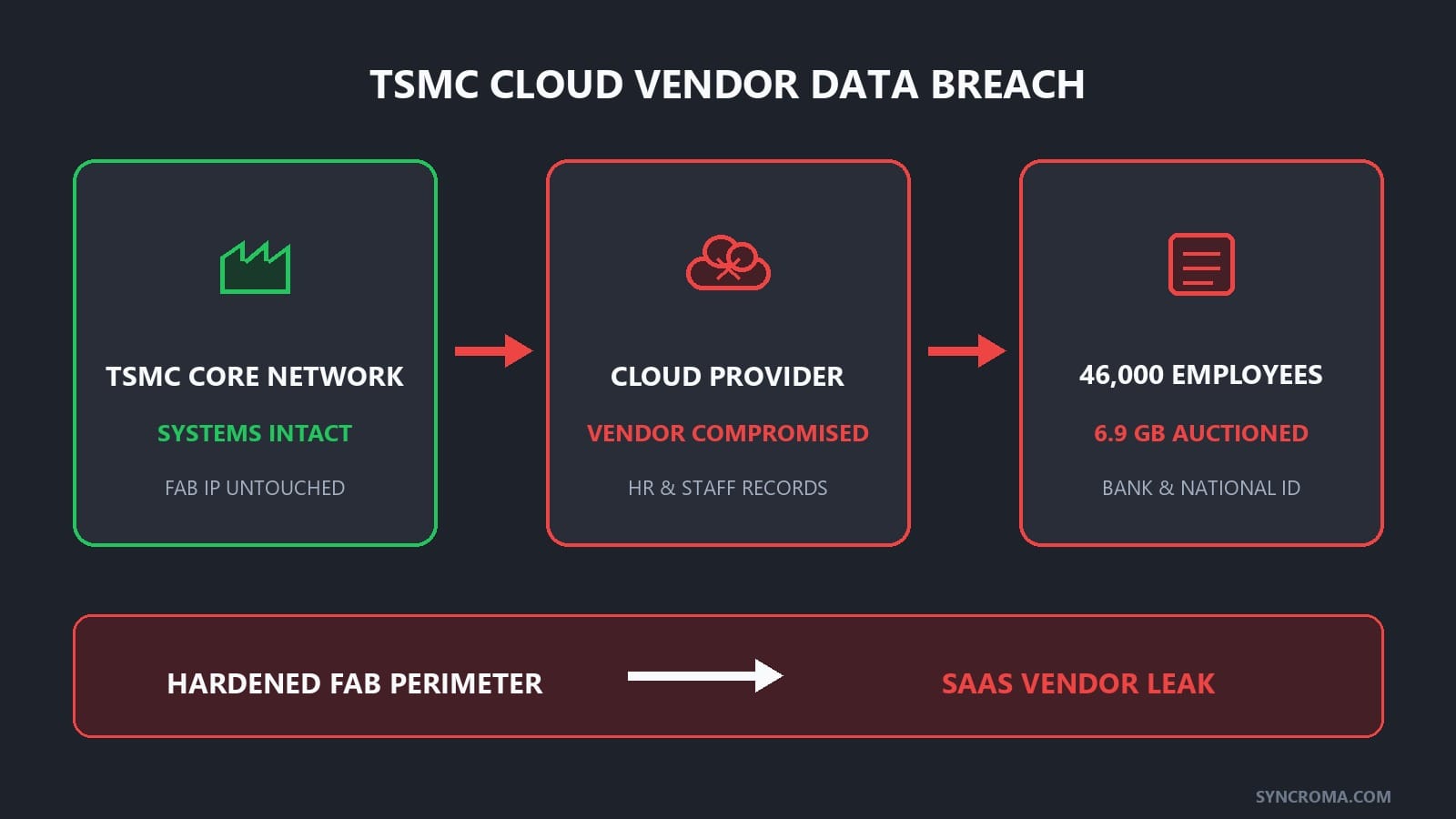
Why Outsourcing HR & Payroll Creates a Single Juicy Target
Breaking straight into TSMC's core Taiwanese fab infrastructure means fighting air-gapped cleanroom networks, hardware segmentation, and nation-state-grade telemetry. By contrast, an external cloud HR or payroll service consolidates bank account numbers, residential addresses, and government IDs for tens of thousands of current and former staff behind multi-tenant web APIs and support portals.
As CFO Wendell Huang confirmed in the SEC filing cited by The Record, TSMC had to coordinate an external cybersecurity firm, investigators, and the cloud vendor simultaneously just to verify what leaked from systems TSMC doesn't even host itself. Worse, this isn't TSMC's first third-party supply-chain hit either: back in 2023, an IT hardware vendor breach exposed TSMC to ransomware fallout, proving again that perimeter walls stop where vendor APIs begin.
Three Architectural Anti-Patterns That Turn SaaS Leaks Into Catastrophes
When sensitive human data leaves your VPC for a cloud vendor, three engineering shortcuts maximize the damage:
- Zero retention pruning for ex-employees: Notice the leak affects both current and former employees. Leaving stale payroll and national ID archives parked inside third-party cloud vendors forever enlarges your breach blast radius for zero business utility.
- Service-managed encryption instead of client-held keys: If a vendor stores raw IBAN/routing numbers and IDs using platform keys accessible to its own runtime, a single compromised admin session or snapshot export dumps everything in plaintext.
- Finding out from an underground auction instead of egress telemetry: Learning about exfiltration only after
SmithBianldumps a 499-row preview and sets a 7-day ransom countdown highlights why vendor SLAs never substitute for strict data minimization.
If your team handles auth strings, timestamps, or sensitive debug snippets day to day, keep secrets strictly in local memory with our new Zero-Upload Base64, URL, Epoch & UUID v4 Browser Suite, scrub traces with the Offline PII & Secret Log Anonymizer, or browse all Syncroma Free Tools.
The Trench Verdict
Your security posture is only as strong as the least audited third-party SaaS vendor syncing your HR or finance tables. Purge former employee records from external platforms on a strict TTL, minimize sensitive columns replicated out of core systems, and design incident playbooks assuming a cloud vendor holding your people's banking data will eventually leak it.
Vector infographic designed by Syncroma Studio.
Sistemas reales, sin humo corporativo Real systems, zero corporate hype
Recibe los análisis a fondo sobre arquitectura, consumo de recursos y computación de bajo nivel directamente en tu bandeja de entrada. Get deep-dive software architecture, resource consumption metrics, and low-level computing essays delivered straight to your inbox.
Suscribirse a Syncroma Subscribe to Syncroma

