(🇪🇸 Leer la versión en español aquí)
Digital music distribution has just encountered its first explicit institutional wall against mass-generated algorithmic content. High-fidelity streaming service Tidal has updated its terms of service to outright ban and retroactively purge from its catalog any music track generated entirely by artificial intelligence.
Below is an engineering analysis of the policy, the technical feasibility of detecting synthetic audio at scale, and the practical implications for producers and audio engineers.
1. What Happened: The Purge of 100% Synthetic Audio
On November 24, 2026, Tidal officially released a major update to its AI Content Policy. Effective December 9, 2026, the platform will systematically reject new ingest submissions and retroactively delete all catalog tracks created entirely through generative AI models (text-to-audio or prompt-to-audio pipelines).
This decision is driven by infrastructure congestion and royalty pool dilution. According to investigative reports from TechCrunch and Digital Music News, 43% of all new audio track submissions delivered to digital distributors over the past 90 days were synthetic AI-generated tracks. Automated bot farms have been bombarding ingestion endpoints with millions of ambient and functional background tracks produced in batch via engines like Suno and Udio to harvest fraction-of-a-cent payouts from subscription pools.
2. Usman's Take: PR Headlines vs. Production Realities
"Tidal’s stance sounds heroic in a press release aimed at appeasing major record labels and audiophile subscribers. But if you look at the raw mechanics of high-throughput ingestion pipelines, enforcing this rule is a technical nightmare.
Today, there is zero probabilistic acoustic classifier in production capable of proving with 100% certainty that a 24-bit / 96 kHz PCM WAV file originated from a neural model rather than an analog outboard chain. Unless an audio file carries cryptographically signed C2PA provenance metadata baked into its headers at generation time, spectral and phase-artifact detectors spit out unacceptable false positive rates the moment a human producer applies modern brickwall limiters, heavy granular synthesis, or aggressive formant processing.
There is also blatant industry hypocrisy at play. Platforms like Spotify actively push synthetic voice algorithms and automated DJ personalities (a friction point we previously explored when analyzing how to mute Spotify AI DJ commentary), yet expect distribution aggregators to magically police where human creativity ends and machine synthesis begins. If enforcement hinges on voluntary self-reporting checkboxes in DistroKid or TuneCore, spam farms will simply blend in 3 seconds of live guitar to bypass heuristics, while independent artists risk false-positive takedowns."
3. Ground Truth: Tidal’s Technical Compliance Matrix
To clarify exactly what workflows pass inspection and what gets purged starting December 9, we examined Tidal’s official documentation and structured it into this compliance breakdown:
| Production Workflow / DSP Technique | Tidal Official Status | Ingestion Detection Vector | Enforcement Risk |
|---|---|---|---|
| Pure prompt-to-audio (Suno, Udio, Stable Audio) | BANNED | Distributor metadata + acoustic fingerprinting | Critical (Retroactive Purge) |
| Unauthorized vocal cloning (Deepfake voice) | BANNED | Biometric matching + DMCA takedowns | Immediate (Account Blacklist) |
| AI-driven stem separation (iZotope RX, RipX) | ALLOWED | Standard stereo master metadata | None (Post-production tool) |
| Algorithmic mastering & EQ (Ozone, LANDR, Sonible) | ALLOWED | Standard DSP processing chain | None (Audio processing) |
| AI-assisted MIDI / Melody generation | ALLOWED | Standard VST synthesizer output | None (Human authorial work) |
| Neural audio restoration & denoising | ALLOWED | Corrective mix engineering | None (Signal cleanup) |
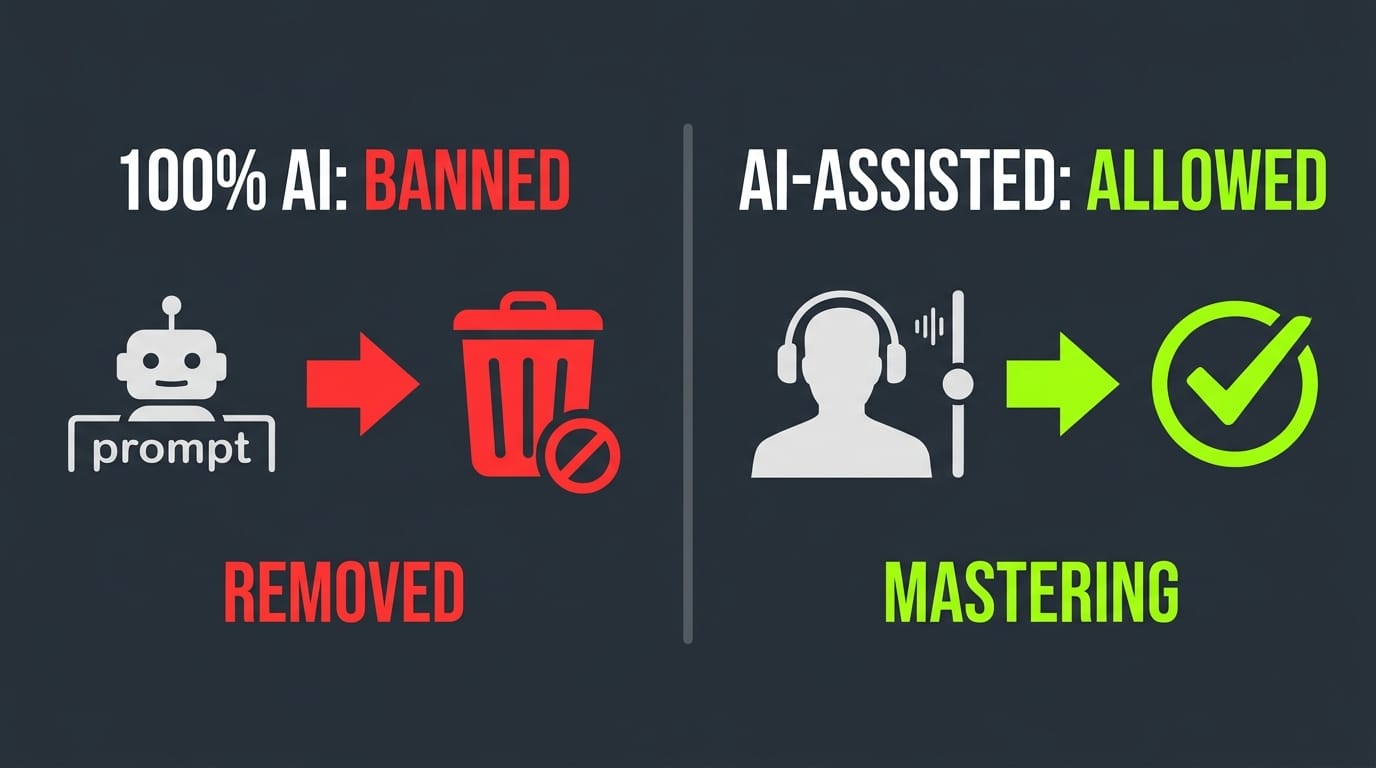
Infographic: Syncroma Studio under editorial license.
The technical boundary drawn by Tidal is conceptually distinct: assisting human workflows across the digital signal processing (DSP) chain is permitted; replacing human composition and musicianship entirely with black-box prompt models is banned.
4. Actionable Steps for Audio Engineers and Music Creators
If you deliver audio content to streaming platforms via aggregators, execute these three preventative steps before December 9:
- Audit release metadata on your distribution dashboard: Log into DistroKid, TuneCore, CD Baby, or Altafonte. Verify that your delivery forms do not incorrectly tag human studio projects as synthetic. If you use AI mastering or spectral restoration plugins, do not flag the track as "100% AI-generated" unless the underlying audio was fully generated by a prompt.
- Proactively take down pure prompt-to-audio experiments: If you have published tracks on Tidal that were generated end-to-end via text-to-music systems, issue takedown requests prior to December 9. Terms-of-service violation strikes across distributor feeds can flag entire accounts and jeopardize legitimate releases.
- Archive your multi-track DAW project sessions: As automated detection filters expand across platforms (similar to the automated fingerprinting we documented regarding social media AI content protection systems), always back up your DAW projects (
.als,.flp,.cpr,.logicx) along with individual multi-track stems. These session stems serve as your sole definitive evidence to overturn algorithmic false positives.
5. What Remains Unanswered
Three major questions remain unresolved:
- Will Spotify and Apple Music follow suit? Tidal holds a relatively modest slice of global streaming share. If market leaders Spotify and Apple Music choose to tag rather than ban pure AI tracks, the financial incentive for synthetic spam farms will remain virtually unaffected.
- The lack of a universal cryptographic watermark standard: The industry has not yet standardized whether C2PA audio headers or invisible perceptual watermarks (such as Google DeepMind's SynthID) will be mandated at the OS or distributor level.
- The hybrid threshold boundary: Tidal’s current guidance does not define the numerical threshold where a hybrid production (for instance, a human electronic track sampling a 2-second synthesized texture) trips the ban wire.
6. Primary Sources and References
Sistemas reales, sin humo corporativo Real systems, zero corporate hype
Recibe los análisis a fondo sobre arquitectura, consumo de recursos y computación de bajo nivel directamente en tu bandeja de entrada. Get deep-dive software architecture, resource consumption metrics, and low-level computing essays delivered straight to your inbox.
Suscribirse a Syncroma Subscribe to Syncroma