(🇪🇸 Leer la versión en español aquí)
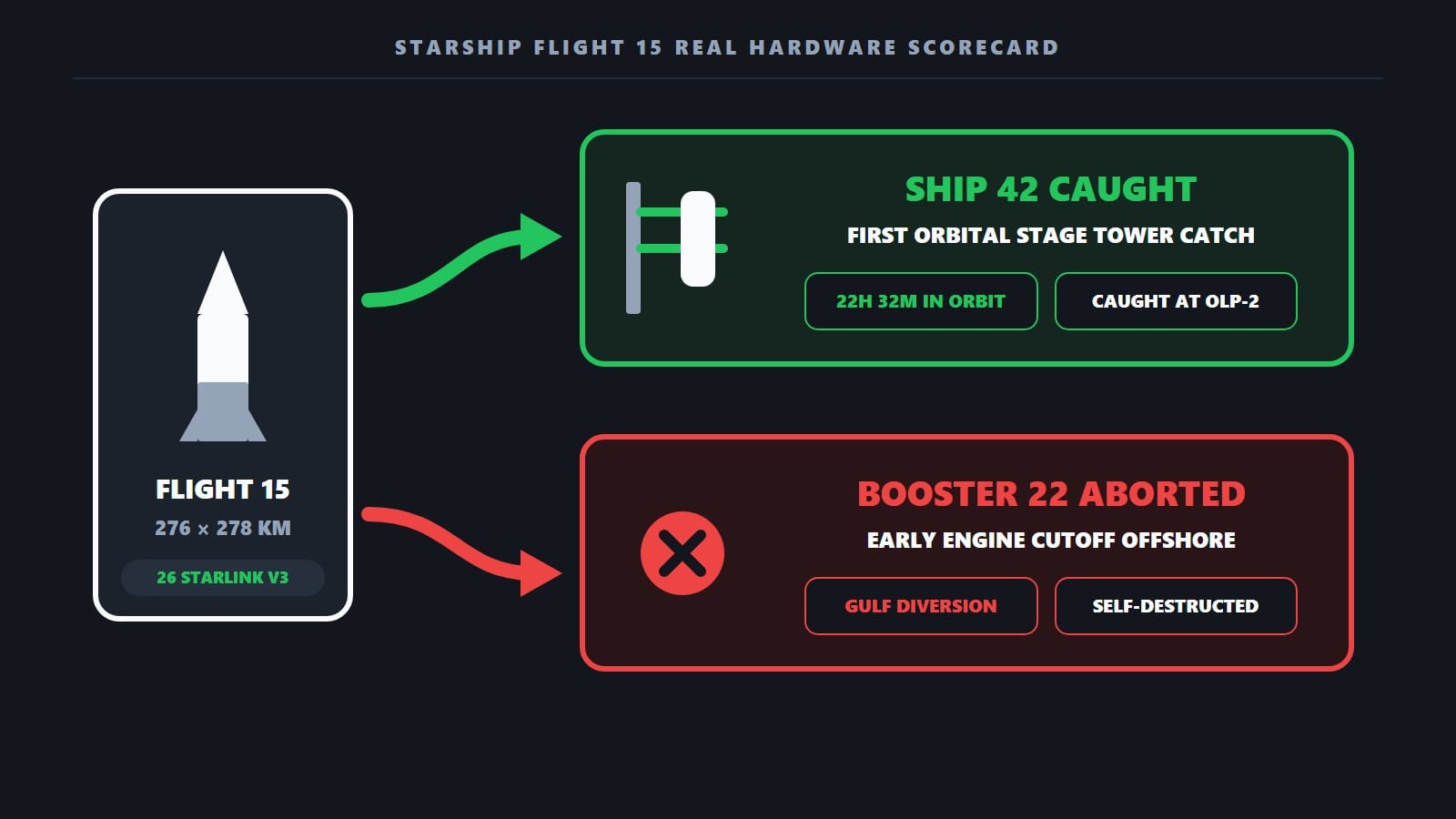
The footage circling the globe right now looks straight out of sci-fi, yet Starship Flight 15's telemetry tells a far sharper engineering story than the celebratory highlight reels. Across November 13–14, 2026, SpaceX pulled off a legitimate aerospace first: catching an orbital-class upper stage — Ship 42 ("Don't Panic") — cleanly between the mechanical chopstick arms of Orbital Launch Pad 2 (OLP-2) after 22 hours and 32 minutes in low Earth orbit deploying 26 Starlink V3 satellites (Wikipedia, Al Jazeera / AP & Reuters, SpaceX).
At the same time, the mission missed its headline goal of spaceflight's first full "double catch." Minutes after liftoff on November 13, Super Heavy Booster 22 (Block 3) suffered an early engine shutdown during descent; its autonomous flight computers aborted the tower approach, diverted offshore over the Gulf of Mexico, and triggered self-destruction (Al Jazeera, Space.com).
Flight 15 (Starlink Group 31-2) Hardware Scorecard
Strip away the hype and look at the verified operational numbers from Starbase:
| Mission Component / Metric | Verified Flight 15 Outcome (Nov. 13–14, 2026) | Operational Takeaway |
|---|---|---|
Upper Stage Ship 42 (Block 3) |
Caught mid-air at OLP-2 (21:20:03 UTC, Nov. 14) |
First orbital rocket upper stage ever recovered by launch-tower arms after reentry (Wikipedia) |
First Stage Booster 22 (Block 3) |
Early engine cutoff on descent; Gulf splashdown & destruct | First Block 3 booster catch remains pending despite three prior Block 1/2 catches (Al Jazeera) |
| Orbit & Endurance | 276 × 278 km, 30.5° inclination, 14 orbits (~22h 32m) |
Sets new Starship endurance mark validating multi-orbit thermal/propellant hold (Wikipedia) |
| Commercial Payload | 26 Starlink V3 satellites (3 with heat-shield inspection cameras) | Uses payload birds as orbital tile inspectors prior to Ship 42's reentry burn (Wikipedia) |
Three Engineering Lessons Behind the Split Result
Beneath the triumph of Ship 42 returning safely to the pad, three realities matter most for engineers watching launch cadence and satellite economics:
- Single-point-of-failure protection beats PR schedules: As SpaceX's Kate Tice noted during coverage,
Booster 22's guidance software detected off-nominal trajectory after early engine cutoff and immediately chose an ocean abort (Al Jazeera). Attempting a risky tower catch on OLP-2 would have risked obliterating the very arms needed 22 hours later to catchShip 42. Deterministic fail-safe aborts remain non-negotiable. - In-orbit observability built into commercial payloads: Equipping three of the 26 Starlink V3 satellites with onboard cameras to inspect
Ship 42's thermal protection tiles in space turned routine constellation deployment into live pre-reentry diagnostics without launching a separate mission. - Why full dual recovery still gates Starlink V3 economics: V3 spacecraft are sized around Starship's massive fairing and lift capacity. Until both Block 3 stages return reliably for rapid turnaround, hardware scrap rates still cap real per-gigabit orbital deployment savings.
Grounded Takeaways for Infrastructure & Reliability Teams
Whether managing launch pads in Boca Chica or distributed clusters on Earth, margins and abort paths decide survival. A reusable architecture only breaks even economically when both halves hit repeatable reliability — and autonomous control loops must fail closed away from shared choke-point infrastructure the instant telemetry drifts out of spec.
Calculate realistic availability budgets before single-point failures wreck your uptime in our SLA Uptime & Error Budget Calculator or size backup link recovery windows with the Data Transfer, Backup RTO & TCP BDP Calculator.
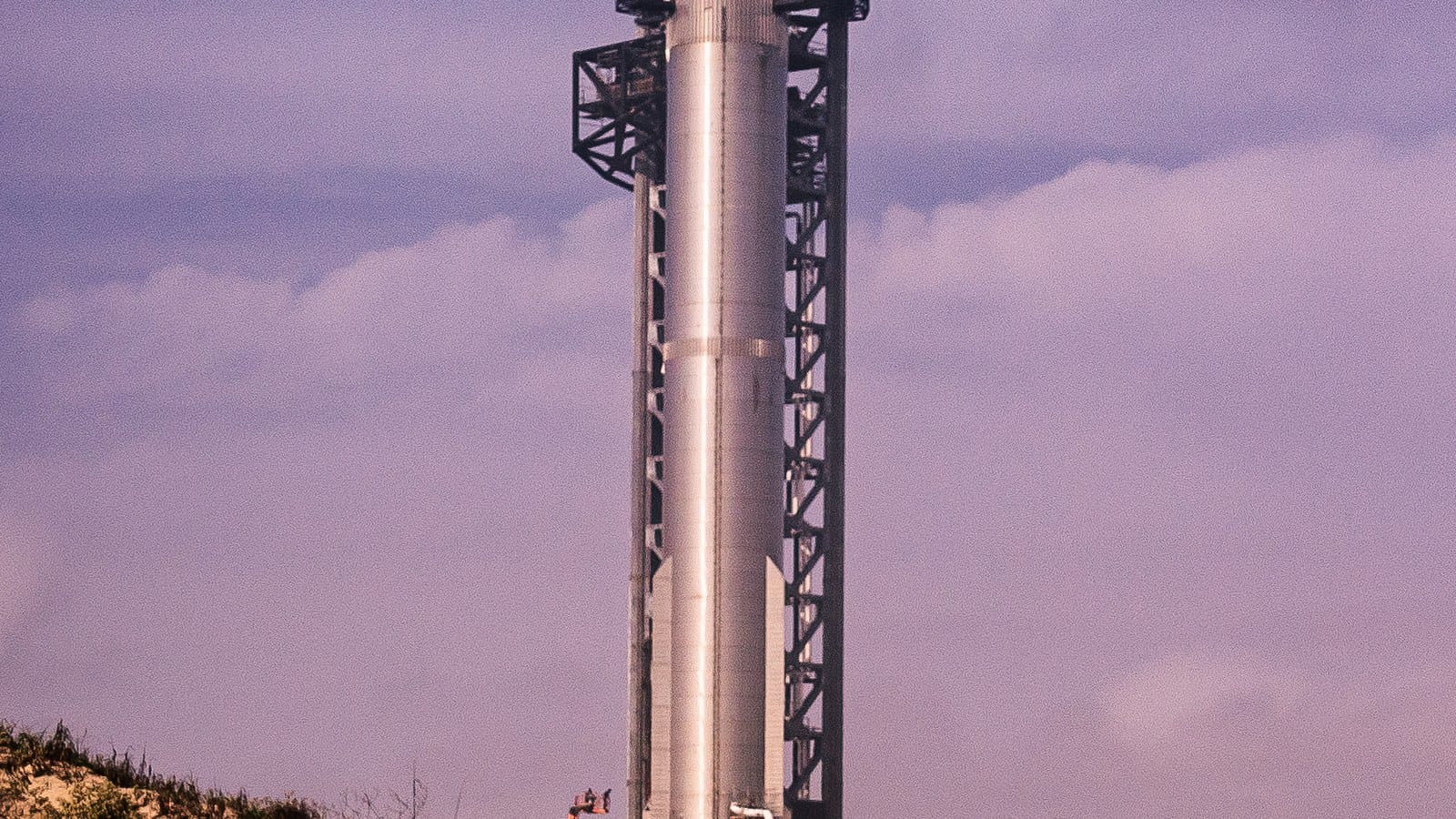
Graphics by Syncroma Studio. Cover photograph: Mobilus In Mobili / Wikimedia Commons (CC BY-SA 2.0).

Sistemas reales, sin humo corporativo Real systems, zero corporate hype
Recibe los análisis a fondo sobre arquitectura, consumo de recursos y computación de bajo nivel directamente en tu bandeja de entrada. Get deep-dive software architecture, resource consumption metrics, and low-level computing essays delivered straight to your inbox.
Suscribirse a Syncroma Subscribe to Syncroma

