(🇪🇸 Leer la versión en español aquí)
If you have been putting off a 32 GB DDR5 upgrade, a 2 TB NVMe drive, or a new laptop waiting for memory prices to mean-revert, SK Hynix just killed that thesis on the record. In its Q3 2026 earnings release, the world's second-largest memory maker warned that global memory demand will outpace production capacity through 2030, as reported by Fortune, TechPowerUp, and PCWorld.
This is not a short-term inventory hiccup or the usual two-year DRAM boom-and-bust cycle. Inside memory fabs, wafer starts are a brutal zero-sum game: every silicon wafer allocated to stacked HBM for AI accelerators is a wafer pulled away from consumer DDR5, laptop LPDDR5X, and smartphone storage.
The Hard Financial Numbers Behind Higher Hardware Bills
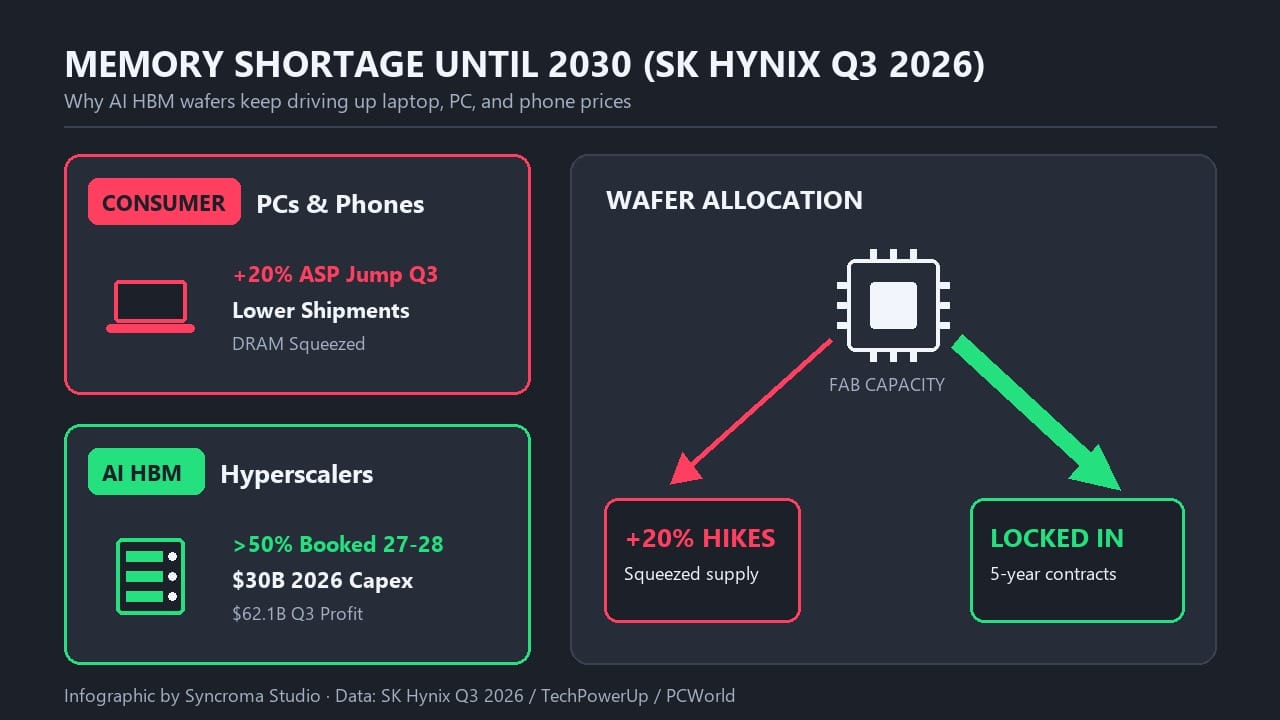
Consumer tech commentary loves to assume new fabs will flood the market any quarter now. SK Hynix's actual Q3 2026 numbers — released on October 28, 2026 — prove why retail laptops and phones sit dead last in the allocation queue:
| Operational Metric (Q3 2026 / Capacity Outlook) | Verified Figure | Real-World Pricing & Supply Impact |
|---|---|---|
| SK Hynix Q3 2026 revenue | 104.6T KRW (~$78.1B) | Up 32% QoQ driven by AI memory demand |
| Q3 2026 operating profit | 83.3T KRW (~$62.1B) | Roughly ~80% operating margin (+38% QoQ) |
| Memory module ASP jump in Q3 | Over +20% QoQ vs. Q2 | Signals 20%+ retail price hikes once buffers drain |
| 2027–2028 supply locked down | >50% pre-sold under LTAs | 14 major buyers locked 5-year agreements |
| 2026 capacity CapEx budget | 40T KRW (~$30B) | New $13B fab will not ramp until 2030 |
The red flag for both PC builders and enterprise IT procurement teams is the velocity of average selling price (ASP) inflation. According to TechPowerUp, memory module ASPs jumped more than 20% in a single quarter. Once PC OEMs and phone vendors burn through cheaper pre-bought DRAM stock, that bill-of-materials (BOM) spike goes straight onto retail stickers.
SK Hynix explicitly projects lower traditional PC and smartphone shipment volumes — and does not lose sleep over it because hyperscaler AI data centers absorb the slack at stratospheric margins. Its CEO previously echoed the 2030 deficit warning (TechPowerUp), while rival Samsung has indicated its own shortage extends at least into 2028 per PCWorld.
Why Throwing CapEx at New Fabs Won't Rescue Prices Tomorrow
Three structural physics and contract constraints prevent quick relief:
- Leading-edge lithography overhead: High-layer HBM stacks and dense server DRAM rely on complex multi-step EUV lithography nodes with tighter yield margins than legacy commodity DDR4/DDR5, yielding fewer total gigabytes per wafer across existing cleanrooms.
- Five-year hyperscaler lock-ins: With 14 heavyweight customers already claiming over 50% of SK Hynix's 2027 and 2028 capacity via five-year long-term agreements, every consumer OEM, gaming brand, and mid-market server builder is bidding on whatever spot wafers remain.
- Multi-year fab lead times: Even with roughly $30 billion earmarked for capacity expansion in 2026 (up from ~$23 billion in 2025) and a $13 billion fab project, pouring cleanroom concrete, installing lithography tools, and qualifying mass yields takes years — leaving that new capacity offline until 2030.
What This Actually Means for Engineers, Builders, and Buyers
Cheap abundant memory subsidized years of bloated Electron apps and oversized inference clusters. That cushion is gone:
- Laptops, smartphones, and consoles: Expect tighter base memory tiers to stick around longer while 32 GB+ laptop SKUs carry painful markups once OEM buffers reset.
- Self-hosted AI & server infrastructure: Stop guessing RAM and VRAM footprints before committing hardware spend. Size model quantization and KV cache strictly using our LLM VRAM calculator and audit real cluster capex against electricity overhead in the GPU cluster power, PUE & TCO calculator.
- Product unit economics: Hardware resellers and SaaS teams facing 20%+ memory and instance hikes should re-check contribution margin thresholds immediately with our break-even point & ROI calculator.
When a memory duopoly/oligopoly pre-sells half of the next two years at nearly 80% operating margins, consumer hardware absorbs the bill.
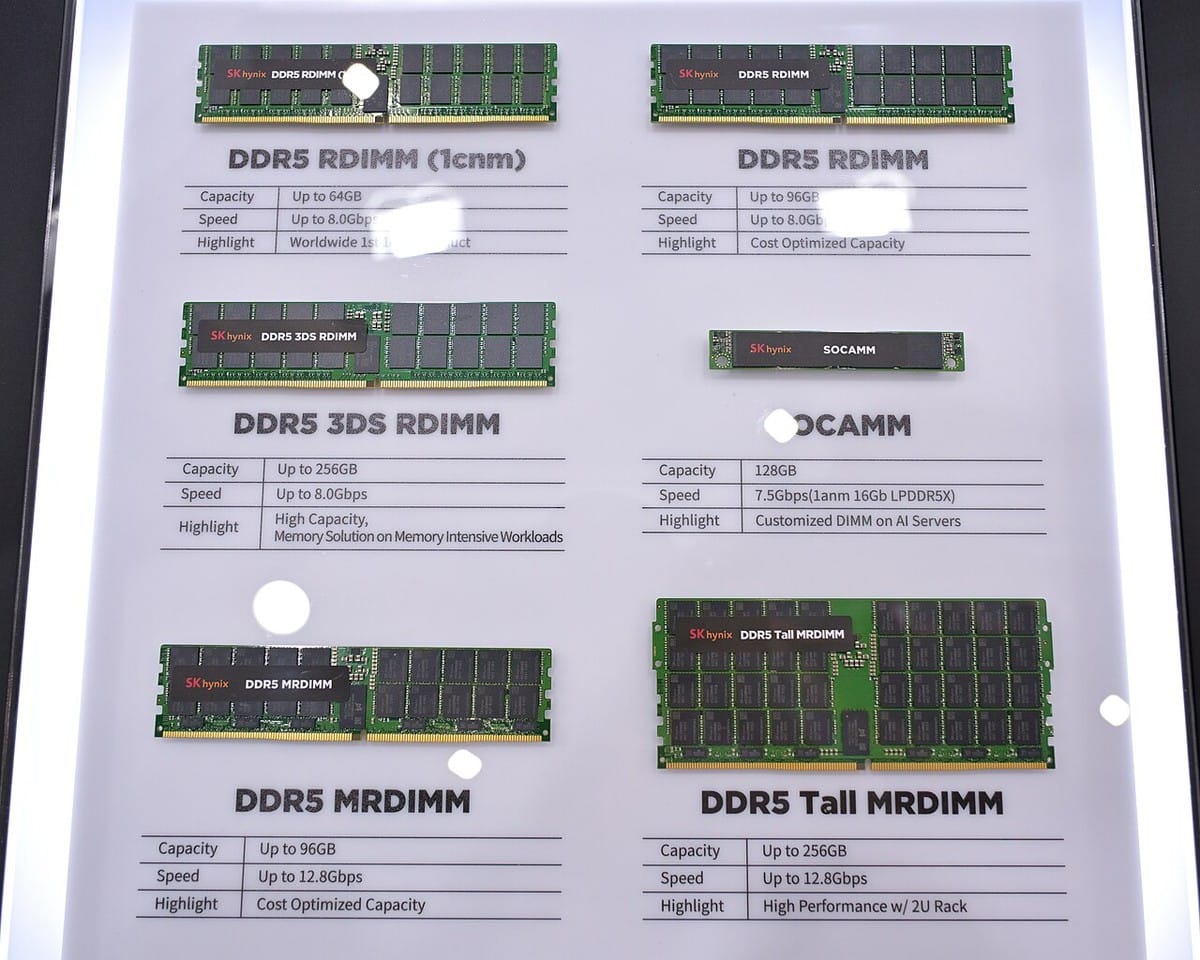
Article and infographic by Syncroma Studio. Cover photo: SK hynix DDR5 RDIMM, SOCAMM, and MRDIMM modules by 4300streetcar on Wikimedia Commons (CC BY 4.0).

Sistemas reales, sin humo corporativo Real systems, zero corporate hype
Recibe los análisis a fondo sobre arquitectura, consumo de recursos y computación de bajo nivel directamente en tu bandeja de entrada. Get deep-dive software architecture, resource consumption metrics, and low-level computing essays delivered straight to your inbox.
Suscribirse a Syncroma Subscribe to Syncroma