(🇪🇸 Leer la versión en español aquí)
Having the world's most rigorous end-to-end cryptographic protocol in transit is meaningless if the host operating system captures unencrypted screenshots of your chat viewport every few seconds. That is the stark warning issued by the Signal Foundation as it deploys aggressive screenshot and screen-recording blocks across iOS and Android, categorizing operating system AI agents as an "existential threat" to user privacy, according to Signal's official statement.
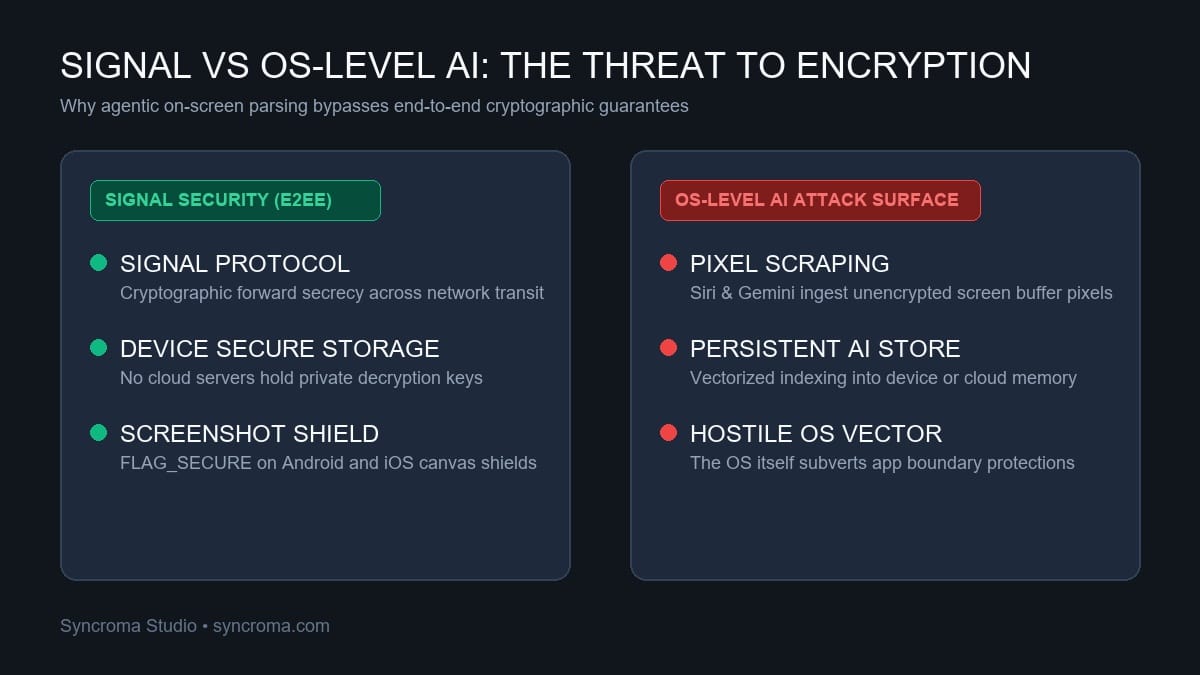
Signal's architectural countermeasure directly targets two big-tech initiatives: Apple's upgraded Siri with Onscreen Awareness and Google's Gemini Intelligence. Both features operate by continuously ingesting user framebuffer pixels to provide contextual assistance.
In doing so, they dismantle the threat model that modern end-to-end encryption was engineered to defend against.
1. The Cryptographic Illusion: Ingesting the Plaintext Pixel
For a decade, security engineers relied on a well-understood security guarantee:
- Decryption keys remain isolated on local client hardware.
- Relay servers only pass blinded ciphertext payloads.
- Telecom carriers, ISPs, and nation-states cannot inspect messages in transit.
However, to display a conversation to a human reader, the application must decrypt the payload and rasterize it directly into the device's display buffer.
When Apple and Google deploy background multimodal agents with system-level screen-capture hooks, the agent does not attempt to break mathematics or crack curve25519 keys: it simply performs optical character recognition (OCR) and visual tokenization on the raw, unencrypted pixels displayed on your glass.
| Security Layer | Traditional E2EE Messaging | With OS-Level AI Active (Siri / Gemini) |
|---|---|---|
| Transit Network | Authenticated ciphertext packets | Authenticated ciphertext packets |
| Relay Servers | Zero plaintext visibility | Zero plaintext visibility |
| Local Framebuffer | Rendered solely for human eyes | Ingested by OS background vision agents |
| Data Persistence | Optional ephemeral auto-deletion | Vectorized into system semantic memory |
2. Signal's Technical Defense: FLAG_SECURE and iOS Canvas Shields
To prevent automated screen scraping from turning private discussions into training or prompt context, Signal implemented targeted defensive primitives:
- On Android (
FLAG_SECUREEnforcement): Signal forces the window manager to designate its canvas as secure. When Gemini Assistant or background screen recorders attempt to dump the surface buffer, the OS Compositor returns a black rectangle. - On iOS (
Block Siri AIDefault): Signal leverages video recording protection and screen-mirroring prevention APIs to block Apple Intelligence agents from silently parsing chat hierarchies. - The Microsoft Recall Precedent: This move mirrors privacy pushback against Microsoft Recall on Windows 11, but shifts the frontline to personal mobile hardware.
For deeper technical context on how accessibility and screen capture APIs create system-level vulnerabilities, read our report on Gemini Computer Use on Mac and TCC Risks.
3. The Uncomfortable Architectural Truth: The Host Always Wins
Signal President Meredith Whittaker openly acknowledged the fundamental architectural reality: this is an incomplete defense.
In operating system design, an unprivileged userland application cannot permanently defeat a hostile host kernel. If Apple or Google decide that their AI agents run with elevated kernel privileges or direct access to window compositor pipelines (SurfaceFlinger on Android, WindowServer on macOS/iOS), third-party apps have zero technical leverage to prevent pixel extraction.
[!WARNING] While blocking window captures stops ambient screenshot ingestion, it cannot defend against accessibility APIs or background notification scraping if the OS pipelines those alerts into local vector databases.
4. The Syncroma Verdict
Signal is entirely right to draw a line in the sand. Turning consumer smartphones into ambient optical wiretaps under the banner of "proactive AI assistance" nullifies confidential computing.
Unless hardware vendors establish standardized kernel-level opt-out APIs that prevent system AI from ever reading private application memory or framebuffers, end-to-end encryption will become a historical relic: impervious over fiber-optic cables, yet freely indexed on your own screen.
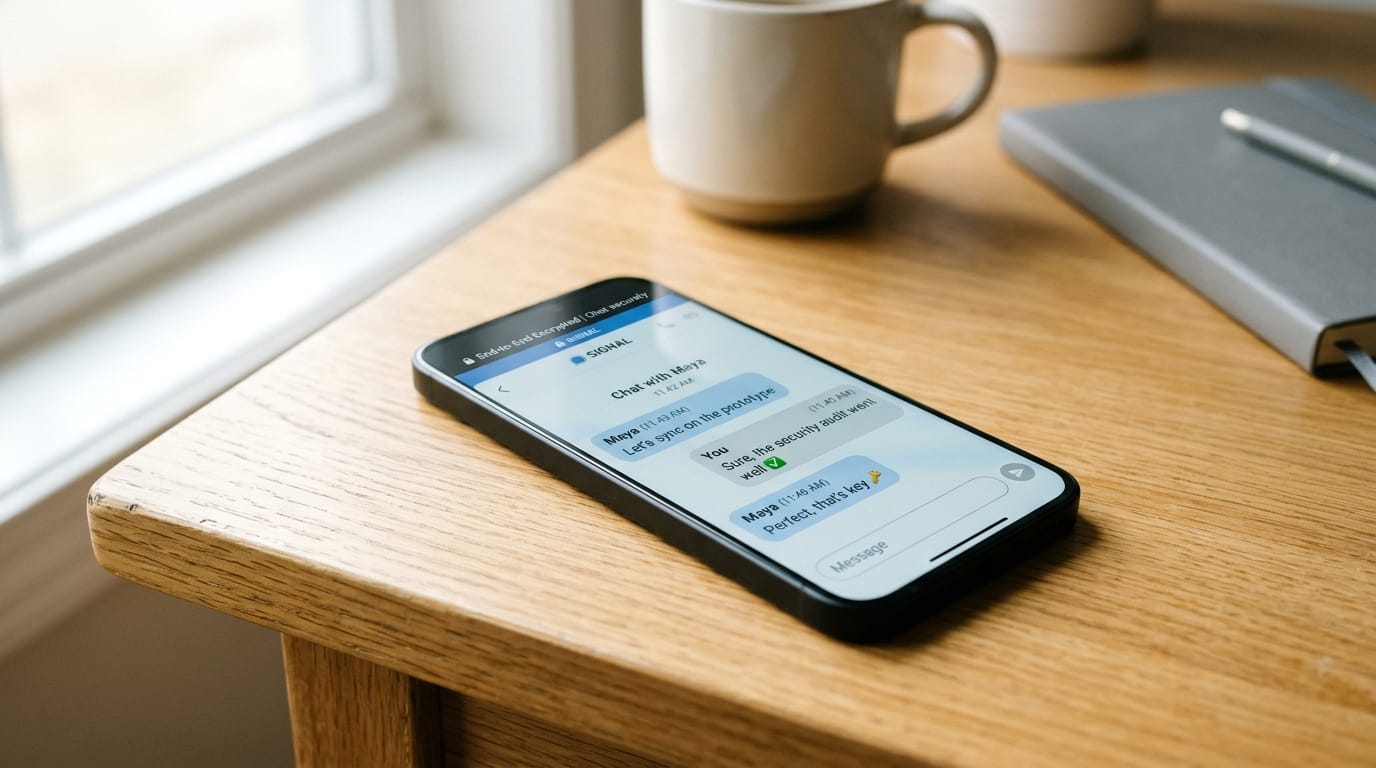
Credits: Technical analysis by Syncroma Studio. Cover image: Editorial smartphone on office workspace desk. Infographic: Syncroma Studio.
Sistemas reales, sin humo corporativo Real systems, zero corporate hype
Recibe los análisis a fondo sobre arquitectura, consumo de recursos y computación de bajo nivel directamente en tu bandeja de entrada. Get deep-dive software architecture, resource consumption metrics, and low-level computing essays delivered straight to your inbox.
Suscribirse a Syncroma Subscribe to Syncroma

