
(🇪🇸 Leer la versión en español aquí)
In cloud incident response, there is a recurring psychological trap that catches operations and security teams off guard: premature vendor patch relief.
Microsoft recently rushed out an emergency server-side mitigation for a critical vulnerability in the management plane of legacy Azure API Management (APIM) instances—specifically affecting the Developer, Basic, Standard, and Premium tiers. The flaw, actively exploited in targeted cyberattacks against critical European infrastructure (including Norwegian energy producers Equinor and Skagerak Energi), allowed unauthenticated threat actors to bypass authentication checks and harvest internal gateway configuration state.
Microsoft deployed a backend fix closing the unauthorized entry vector within roughly 24 hours. Many engineering teams saw the advisory, breathed a sigh of relief, and closed their internal incident tickets.
Yet if you understand how persistence and lateral movement operate in backend cloud architecture, you know that relief is a catastrophic mistake: a platform patch locks the front door, but it does nothing to revoke the master keys the adversary already copied and took home.
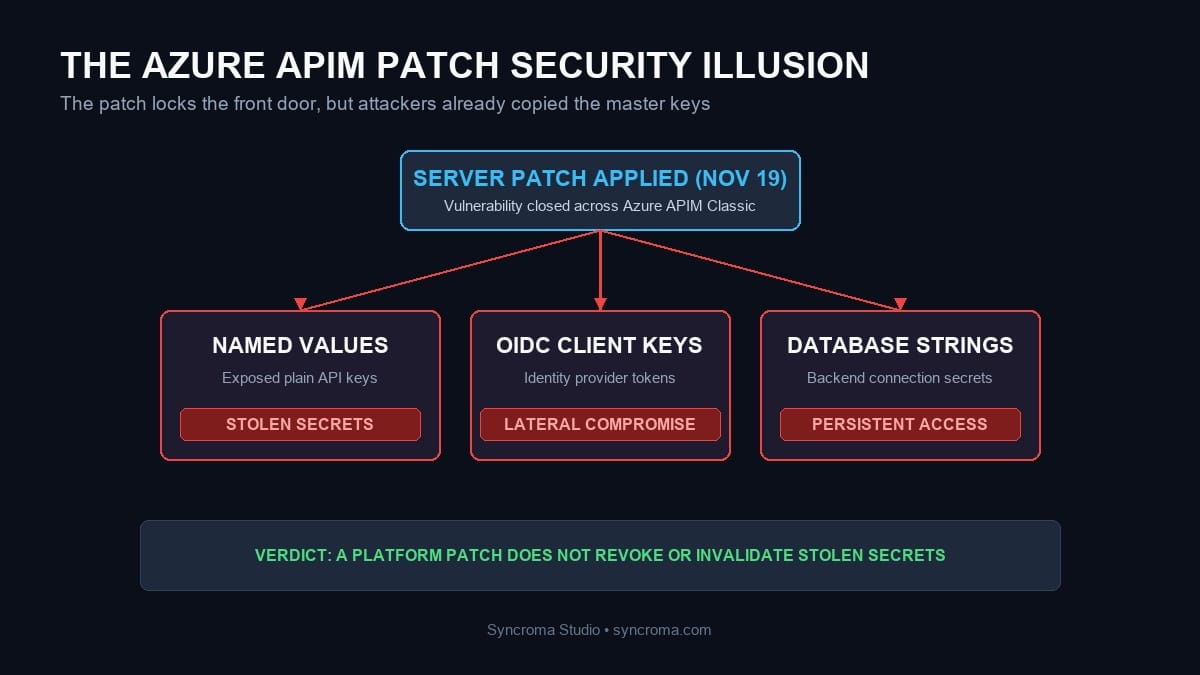
1. The Perfect Loot: The Hazard of Static Named Values
To comprehend the blast radius of this compromise, you have to examine how development teams store integration secrets inside Azure APIM.
The default feature is called Named Values. Officially, Microsoft’s architectural best practices recommend that sensitive secrets should reference an external Azure Key Vault secret resolved via a system-assigned Managed Identity.
In production reality, however, under the pressure of tight deadlines, thousands of live enterprise gateways store secrets directly as raw plaintext or local secret strings within APIM’s internal database:
- Third-Party API Keys: Payment gateway tokens (Stripe, Adyen), messaging endpoints (Twilio, SendGrid), and AI inference broker credentials.
- Database Connection Strings: Master JDBC and ODBC connection strings containing embedded administrative usernames and passwords for Azure SQL, PostgreSQL, and Cosmos DB instances.
- Identity Provider & OIDC Client Secrets: Client credentials used to validate JSON Web Tokens (JWTs) or federate application trust with Microsoft Entra ID, Okta, and Auth0.
- Subscription Keys & Direct Management Tokens: Master keys that permit arbitrary callers to invoke backend APIs while bypassing rate-limiting and quota policies.
The attackers targeting this flaw were not interested in executing noisy denial-of-service attacks. They were conducting silent metadata and secret harvesting. Once an adversary extracts your table of Named Values, they never need to touch your Azure APIM instance again to compromise your infrastructure.
2. Why the Patch Is Only 10% of the Remediation
Norway’s National Security Authority (NSM) and independent cloud security researchers have issued an unambiguous advisory: assume total compromise.
When an adversary possesses your raw connection strings and third-party tokens:
- Direct Backdoor Access: The attacker no longer routes traffic through your API Management gateway. They bypass gateway WAF rules, inspection policies, and rate limits entirely, connecting directly to the public IP addresses or exposed ingress controllers of your backend databases using legitimate stolen credentials.
- Silent Lateral Movement: Armed with a stolen Microsoft Entra ID client secret, an adversary can mint application tokens, request elevated API permissions, and access internal enterprise Microsoft Graph APIs without triggering immediate perimeter alarms.
- Immutable Persistence: The fact that Microsoft patched the underlying management-plane vulnerability on November 19 does not alter a single character of the credentials sitting in the attacker’s repository.
3. The Design Anti-Pattern: Treating Gateways as Secret Vaults
This incident highlights an architectural flaw deeply embedded in modern cloud deployments: using the API Gateway as a persistent credential store.
An API Gateway is meant to be a high-performance, stateless reverse proxy. The moment you store static secrets directly inside XML gateway policies:
<!-- The architectural anti-pattern that dooms your perimeter -->
<policies>
    <inbound>
        <base />
        <send-request mode="new" response-variable-name="token">
            <set-url>https://identity.enterprise.com/oauth/token</set-url>
            <set-method>POST</set-method>
            <set-header name="Authorization" exists-action="override">
                <!-- Static secret exposed in plaintext Named Values -->
                <value>@("Basic " + Convert.ToBase64String(Encoding.UTF8.GetBytes("{{client-id}}:{{client-secret}}")))</value>
            </set-header>
        </send-request>
    </inbound>
</policies>
If that gateway plane is breached, your entire downstream authentication boundary crumbles in a single cascade.
4. Mandatory Hardening Playbook for Engineers
If your organization operates or has operated Azure APIM Classic instances over the past twelve months, do not rely on green health check dashboards in the Azure portal. Execute this decontamination checklist immediately:
- Mandatory 100% Rotation of All Named Values: Assume that every single secret string and plaintext value stored within APIM has been exported. Rotate database passwords, third-party API tokens, and OAuth client credentials without exception.
- Revoke Subscription Keys & Mutual TLS Certificates: Regenerate all primary and secondary APIM subscription keys, and revoke any client X.509 certificates used for mutual TLS authentication with backend microservices.
- Enforce Azure Key Vault with Managed Identities: Eradicate local secret strings from APIM entirely. All sensitive parameters must reside inside a private-endpoint-restricted Key Vault, and APIM must resolve them exclusively via short-lived, system-assigned Managed Identity tokens.
- Audit Target Logs for Stolen Credential Abuse: Stop looking at APIM logs; inspect Microsoft Entra ID sign-in logs and backend database audit trails for connections originating from anomalous IP ranges using the compromised credentials.
In cloud security, a vendor patch fixes the provider’s software bug. Credential hygiene, secret rotation, and blast-radius containment remain solely your responsibility.
Architectural analysis and technical investigation by Syncroma Studio.
Sistemas reales, sin humo corporativo Real systems, zero corporate hype
Recibe los análisis a fondo sobre arquitectura, consumo de recursos y computación de bajo nivel directamente en tu bandeja de entrada. Get deep-dive software architecture, resource consumption metrics, and low-level computing essays delivered straight to your inbox.
Suscribirse a Syncroma Subscribe to Syncroma