
(🇪🇸 Leer la versión en español aquí)
While the enterprise technology sector pours billions of dollars into debates over AI agent alignment and frontier model security, two languages that form the bedrock of the modern web have just delivered a harsh reality check to infrastructure engineers: production workloads still run on 30-year-old C runtimes, where a single miscalculated byte in memory demolishes every perimeter defense you built.
Over the past 72 hours, security operations centers worldwide entered emergency triage following the coordinated disclosure of two critical, unauthenticated Remote Code Execution (RCE) flaws: ruby2shell (CVE-2026-132825) and phpAfterShell (CVE-2026-126714).
Ranging from self-hosted GitLab instances and GitHub Enterprise Server (GHES) appliances to enterprise platforms like Discourse, Mastodon, and millions of legacy web applications, these vulnerabilities expose the extreme fragility of trusting baseline language interpreters.
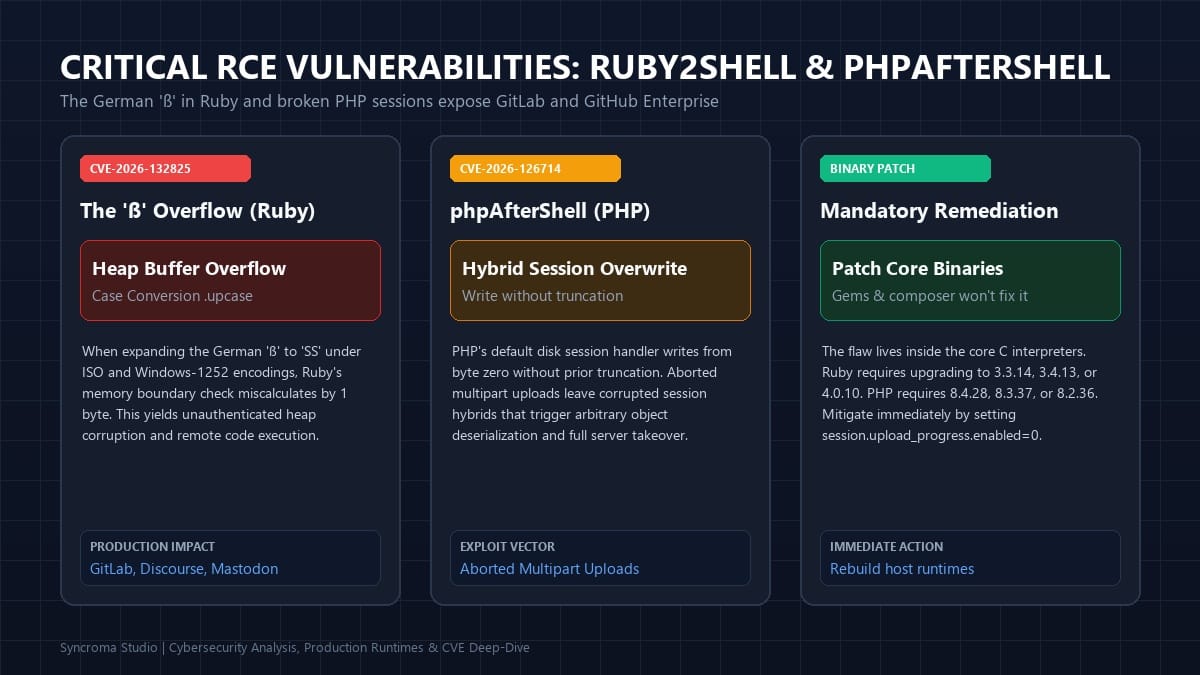
1. ruby2shell: The German 'ß' That Corrupts Ruby's Heap
The first flaw, tracked as ruby2ßhell, embodies the painful irony of systems programming: a critical heap out-of-bounds write triggered by capital casing a single letter from the German alphabet.
Deep inside the C implementation of Ruby's core string manipulation routines (.upcase, .downcase, and .capitalize), memory allocation logic dynamically adjusts buffer sizes based on character encodings:
- Under modern UTF-8, multi-byte grapheme clusters are calculated dynamically via Unicode character database tables.
- However, when applications parse user-supplied strings under legacy single-byte character encodings (such as ISO-8859-1, ISO-8859-15, or Windows-1252), the German lowercase character 'ß' (Eszett) presents a rare linguistic quirk: capitalized, it does not exist as a single byte in legacy sets; it expands into two uppercase characters: 'SS'.
The vulnerability in Ruby's runtime stems from a fundamental off-by-one arithmetic flaw: the allocation boundary check assumed a 1:1 character-to-byte correspondence for single-byte encodings, but the transformation routine wrote two full bytes into the heap buffer.
That single overflowing byte corrupts metadata in adjacent heap chunks managed by malloc or jemalloc. By executing standard heap-grooming techniques (spraying the heap via concurrent HTTP requests), an unauthenticated remote attacker can hijack function pointers and force the process into executing arbitrary shellcode with the full privileges of the web worker.
2. Blast Radius: Why GitLab and GitHub Enterprise Server Scrambled
The severity of ruby2shell is not merely captured by its CVSS 9.8 rating, but by the omnipresence of Ruby across enterprise developer tooling and CI/CD pipelines:
- Self-Hosted GitLab: Much of the core GitLab application backend runs on Ruby on Rails. Unauthenticated instances exposed to public networks with public sign-up or issue tracking endpoints allow attackers to send weaponized usernames, commit tags, or search parameters. GitLab rapidly shipped emergency security versions (19.6.1+) bundling a patched Ruby runtime.
- GitHub Enterprise Server (GHES): While GitHub.com in the cloud is shielded by custom edge WAFs and real-time live patching, on-premises GHES virtual appliances package frozen Linux environments with bundled Ruby runtimes that do not update automatically.
- Forums & Decentralized Networks (Discourse and Mastodon): Thousands of self-hosted developer communities and ActivityPub federated nodes process untrusted user input and search queries through vulnerable background workers every second.
A critical operational detail that caught IT teams off-guard during initial response hours: running bundle update does not resolve this vulnerability. The defect does not exist in a third-party Ruby gem; it lives inside the compiled C binary at /usr/bin/ruby. Systems require complete runtime binary updates (Ruby 3.3.14, 3.4.13, or 4.0.10).
3. phpAfterShell: Why Forgetting to Truncate a File Costs You a Server
While the Ruby community grappled with German typography, researchers at Depthfirst dropped another bombshell: phpAfterShell (CVE-2026-126714), rated at CVSS 9.2.
This vulnerability targets the default, most ubiquitous session storage mechanism in web history: PHP's disk-based file session handler (session.save_handler = files).
The flaw is almost elementary:
- Overwriting from Byte Zero Without Truncation: When PHP serializes session data at the end of a request, it opens
/tmp/sess_<id>in write mode (r+or similar) and streams serialized data starting from byte zero. However, it never issues anftruncate()system call to trim residual data if the newly serialized payload is smaller than the previous session payload. - The Aborted Multipart Upload Vector: When clients submit multipart form uploads with
session.upload_progressenabled, PHP automatically generates transient session structures tracking bytes received. If an attacker terminates the TCP connection mid-upload, PHP leaves the session file in a "hybrid" state: the beginning of the file contains the interrupted upload structure, while trailing bytes retain raw serialized objects from prior requests. - Arbitrary Object Deserialization (RCE): On subsequent requests invoking
session_start(), PHP's internal deserializer attempts to unpack this franken-session. When parsing corrupt byte boundaries alongside crafted gadget chains (present in standard frameworks like Laravel, Symfony, or WordPress), the engine executes magic destructors (__destruct()), granting attackers arbitrary operating system command execution.
4. Operational Runbook: How to Audit and Patch Production Today
If you maintain web infrastructure, remediation must happen at the operating system and container layer immediately:
In Ruby Environments:
- Confirm you are running on patched branches: Ruby >= 3.3.14, >= 3.4.13, or >= 4.0.10.
- For Docker and Kubernetes clusters, restarting pods is insufficient: base container images must be rebuilt and pulled fresh from upstream package repositories.
Verify the runtime version across all app servers:
ruby --version
In PHP Environments:
- Upgrade core PHP binaries immediately to: 8.5.13, 8.4.28, 8.3.37, or 8.2.36.
- Migrate session storage off local filesystem disks into an atomic, in-memory store like Redis (
session.save_handler = redis), where key replacements (SETandEXPIRE) atomically overwrite session state without residual file fragmentation.
If legacy application dependencies delay binary patching over the next 24 hours, apply the temporary emergency mitigation in php.ini:
session.upload_progress.enabled = 0
This disables the multipart upload progress tracking mechanism that feeds the session corruption primitive.
Conclusion: The Fragility of Foundation Software
The dual disclosures of ruby2shell and phpAfterShell offer a sober reminder for software architects: we spend millions hardening microservice APIs with zero-trust mTLS proxies, AI-driven behavioral WAFs, and container sandboxes, yet our production applications ultimately execute on language engines whose memory allocators and POSIX file handling routines were drafted decades ago.
In real-world cybersecurity, you rarely get hacked by a sentient AI agent; you get hacked because an unauthenticated attacker realized your server crashes when attempting to capitalize the German letter 'ß'.
(Visual Credit: Syncroma Studio | Cybersecurity Analysis, Production Runtimes & CVE Deep-Dive)
Sistemas reales, sin humo corporativo Real systems, zero corporate hype
Recibe los análisis a fondo sobre arquitectura, consumo de recursos y computación de bajo nivel directamente en tu bandeja de entrada. Get deep-dive software architecture, resource consumption metrics, and low-level computing essays delivered straight to your inbox.
Suscribirse a Syncroma Subscribe to Syncroma

