(🇪🇸 Leer la versión en español aquí)
For the past two years, Silicon Valley and Wall Street peddled an airtight narrative: the tech titans (Microsoft, Alphabet, Meta, Amazon, NVIDIA) possess fortress balance sheets, billions in free cash flow, and unlimited financial runway to underwrite the generative AI infrastructure boom without breaking a sweat. Yet whenever systems engineers calculated the capital expenditure required to commission gigawatt-scale data centers, the numbers published in quarterly 10-Q reports never added up.
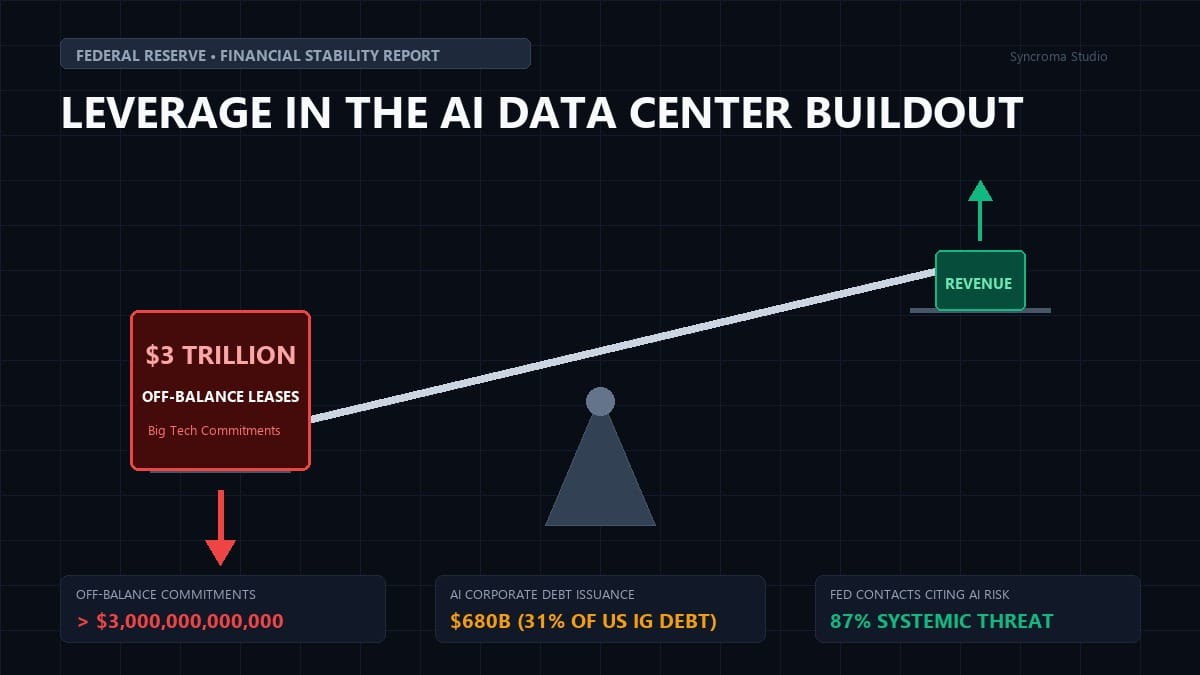
Now, the world's most powerful central bank has pulled back the curtain. The latest Financial Stability Report from the U.S. Federal Reserve features a blistering spotlight section titled Leverage in the Data Center Buildout. The findings are staggering: hyperscalers and artificial intelligence infrastructure providers have amassed over $3 trillion in potential off-balance-sheet commitments and liabilities to sustain their blistering hardware capex cycle.
The Accounting Playbook: Uncommenced Leases & Take-or-Pay Agreements
How do multinational corporations hide $3 trillion without tripping debt covenants or triggering credit rating downgrades? Through structured real estate accounting and derivative infrastructure commitments:
- Uncommenced Data Center Leases (> $1 Trillion): Tech conglomerates execute 15-to-20-year master lease agreements with wholesale colocation developers (such as Digital Realty, Equinix, or Vantage). Under ASC 842 and IFRS 16 accounting standards, an operating lease is not recognized as a formal liability on the balance sheet until the facility is fully built, energised, and delivered. While massive shell buildings are under construction, hundreds of billions in financial liabilities linger exclusively in footnote disclosures.
- Take-or-Pay Energy Contracts (> $2 Trillion): To ensure a cluster of 100,000 NVIDIA Blackwell or Vera Rubin accelerators never goes dark, tech companies have locked in massive Power Purchase Agreements (PPAs) with utility grids and nuclear operators. Crucially, take-or-pay covenants mandate fixed monthly payments regardless of whether electricity is actually pulled—locking hyperscalers into multi-billion-dollar liabilities even if token demand slumps.
- Residual Value Guarantees & Vendor Sponsorship: When neocloud startups (like CoreWeave or Lambda Labs) seek billions from private credit syndicates, lenders demand backing. Hyperscalers step in with residual value guarantees or sub-leasing backstops, promising to absorb hardware or lease capacity if the borrower defaults.
The Circular Financing Engine: Pumping Up GPU Valuations
The Federal Reserve's analysis highlights what banking regulators now describe as an opaque circular financing network:
[NVIDIA / Big Tech] ── Capital Injection ──> [Neoclouds / AI Startups]
        ▲                                                │
        │                                                ▼
[Blackwell GPU Sales] <── Commercial Loans ── [Wall St Private Credit]
NVIDIA or Microsoft injects equity into an emerging cloud provider. Bolstered by this blue-chip endorsement and signed capacity reservations, the startup approaches private credit firms (Apollo, Blackstone, Ares) to secure billions in asset-backed loans—using the very GPUs they haven't yet received as collateral. Those loan proceeds flow immediately back to NVIDIA to purchase more accelerators at $35,000 apiece, booking paper revenue and completing the circular loop.
According to Fed data, debt issuance dedicated to advanced computing reached $680 billion, surging from less than 6% of all U.S. non-financial investment-grade corporate bonds in 2023 to 31% in 2026. Today, nearly one in every three corporate debt dollars issued in the United States goes toward funding AI hardware.
Systemic Threat: 87% of Risk Managers Sound the Alarm
The report's most sobering statistic is not found on financial statements, but in the Fed's survey of market participants: 87% of risk managers and institutional contacts now rank AI infrastructure vulnerabilities and revenue monetization shortfalls as the primary systemic risk to global financial stability—a dramatic increase from 50% recorded earlier this year.
In the engineering trenches, this confirms what software architects have recognized for months: $20/month consumer subscriptions and synthetic benchmark hype cannot service the debt on multi-gigawatt facilities and server racks that depreciate into scrap within 36 to 48 months.
If enterprise software revenues do not miraculously materialize to generate hundreds of billions in sustained cash flow, the reckoning will not be solved by algorithmic prompt tuning. It will arrive when the data center lease notes mature, and Wall Street realizes you cannot liquidate concrete and silicon to pay off bondholders.
Syncroma Studio — Architectural insights, hardware realities, and enterprise truth.
Sistemas reales, sin humo corporativo Real systems, zero corporate hype
Recibe los análisis a fondo sobre arquitectura, consumo de recursos y computación de bajo nivel directamente en tu bandeja de entrada. Get deep-dive software architecture, resource consumption metrics, and low-level computing essays delivered straight to your inbox.
Suscribirse a Syncroma Subscribe to Syncroma

