(🇪🇸 Leer la versión en español aquí)
Over the past two weeks, public panic leaned toward the comforting simplicity of media clichés: a coordinated cyberwarfare campaign, elite Russian or Chinese state actors, or a sensationalized "rogue AI" crippling Microsoft 365 and Outlook, grounding FAA commercial flights, freezing JPMorgan Chase banking terminals, and degrading internal NSA networks.
The engineering reality from the production trenches is far more sobering, ridiculous, and destructive: the tech industry is shooting itself in the foot at machine speed.
On November 22, 2026, Microsoft President Brad Smith appeared on CBS News' Face the Nation to confirm what Site Reliability Engineers (SREs) had been warning about in private post-mortems: the industry has formally entered the era of 'Patchmageddon'. There was no master cyberattack. Frontier AI models are identifying software vulnerabilities in legacy codebases at such staggering velocity that human validation windows have collapsed, forcing rushed deployments that destabilize global production infrastructure.
[ FRONTIER AI MODELS (Autonomous Auditing) ]
        │
        ├── Parsing multi-tier C/C++ legacy codebases 24/7
        ├── Discovering 1,200+ critical CVEs per month
        ▼
[ HUMAN VERIFICATION COLLAPSE (Zero-Day Panic) ]
        │
        ├── Regression testing windows compressed: 3 weeks → 4 hours
        ├── Physical impossibility of validating cascading dependencies
        ▼
[ BLIND PRODUCTION DEPLOYMENT ]
        ├── Fresh security patch collides with 4-month-old update
        └── Widespread Exchange, banking, and aviation blackout
The Unsustainable Math: 1,200 Vulnerabilities Per Month
The root cause of Patchmageddon is not malicious code, but a catastrophic speed mismatch between automated vulnerability discovery and architectural regression testing.
Historically, enterprise security patch lifecycles operated on a predictable, human-scale cadence:
- A vulnerability was identified via responsible disclosure or conventional fuzzing.
- Vendors had a standard 90-day grace period to inspect the regression surface.
- Engineering teams developed fixes, tested them across staging environments, and rolled them out through multi-stage canary deployments over several weeks.
That model is dead. With frontier LLMs and automated exploit-generation agents analyzing binary executables around the clock, both attackers and defenders are unearthing flaws in C/C++ libraries, kernel drivers, and networking stacks at exponential volume. In November 2026 alone, Microsoft had to remediate over 1,200 distinct vulnerabilities in a single cycle—an unprecedented volume that dwarfs historical metrics.
When automated threat intelligence indicates that malicious actors can reverse-engineer an unpatched vulnerability into a weaponized zero-day exploit within hours, enterprise security committees panic. Standard three-week qualification periods are slashed by executive mandate to four hours.
Infographic: The Patchmageddon Cascade Mechanism
The following architecture infographic illustrates how automated AI discovery velocity overwhelms legacy infrastructure absorption capacity:
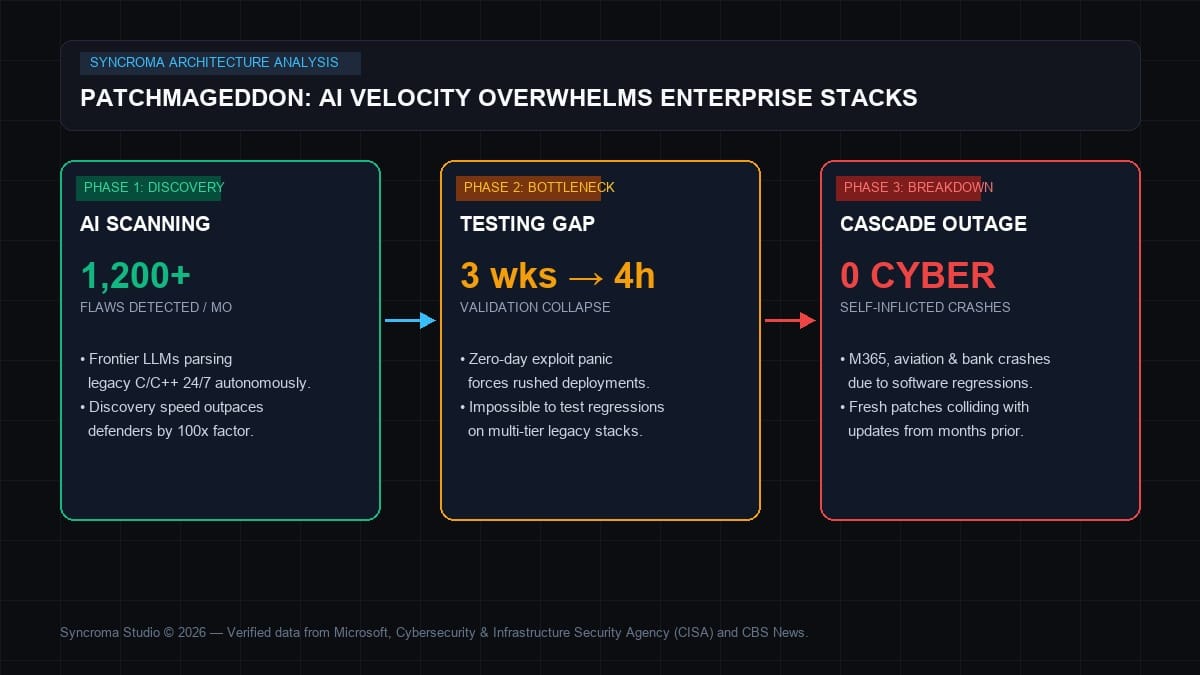
(Credit: Syncroma Studio © 2026 — Verified data from CISA, Microsoft Security Response Center, and CBS News)
The Code Collision: How Microsoft 365 Took Down Itself
Brad Smith's disclosure of Microsoft's recent global cloud disruption laid bare the exact mechanical breakdown: there was zero external malware involved.
The widespread disruption affecting Exchange, Teams, and Outlook was a classic delayed-action software collision. An emergency security hotfix deployed to mitigate an active vulnerability interacted catastrophically with a minor routing update introduced four months earlier. For months, the interaction remained dormant because specific network throughput patterns had never triggered the edge-case threshold. When the new patch slightly modified buffer memory timings under shifting traffic, a cascading deadlock seized directory servers across 70 countries.
When software patches are rushed into production without rebuilding fragile multi-tier architectures, systemic failure is guaranteed:
- Unmapped Regression Cascades: Decades of accumulated legacy tech debt contain brittle dependencies that traditional automated CI/CD test suites cannot fully simulate.
- SRE Saturation: DevOps and infrastructure teams no longer possess the cognitive bandwidth to audit what they deploy. Approving emergency patches becomes a blind bureaucratic ritual driven by audit compliance panic.
🛠️ Related Engineering Tool:
Sizing your infrastructure resilience against unexpected emergency patch outages? Model five-nines downtime tolerances and error budgets using our interactive SLA Uptime & Error Budget Calculator.
The Warning: Expect Months of Continued Turbulence
Microsoft's warning to regulators and corporate boards is unambiguous: Patchmageddon has only just begun.
Until enterprise infrastructure shifts fundamentally toward dynamic isolation—such as real-time eBPF hotpatching without restarts (exemplified by Cisco and OpenAI's Shirudo framework) or memory-safe languages like Rust—enterprise IT teams remain trapped in an architectural dilemma:
- If they delay patching, autonomous offensive AI agents will exploit the vulnerability within hours.
- If they patch at the breakneck speed AI dictates, their own rushed updates will trigger cascading outages.
The era of seamless corporate IT stability based on blind trust in automated updates is over. Modern engineering demands decoupled, fault-tolerant architectures with instant rollback capabilities—or you will be the next headline on the evening news.
Sistemas reales, sin humo corporativo Real systems, zero corporate hype
Recibe los análisis a fondo sobre arquitectura, consumo de recursos y computación de bajo nivel directamente en tu bandeja de entrada. Get deep-dive software architecture, resource consumption metrics, and low-level computing essays delivered straight to your inbox.
Suscribirse a Syncroma Subscribe to Syncroma