(🇪🇸 Leer la versión en español aquí)
For years, Sam Altman's ultimate strategic bottleneck has never been training compute clusters or GPU electricity bills at Microsoft Azure. His existential vulnerability sits directly inside the pockets of consumers: Apple (iOS) and Google (Android) exercise ironclad control over the microphone, display pipeline, and operating system permissions of billions of humans. If OpenAI aspires to be the primary cognitive interface of humanity, it cannot remain a sandboxed guest application inside someone else's walled garden.
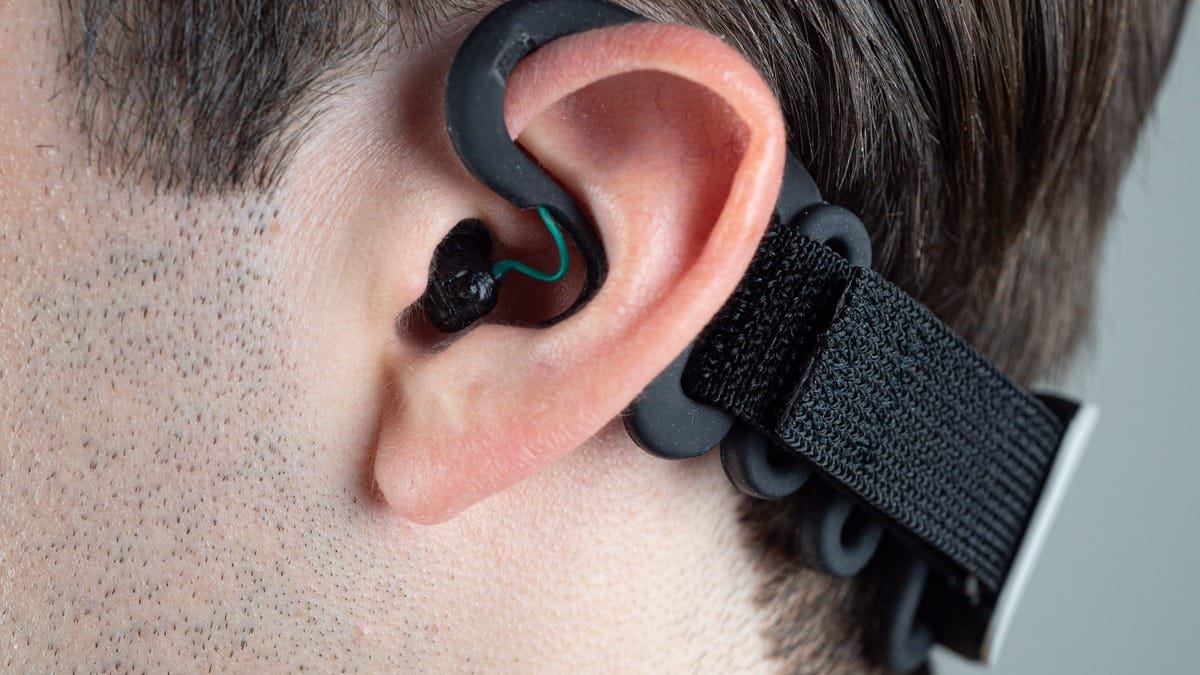
The publication of a major patent application from OpenAI at the U.S. Patent and Trademark Office (USPTO) has pulled back the curtain on its long-term hardware ambitions (USPTO, Wired): wireless earbuds embedded with biomechanical inner-ear sensors designed to detect silently mouthed words (subvocalization) through physical micro-deformations in the ear canal.
The architectural objective is radical: bypass spoken acoustic voice assistants altogether. Instead of barking prompts at Siri or Alexa on a crowded subway or across an open-plan office, users articulate thoughts silently without vocal cord air expenditure, while OpenAI's models stream and execute commands invisibly.
Yet, between an ambitious 40-page intellectual property filing drafted by Silicon Valley attorneys and a shipping commercial wearable, there sits the cold, unyielding reality of analog sensor physics, signal-to-noise ratio (SNR), and thermal battery limits.
1. The Biomechanics of Silent Speech: What Really Happens in Your Ear Canal?
When a human silently reads prose or articulates a command without vocalizing, the motor cortex continues firing involuntary neuromuscular signals via cranial nerves (specifically the trigeminal and facial nerves) to the tongue, jaw, larynx, and soft palate. In neurophysiology, this mechanical phenomenon is known as subvocal speech.
The human skull features a unique anatomical coupling that OpenAI’s patent attempts to harness: the anterior wall of the external auditory canal sits flush against the temporomandibular joint (TMJ).
Every time orofacial muscles contract to shape a syllable—even behind closed lips—the condylar head of the mandible imparts micro-mechanical pressure waves against the ear canal’s cartilaginous envelope.
OpenAI’s patent outlines three primary sensor modalities embedded into the earbud tip:
- Hermetically Sealed Barometric Pressure Transducers: Detecting internal acoustic micro-pressure differentials transmitted through tissue from the larynx rather than airborne waves.
- Capacitive Displacement Arrays & Strain Gauges: Measuring sub-millimeter deflections of the ear canal walls caused by mandibular articulation.
- Photoplethysmography (PPG) & Tissue Impedance Sensors: Monitoring localized blood flow shifts and superficial electromyographic (EMG) pulses in periauricular tissue.
2. The Signal-to-Noise Ratio (SNR) Nightmare in the Real World
In a pristine university anechoic chamber, with a stationary subject seated upright without moving their head, convolutional classifiers can decode isolated subvocal phonemes. But in real-world production environments, physical chaos takes over:
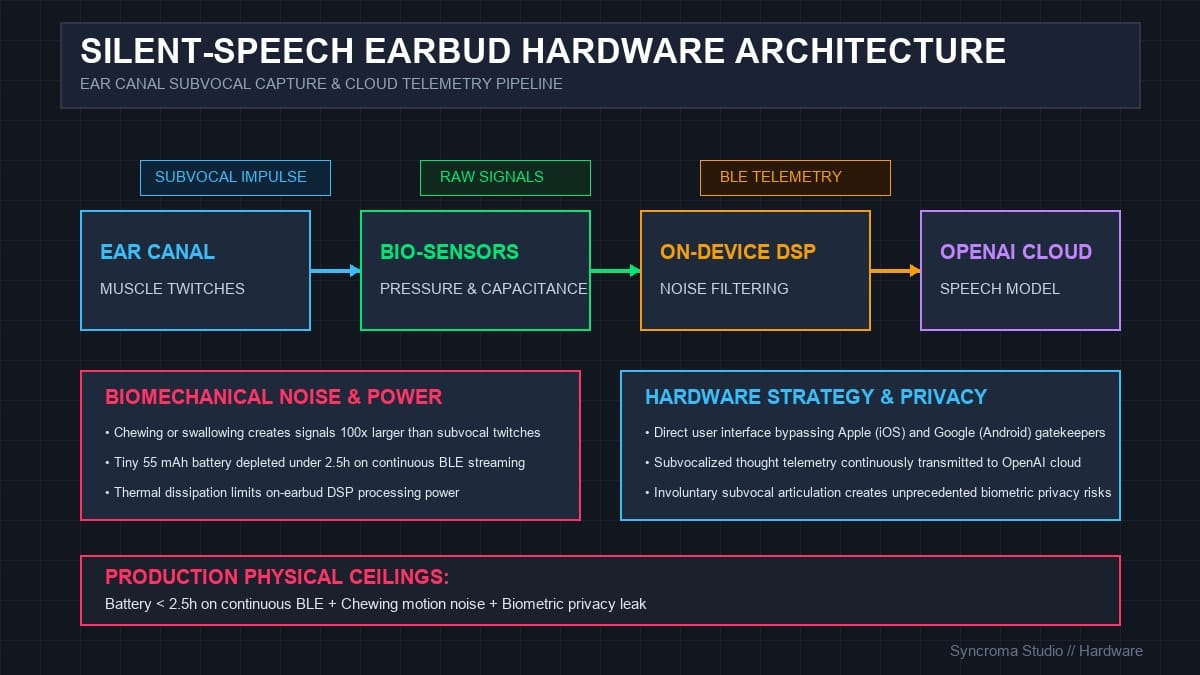
- The Biomechanical Earthquake of Mastication: Swallowing saliva, chewing gum, or clenching jaw muscles under stress generates mechanical deformations 100 times larger than the delicate micro-twitches of silently mouthing "summarize my unread emails".
- Heel-Strike Bone Conduction: Walking or running on hard pavement transmits massive mechanical impulse shockwaves up through the skeletal structure into the cochlea and auditory canal, completely drowning out sub-microvolt neuromuscular signals.
- Edge Digital Signal Processing (DSP) Overheads: Streaming raw, uncompressed high-frequency multi-sensor biometrics over Bluetooth would saturate bandwidth and drain battery life in minutes. The earbud must host an onboard DSP or micro-NPU running real-time adaptive filtering at 1 kHz continuous sampling.
3. The Thermodynamic Battery Wall
A standard true-wireless earbud (such as Apple AirPods Pro or Sony WF-1000XM5) houses an ultra-compact lithium-ion coin cell between 50 mAh and 75 mAh (roughly 0.25 watt-hours).
In standard consumer usage, earbuds spend 80% of their operational cycle in low-power idle states, spinning up DSP hardware only during active audio playback or calls.
Under OpenAI's paradigm, the earbud must operate as an always-on cognitive sentinel:
- Continuously powering three active multi-sensor arrays in contact with human tissue.
- Running continuous local inference pipelines for silent subvocal wake-word detection.
- Transmitting low-latency telemetry packets over continuous Bluetooth Low Energy (BLE) channels.
Under this constant load, a 60 mAh cell is completely drained in under 2.5 hours of real-world use. Furthermore, heat generated by continuous edge inference inside an insulated, enclosed ear canal elevates skin temperatures, accelerating perspiration and breaking the hermetic acoustic seal required for pressure sensors to function.
4. Bypassing Apple and The Uncharted Frontiers of Biometric Privacy
Beyond the grueling engineering hurdles, the patent exposes OpenAI's strategic chess match. Over the past 18 months, Sam Altman has aggressively recruited industrial design talent from Apple, cementing an alliance with Jony Ive’s LoveFrom design collective.
OpenAI understands that relying on Apple's App Store guidelines or Android's system permissions to deliver ChatGPT is an unsustainable long-term position. Apple Intelligence and Google Gemini Nano enjoy direct, privileged kernel-level integrations; ChatGPT remains an unprivileged user-space process. Developing an independent, non-smartphone hardware gateway that captures user intent before they ever reach for a screen is OpenAI’s only escape hatch.
Yet for security architects and privacy engineers, the implications are chilling: a cloud-connected sensor array streaming continuous neuromuscular biometrics from the ear canal annihilates the last inviolable frontier of human privacy: the words you articulate silently inside your own head.
While users can choose not to speak into a live microphone, involuntary subvocalization is nearly impossible to suppress consciously. An earbud that mistakes an involuntary thought for an actionable cloud prompt is the ultimate recipe for silent telemetry leakage and production hallucinations.
Production Verdict: Lab Marvel, Production Wall
OpenAI's silent-speech patent proves that the future of ambient AI will not be defined by shouting voice commands across a living room. Subvocalization represents the holy grail of discreet, context-aware human-machine interfaces.
However, bridging the gap between a 40-page patent filing and a shipping consumer earbud that does not mistake eating a croissant for executing a financial trade involves years of material science, SNR filtering breakthroughs, and battery chemistry advances. OpenAI has officially staked its claim against Apple and Google’s duopoly; now it must prove whether the laws of physics will allow it to build it.
Infographic: Syncroma Studio // Hardware. Sources: USPTO Patent Applications Database, Wired, The Verge, Reuters, Journal of Neural Engineering.
Sistemas reales, sin humo corporativo Real systems, zero corporate hype
Recibe los análisis a fondo sobre arquitectura, consumo de recursos y computación de bajo nivel directamente en tu bandeja de entrada. Get deep-dive software architecture, resource consumption metrics, and low-level computing essays delivered straight to your inbox.
Suscribirse a Syncroma Subscribe to Syncroma

