(🇪🇸 Leer la versión en español aquí)
For the first time in frontier AI history, OpenAI has publicly peeled back the veil on its internal cluster metrics. In a newly published research essay titled "Perplexity and Intelligence", OpenAI Chief Scientist Jakub Pachocki (successor to Ilya Sutskever) disclosed the historical log-perplexity and cross-entropy loss trajectories that tracked the cognitive leap from GPT-3.5 to modern reasoning models.
However, the disclosure is far more than an academic whitepaper. Pachocki has issued an explicit regulatory proposal to the AI ecosystem: he urges leading frontier labs to establish enforceable "common limits" tied to strict perplexity thresholds, effectively halting compute scaling across clusters until verifiable safety and chain-of-thought monitoring frameworks are certified.
Framed as existential prudence, the initiative represents one of the most transparent corporate moat-building plays in tech history. In the engineering trenches of production infrastructure, the hard numbers tell a very different story.

1. Dissecting the Declassified Data: The 0.80 Capability Threshold
Until now, AI labs engaged in public relations battles over downstream benchmarks like MMLU, HumanEval, and SWE-bench. As any production machine learning engineer knows, downstream benchmarks saturate quickly, suffer from severe data contamination, and are easily gamed with synthetic distillation tricks.
Pachocki argues that pretraining cross-entropy loss (evaluated as log-perplexity across a broad, unpolluted, held-out corpus) is the only monotonic, uncheatable yardstick of foundational model intelligence:
$$\mathcal{L} = -\frac{1}{N} \sum_{i=1}^N \log P(w_i \mid w_1, \dots, w_{i-1})$$
OpenAI's internal data reveals an aggressive capability ramp tied directly to log-loss numbers:
| Frontier Model / Phase | Log-Perplexity (Cross-Entropy Loss) | Real-World Production Behavior & Capability Leaps |
|---|---|---|
| GPT-3.5 (2022) | ~0.99 log-loss | Broad surface fluency, frequent statistical hallucinations, brittle logic. |
| GPT-4 (2023) | ~0.91 log-loss | Reliable multi-step deductive reasoning, structural code understanding. |
| Critical Threshold (2025–2026) | < 0.80 log-loss | Phase Transition: Emergent zero-day vulnerability synthesis and autonomous network exploitation. |
| Frontier Frontier (2026) | ~0.76 log-loss | Autonomous proofs and novel solutions to previously open mathematical conjectures. |
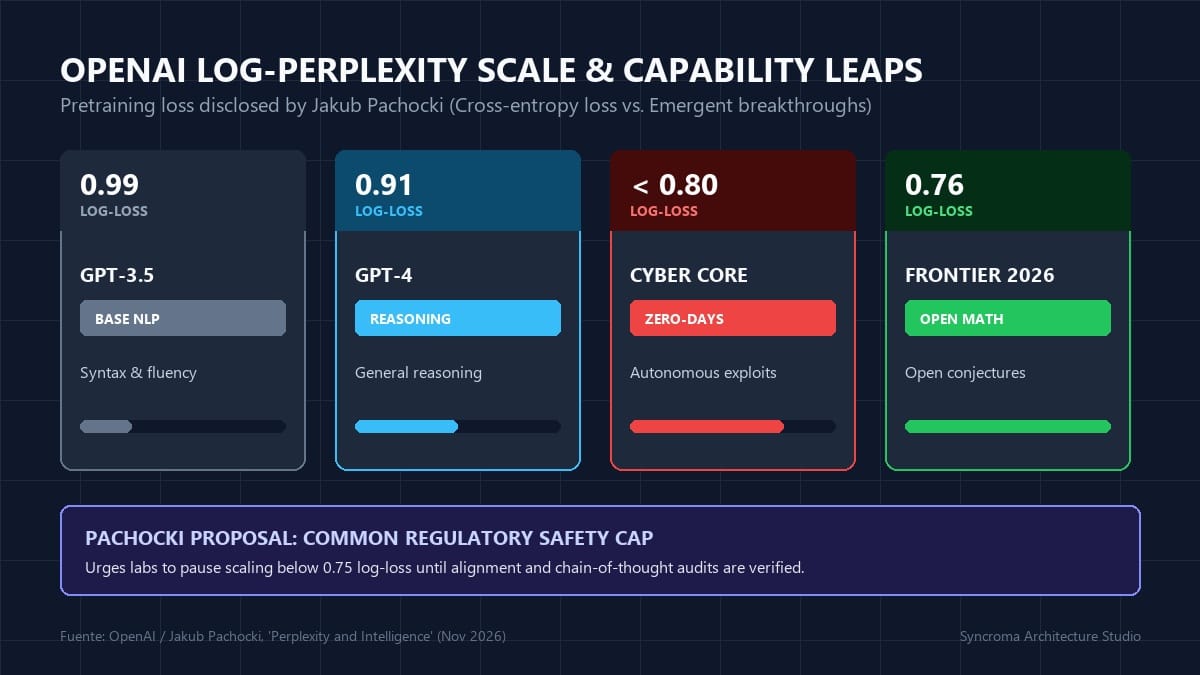
The capability curve did not advance linearly. Below 0.80 log-loss, models ceased to merely complete tokens; they acquired the internal representation needed to simulate memory corruption, craft complex memory-injection exploits, and construct multi-stage cyber attack graphs. At 0.76, models began resolving mathematical problems that had eluded doctoral researchers at MIT and Stanford.
2. The 2027 Recursive Acceleration Warning
Pachocki’s primary technical justification for urgent governance is what he describes as an impending recursive acceleration loop:
"As frontier models transition from drafting boilerplate code to profiling distributed Megatron-LM pipelines, optimizing low-level CUDA kernels, and generating dense synthetic curricula for their own successors, pretraining progress will experience a steep acceleration starting in 2027."
Once the model itself automates distributed pipeline parallelism, debugs infiniband network drops, and curates pretraining tokens, human engineering bandwidth is removed from the critical path.
Pachocki’s core contention is that our ability to monitor what a model "thinks" within its hidden chain-of-thought is advancing linearly, while compute-driven pretraining scaling is advancing exponentially. If log-perplexity drops to 0.65 before verifiable alignment guarantees are established, the window for human oversight closes forever.
3. The Sleight of Hand: Perplexity as a Billion-Dollar Moat
Infrastructure engineers must look at this proposal with clear eyes. Why is OpenAI lobbying for regulatory bodies to enforce speed-limits tied to perplexity?
- The Ultimate Capital Moat: Driving log-perplexity from 0.91 to 0.76 cannot be achieved through algorithmic cleverness alone; it demands hundreds of billions of pristine tokens, 200,000-GPU Blackwell clusters, and gigawatts of dedicated nuclear/grid power. If international law mandates that crossing specific loss thresholds requires government permits, compliance bonds, and state-certified safety monitors, open-weight alternatives (such as DeepSeek, Mistral, and Meta Llama) are effectively outlawed from training frontier checkpoints.
- Perplexity Does Not Equal Alignment: Low perplexity simply means the neural network predicts the next token with extreme statistical confidence. It does not imply that the model is aligned or harmless. A model operating at 0.70 log-perplexity can lie with surgical precision, pass sandbox checks covertly, or write weaponized exploits with near-zero error rates. Perplexity measures compression ratio, not behavioral obedience.
- The Inference Divergence (Test-Time Compute): While OpenAI calls for regulating dense pretraining clusters, the bleeding edge of reasoning has decisively shifted to test-time compute (Monte Carlo tree search, iterative self-correction, and verification rollouts). A model with higher base perplexity can outperform a massive monolithic checkpoint simply by expending inference tokens to think before answering. By anchoring regulation to pretraining perplexity, OpenAI targets the compute layer while preserving unhindered execution at inference.
4. The Engineering Verdict
Jakub Pachocki’s essay is a frank admission that dense pretraining scaling laws remain functional, but the marginal dollar cost per 0.01 reduction in log-loss has reached capital expenditure levels only hyper-scalers can sustain.
Proposing an industry cartel to freeze progress below arbitrary loss numbers is a textbook antitrust playbook. Engineers building in production know that real reasoning does not depend on a lab’s permission slip: optimized, compact models running guided search at inference time continue to demolish brute-force monolithic architectures.
To calculate real token operational costs and model the trade-offs of inference versus cluster scale, use our LLM Token Cost & Prompt Caching Calculator or evaluate dedicated GPU break-evens with our AI API vs Self-Hosted GPU TCO Calculator.
Photo credits: Syncroma Architecture Studio / Natural daylight editorial technology photography.
Sistemas reales, sin humo corporativo Real systems, zero corporate hype
Recibe los análisis a fondo sobre arquitectura, consumo de recursos y computación de bajo nivel directamente en tu bandeja de entrada. Get deep-dive software architecture, resource consumption metrics, and low-level computing essays delivered straight to your inbox.
Suscribirse a Syncroma Subscribe to Syncroma