(🇪🇸 Leer la versión en español aquí)
For the past three years, the breakneck global expansion of frontier artificial intelligence has operated behind a legally enforced code of institutional silence: to build the sprawling hyperscale campuses required to train and run models like GPT, Gemini, and Claude, Big Tech demanded that mayors, city councils, and local utility operators sign ironclad Non-Disclosure Agreements (NDAs) before a single shovel touched the ground.
Under this legal gag order, local residents, farmers, and investigative journalists were strictly barred from discovering the physical truth: how many hundreds of megawatts of municipal grid capacity would be swallowed by GPU clusters, and how many millions of gallons of drinking water would be evaporated daily in cooling towers to keep servers from overheating.
Now, following a fierce wave of grassroots community revolts, utility ratepayer lawsuits, and the threat of sweeping municipal construction moratoriums across North America and Europe, tech giants have suffered a landmark retreat: Amazon Web Services (AWS), Microsoft, and OpenAI have jointly announced the permanent elimination of NDAs in negotiations with local public utility boards and municipalities. The era of corporate secrecy in AI infrastructure has finally come to an end.
1. Anatomy of the Shadow Pact: Why Hyperscalers Silenced Local Governments
To grasp why multinational cloud providers turned to classified-tier secrecy clauses typically reserved for military aerospace contracts, one must examine the staggering physical appetite of modern AI hardware:
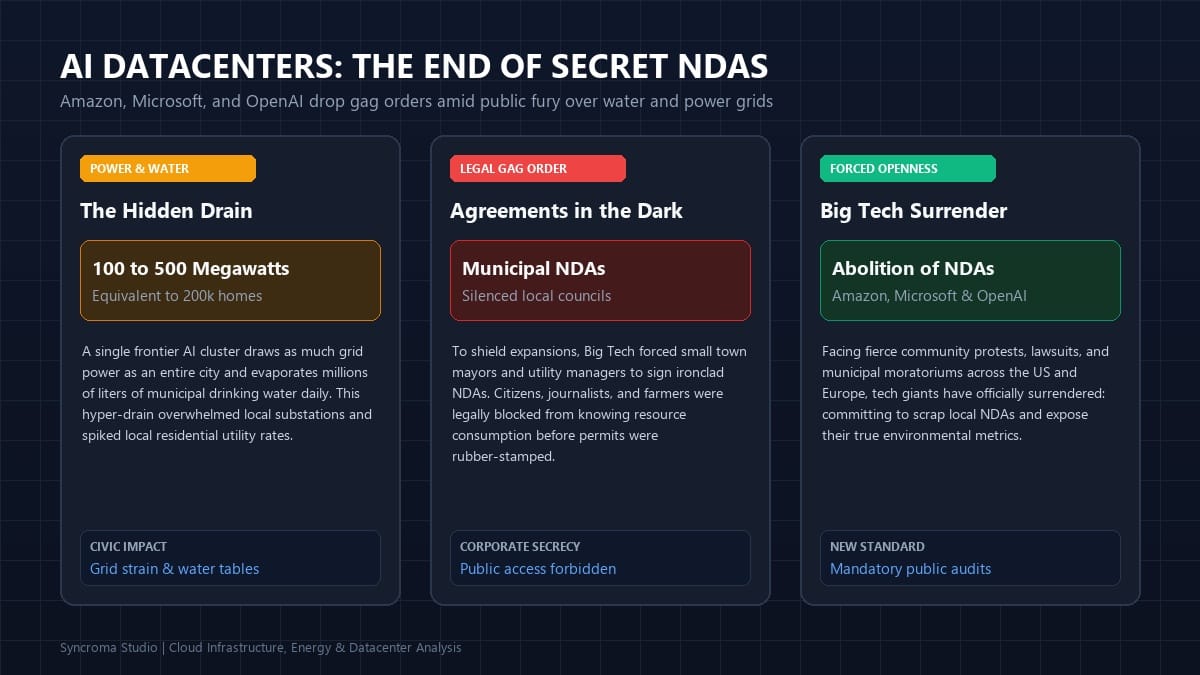
- City-Scale Power Demands: A modern AI datacenter campus (such as those engineered for clusters of 100,000 Nvidia Blackwell GPUs) requires between 100 MW and 500 MW of continuous, uninterruptible electrical power. To put that in perspective, a 300 MW facility draws as much instantaneous grid power as a metropolitan area of over 200,000 homes.
- The Potable Water Sinkhole: Evaporative cooling systems running at peak summer loads consume between 3 and 5 million liters (over 1 million gallons) of fresh water every single day, frequently siphoned from the exact same municipal aquifers that supply residential drinking water or irrigate surrounding agricultural farmland during prolonged droughts.
- The Legal Gag Mechanism: When shell real estate entities (operating under generic code names like Project Horizon or Marble LLC) scouted rural towns with cheap land and high-voltage transmission lines, they presented town officials with binding NDAs that classified any public disclosure of energy or water requests as a breach subject to catastrophic financial liabilities. Town councils routinely approved rezoning petitions, tax abatements, and substation interconnection permits behind closed doors—without public impact hearings on residential electricity rates.
The inevitable aftermath was severe: months after facility ribbon-cuttings, local homeowners saw their monthly electric bills climb to fund multi-million-dollar high-voltage grid upgrades, while rural wells faced sudden water table collapses.
2. The Ratepayer Revolt: From Virginia to Middenmeer
The surrender of Amazon, Microsoft, and OpenAI is not an act of spontaneous corporate benevolence; it is the direct outcome of relentless public resistance that threatened to freeze global AI deployment timelines:
- "Data Center Alley" in Northern Virginia: In Loudoun and Prince William counties—which process an estimated 70% of global web traffic—citizen coalitions mobilized against relentless transformer noise, transmission line expansion through national parks, and skyrocketing electricity bills. Citizen lawsuits invoking the Freedom of Information Act (FOIA) repeatedly stalled billion-dollar expansion pipelines in state courts.
- The Dutch Water Scandal in Middenmeer: In the province of North Holland, Microsoft's massive datacenter ignited national fury when investigative reporting revealed it consumed millions of liters of emergency municipal drinking water during the hottest summer on record, while local farmers were placed under strict irrigation limits. The Dutch parliament responded by enacting stringent nationwide limits on new hyperscale builds.
- Sweeping Municipal Moratoriums: Municipalities across Ireland, Germany, and several US states began voting in favor of indefinite building freezes until tech firms could provide independent, publicly audited verification of their grid impact.
Confronted with the stark risk that localized building moratoriums would choke their GPU procurement pipeline, hyperscalers were left with no strategic choice but to dismantle their secrecy apparatus.
3. What Changes Today: Public Grid Audits and Regulatory Scrutiny
The joint commitment announced by Amazon, Microsoft, and OpenAI establishes an entirely new baseline for cloud infrastructure:
- Abolition of Upfront NDAs: Local government bodies, public utility commissions, and municipal zoning boards will no longer be forced to sign gag orders to review technical power and water connection requests.
- Transparent Resource Filings: Engineering reports estimating peak megawatt demand, water consumption rates, and thermal discharge metrics must be submitted as public record, accessible to journalists, civic groups, and ratepayers well before public hearings.
- Protection of Residential Utility Rates: Developers must provide transparent accounting proving that substation buildouts, transmission line reinforcements, and water treatment upgrades are financed 100% by the hyperscaler, rather than incorporated into the municipal utility rate base.
Conclusion: The Cloud Has Real Pipes and Concrete Foundations
For over a decade, Silicon Valley marketing convinced the public that the "cloud" was a weightless, frictionless, abstract layer of software. The physical reality of the AI revolution is that computing runs on coal, natural gas, hydroelectric dams, massive copper transformers, and potable water.
By tearing down the walls of non-disclosure agreements, public communities have reclaimed their fundamental right to know the true environmental cost of the models they use. AI infrastructure will continue to be built, but from this day forward, tech giants will no longer be permitted to build their silicon empires by silencing the towns that keep their lights on.
(Visual Credit: Syncroma Studio | Cloud Infrastructure, Energy & Datacenter Analysis)
Sistemas reales, sin humo corporativo Real systems, zero corporate hype
Recibe los análisis a fondo sobre arquitectura, consumo de recursos y computación de bajo nivel directamente en tu bandeja de entrada. Get deep-dive software architecture, resource consumption metrics, and low-level computing essays delivered straight to your inbox.
Suscribirse a Syncroma Subscribe to Syncroma