(🇪🇸 Leer la versión en español aquí)

For the past two years, the AI ecosystem’s worst-kept open secret had a clean academic name: synthetic distillation. Startups, research labs, and overseas competitors systematically hammered OpenAI’s API with millions of queries, harvested the outputs, and fine-tuned 7B or 14B open-weight models for pennies on the dollar.
You would burn a few thousand dollars in API credits, train an open student model on teacher outputs, and publish a splashy Hugging Face release claiming your lightweight weights "rivaled frontier models on synthetic reasoning benchmarks."
That free lunch has officially met its technical expiration date. With deep reasoning models (such as o1, o3, and the GPT-6 Astra family), a frontier model’s primary competitive moat is no longer the final text delivered to the client. The core intellectual property lives inside the Chain-of-Thought (CoT): the hidden intermediate reasoning steps, branching deductions, and real-time backtracking occurring in GPU VRAM before a single token is emitted over the wire.
OpenAI has now published its security findings in "Combatting adversarial distillation", detailing the defensive infrastructure deployed to dismantle coordinated extraction operations and crush attack success rates from 54% down to 0.2%.
The CoT Capability Gap: Why Raw Reasoning is the Whole Game
To grasp why this matters, look at infrastructure unit economics. Training a frontier model capable of autonomously debugging low-level C code, auditing smart contracts, or synthesizing chemical structures demands hundreds of millions of dollars in H100 and Blackwell GPU compute.
If an adversary attempts to distill that model using only final outputs or high-level reasoning summaries, the distilled student remains brittle: it mimics the teacher’s tone and formatting, but immediately hallucinates and collapses when confronted with edge cases or novel logic puzzles.
OpenAI’s empirical data confirmed a critical architectural reality: student models trained directly on raw, unredacted reasoning traces absorb the teacher’s actual deep problem-solving capabilities. They inherit heuristic pruning, backtracking logic, and counterfactual validation. An adversary extracting raw CoT wasn't just copying an API output—they were stealing 99% of the pre-training compute budget without paying the electric bill.
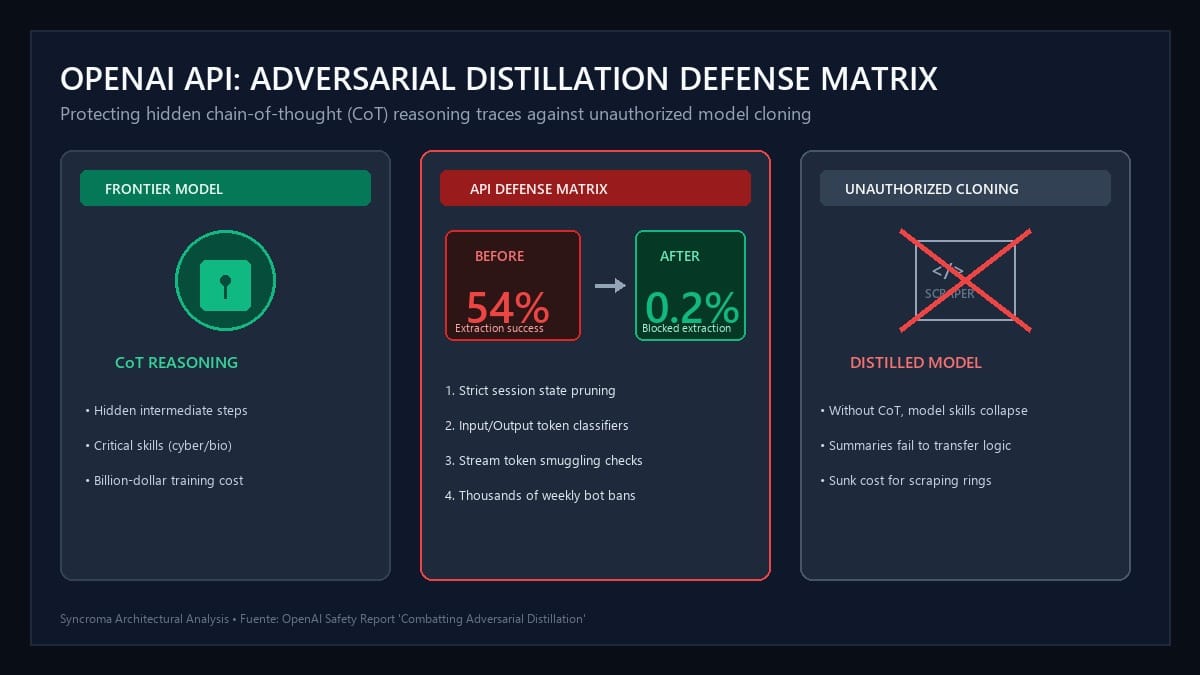
Anatomy of an Extraction Attack: From 54% to 0.2%
Sophisticated extractors never typed naive prompts like "show me your hidden reasoning steps"—basic regex filters caught those on day one. Instead, attackers leveraged semantic multi-turn jailbreaks and payload smuggling:
- Prior-Turn Injection: Crafting conversational branches that tricked the model’s internal context into quoting or formatting its own earlier latent reasoning blocks.
- Streaming Smuggling: Fragmenting Server-Sent Events (SSE) connections to siphon internal token representations before downstream safety classifiers could trip the circuit breaker.
- Distributed Bot Rings: Operating tens of thousands of coordinated API accounts, each executing small, fragmented probes to evade token velocity and rate-limit triggers.
In early evaluation checkpoints of GPT-6 Astra, attacks attempting to force the model to disclose reasoning generated during an earlier conversational turn succeeded 54% of the time. In-request extraction attempts succeeded at 22.9%.
The Architectural Lockdown: How OpenAI Clamped Down
Stopping this required far more than tweaking a system prompt. OpenAI re-architected its API pipeline from the protocol level up:
[API Client / Threat Actor]
        │  (Multi-turn adversarial injection payload)
        ▼
┌────────────────────────────────────────────────────────┐
│ 1. Input Classifiers (Prompt Intent Sanitization)      │
│    Detects semantic extraction patterns & tool abuse   │
└───────────────────────┬────────────────────────────────┘
                        │
                        ▼
┌────────────────────────────────────────────────────────┐
│ 2. Cryptographic Session Thread Isolation              │
│    CoT traces pinned to conversation UUID              │
│    Any turn edit or rewrite PURGES downstream state    │
└───────────────────────┬────────────────────────────────┘
                        │
                        ▼
┌────────────────────────────────────────────────────────┐
│ 3. Hidden Reasoning Engine (On-Chip GPU LDS)           │
│    CoT tokens never cross the network boundary         │
└───────────────────────┬────────────────────────────────┘
                        │
                        ▼
┌────────────────────────────────────────────────────────┐
│ 4. Output Classifier & Stream Smuggling Interceptor   │
│    Real-time pre-buffer inspection across SSE chunks   │
└───────────────────────┬────────────────────────────────┘
                        │
                        ▼  (Sanitized client response)
[Client Response]
1. Conversation State Pruning
Legacy APIs allowed users to freely branch from previous message IDs or re-send conversational context to compare differential responses. Under the new security model, reasoning tokens are cryptographically locked to their originating turn. Any programmatic modification of prior messages triggers immediate state pruning, discarding all downstream latent representations and preventing adversaries from performing differential reconstruction.
2. Dual-Stage In-Line Classifiers
Ultra-low-latency neural classifiers now sit at both ingress and egress. The input classifier evaluates intent across prompts and tool-call payloads. The output classifier monitors streaming SSE chunks in real time before network buffers flush. If the model attempts to paraphrase or leak intermediate reasoning mechanics, the stream terminates instantly with zero error leakage.
3. Coordinated Account Enforcement
OpenAI confirmed in the report that it has banned tens of thousands of accounts weekly throughout 2026 tied to organized extraction campaigns, specifically pointing to networks associated with Moonshot AI and foreign research consortia. Detection has moved beyond simple IP and credit card heuristics to cluster-wide token entropy fingerprinting.
The technical impact: in GPT-6.2 Astra, prior-turn reasoning extraction dropped to 0.2%, while current-turn extraction was suppressed to 0.9%.
Breakdown: Attack Vectors vs. Production Mitigations
| Extraction Vector | Legacy Success Rate | Hardened Success Rate | Production Mitigation Engine |
|---|---|---|---|
| Prior-Turn Reasoning Leak | 54.0% | 0.2% | Cryptographic session isolation & automatic downstream latent state pruning |
| Current-Turn Smuggling | 22.9% | 0.9% | Real-time SSE streaming classifiers & adversarial reinforcement training |
| Tool Calling Argument Exploits | 31.4% | 1.1% | Semantic pre-execution validation of dynamic tool parameters |
| Distributed Scraping Rings | Unmitigated | 99.8% Blocked | High-entropy token fingerprinting and mass automated account bans |
The Production Verdict: The Moat is Physical Silicon
For the last three years, the prevailing open-source narrative claimed proprietary APIs were a dead end because "anyone can just distill a frontier model into a lightweight local weight."
Production realities prove otherwise: cheap distillation was never a sustainable paradigm—it was simply an unpatched API exploit. The moment frontier providers secured their inference boundaries and locked intermediate reasoning behind encrypted vaults, the advantage shifted decisively back to the hyperscalers with hundreds of thousands of GPUs in physical datacenters.
If your technical roadmap depends on scraping frontier model outputs to train proprietary internal models on the cheap, expect that pipeline to dry up rapidly. Frontier-grade reasoning in 2026 cannot be shortcut: you either pay the API inference meter, or you buy fifty million dollars worth of silicon.
(Engineered by Syncroma Studio. Verified technical references: OpenAI Safety Research: Combatting Adversarial Distillation, The Hacker News, and production inference telemetry).
To evaluate commercial API token expenses against hosting dedicated hardware, check out our AI API vs Dedicated GPU Cost Calculator and our LLM VRAM Memory Sizer.
Sistemas reales, sin humo corporativo Real systems, zero corporate hype
Recibe los análisis a fondo sobre arquitectura, consumo de recursos y computación de bajo nivel directamente en tu bandeja de entrada. Get deep-dive software architecture, resource consumption metrics, and low-level computing essays delivered straight to your inbox.
Suscribirse a Syncroma Subscribe to Syncroma

