
(🇪🇸 Leer la versión en español aquí)
Asking an AI assistant to book travel or buy gear online always hits the same wall at checkout: either you take over manually to type card digits, or you risk exposing raw payment credentials inside an agent browser session vulnerable to prompt injection.
Today (November 13, 2026), OpenAI officially launched ChatGPT Wallet, as reported by TechCrunch, PCMag, and 9to5Mac. Built in direct partnership with Visa, Mastercard, and American Express (alongside major U.S. issuers like Chase), the architecture stops both the AI agent and merchants from ever reading your actual card number.
How ChatGPT Wallet Works (And Where It Is Locked Down)
As detailed by 9to5Mac and TechCrunch, OpenAI intentionally kept Wallet out of standard chat boxes:
- Restricted to "dots": ChatGPT Wallet operates exclusively inside threads powered by dots—OpenAI's background personal agents. It is disabled inside regular chats, work workspaces, and standalone Codex threads.
- U.S. ChatGPT Pro rollout first: Available at launch to ChatGPT Pro subscribers aged 18+ in the United States using an eligible U.S.-issued primary card and billing address.
- No silent autonomous spending: You save card details once, yet every single checkout stops for explicit human review. You verify merchant, cart items, total price, and card, then approve with Face ID, fingerprint, or device biometrics.
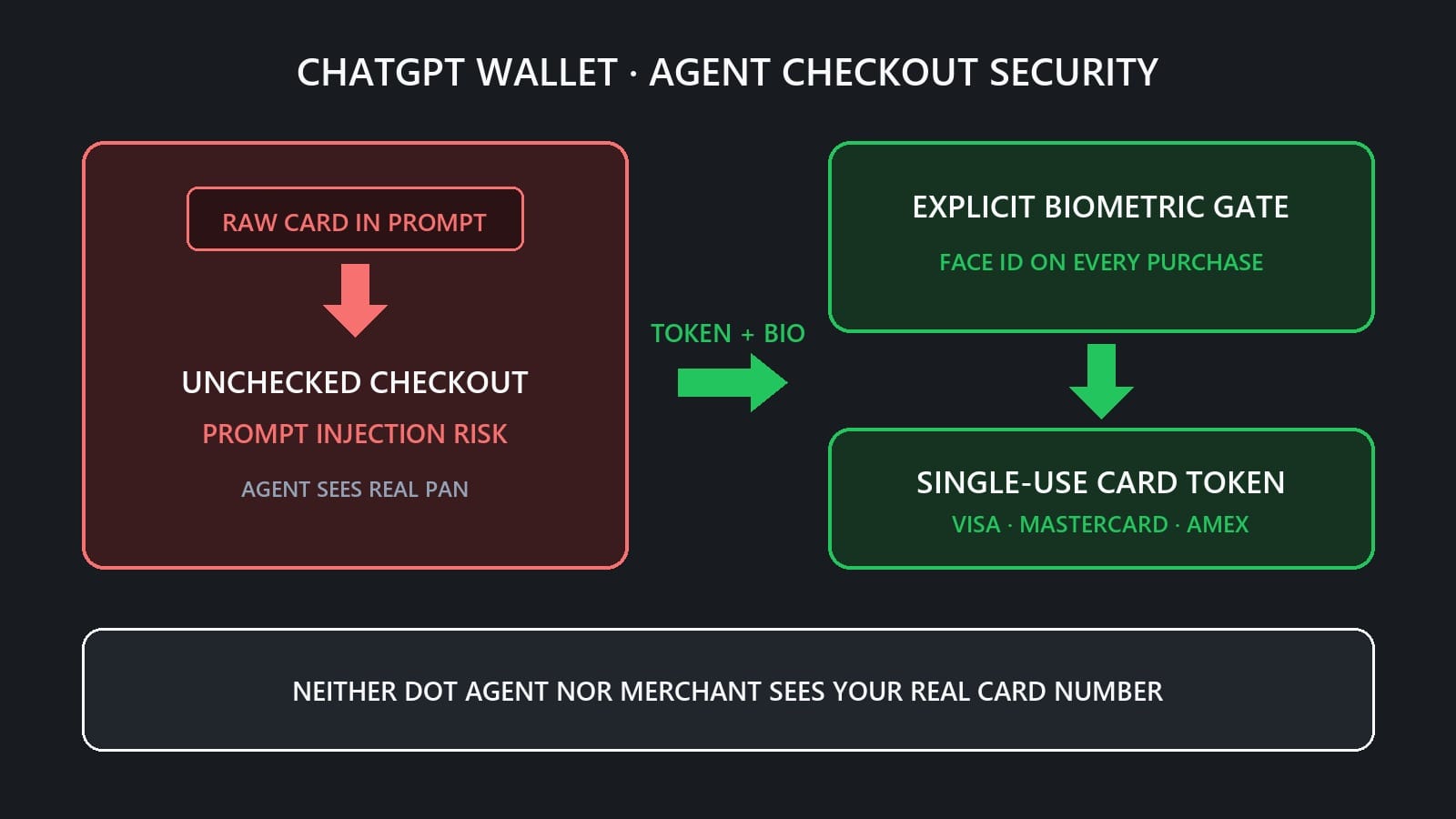
Inside the Tokenization Flow: Single-Use Credentials vs. Raw Card Risk
Putting this alongside rival agentic commerce bets from Google, Coinbase, and Circle analyzed by FinanceFeeds, OpenAI's security model rests on two strict boundaries:
| Security Layer | Raw Card Paste in Browser Agent | ChatGPT Wallet Official Design | Practical Outcome |
|---|---|---|---|
| Card visibility | Model / DOM sees 16-digit PAN + CVV | Network-vaulted credentials | Neither dot agent nor merchant sees your real PAN |
| Checkout credential | Reusable card exposed if merchant breaches | Single-use payment token (one-off PAN, expiry, CVV) | Useless outside that specific transaction |
| Execution gate | Autonomous clicks open to prompt injection | Mandatory biometric approval per purchase | Keeps human in the financial loop |
| Cardholder perks | Risky proxy billing strips rewards | Keeps points, miles & standard fraud disputes | Normal credit card protections apply |
Day-One Friction You Need to Know
- Merchant anti-bot WAFs will block agents at first: Because ChatGPT Wallet navigates standard merchant web checkouts, automated fraud filters and bot defenses will initially trip over agent requests—prompting OpenAI to ship a Commerce Partner Playbook so retailers can whitelist legitimate agent checkouts, per PCMag.
- One-tap Face ID shrinks spending friction: Delegating cart assembly to an AI and paying with a glance makes impulse subscriptions effortless. Keep recurring AI and SaaS spend visible with Syncroma's Annual Subscription Cost Auditor, inspect cryptographic token signatures locally with our Private JWT Decoder & WebCrypto HMAC Auditor, or review portfolio tax impact with our Spain Capital Gains IRPF Calculator.
Verdict
ChatGPT Wallet is the exact moment consumer AI crosses from "find me three options" into "approve the cart with Face ID." Requiring network-issued single-use tokens and mandatory biometric confirmation on every checkout proves OpenAI smartly refused to hand LLMs an unlocked credit card. Now the real test moves to merchants: will legacy anti-bot checkouts let AI shoppers through without breaking fraud detection?
Infographics created by Syncroma Studio. Cover photo: Wikimedia Commons (CC BY-SA) (editorial crop).

Sistemas reales, sin humo corporativo Real systems, zero corporate hype
Recibe los análisis a fondo sobre arquitectura, consumo de recursos y computación de bajo nivel directamente en tu bandeja de entrada. Get deep-dive software architecture, resource consumption metrics, and low-level computing essays delivered straight to your inbox.
Suscribirse a Syncroma Subscribe to Syncroma

